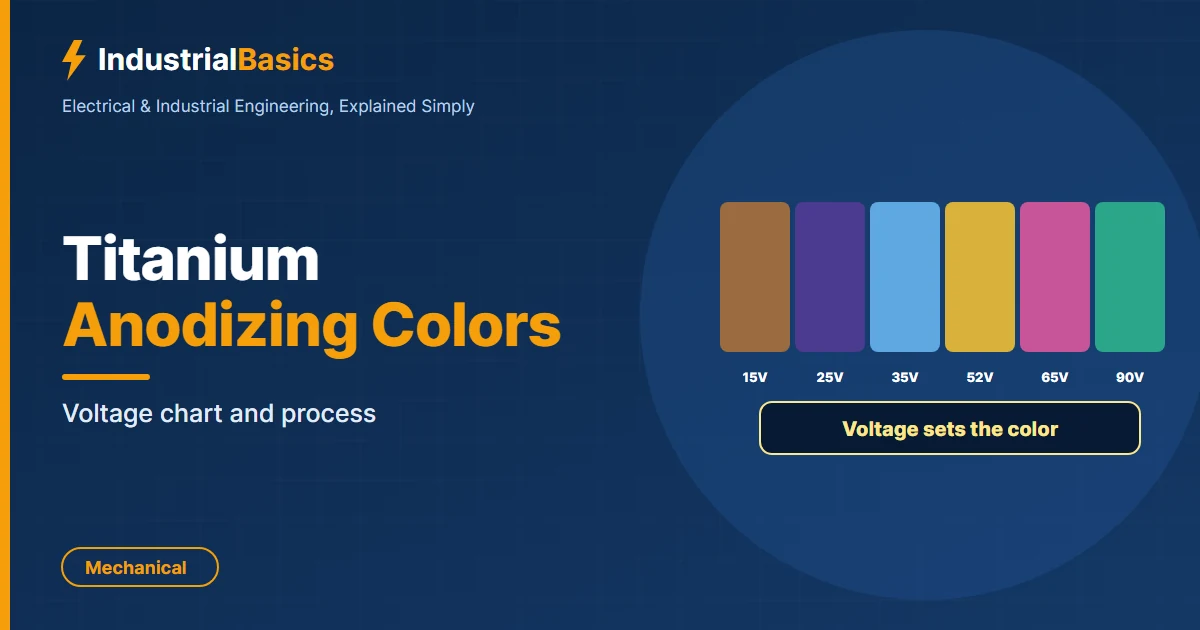
Titanium anodizing colors come from oxide thickness, which is set by the DC voltage. A typical chart runs: bronze at 10–15 V, dark blue or purple at 20–25 V, light blue at 30–40 V, gold at 50–55 V, pink or magenta at 60–70 V, and teal or green at 80–100 V. The color is thin-film interference in a clear titanium dioxide layer about 30–110 nm thick, with no dye. Alloy, surface finish and electrolyte shift the result by a few volts, so test on scrap.
Titanium Anodizing Color Chart
| DC voltage | Approximate color | Oxide thickness |
|---|---|---|
| 10–15 V | Bronze / brown | ≈300 Å (30 nm) |
| 20–25 V | Dark blue / purple | ≈400 Å (40 nm) |
| 30–40 V | Light blue (sky) | ≈500 Å (50 nm) |
| 50–55 V | Gold / yellow | ≈800 Å (80 nm) |
| 60–70 V | Pink / magenta | ≈950 Å (95 nm) |
| 80–100 V | Teal / green | ≈1100 Å (110 nm) |
Voltage to Color Calculator
Why Voltage Controls Color
Anodizing makes the titanium part the anode in an electrolyte bath, growing its natural oxide into a thicker, transparent TiO₂ film. Wikipedia explains the color. Light reflecting off the top of the oxide interferes with light that passes through and reflects off the metal underneath. Depending on the film thickness, some wavelengths reinforce and others cancel. The oxide thickness depends on the anodizing voltage, so each voltage gives a repeatable color sequence.
The same effect colors soap bubbles and oil films (see Wikipedia, thin-film interference). Niobium and tantalum anodize the same way, while aluminum anodizing is different: it makes a porous layer that is usually dyed.
Grade 2 vs Grade 5 Titanium
HonTitan reports that commercially pure titanium (Grade 1 and 2) forms a clean TiO₂ film with bright, gem-like colors. Grade 5 (Ti-6Al-4V) adds aluminum and vanadium oxides to the film, so colors look darker and more muted, and the gold setting can come out antique brass. Choose CP titanium where color matters most, and Grade 5 where strength matters most.
Equipment and Process
- DC power supply: variable, about 0–120 V and 3 A, to reach high-voltage colors (HonTitan).
- Cathode (negative): titanium mesh or stainless steel; avoid aluminum or copper, which dissolve into the bath.
- Anode (positive): titanium wire holding the part; steel or copper wire short-circuits the process.
- Preparation: degrease (acetone or detergent, ideally ultrasonic), etch, then rinse in distilled water; handle only with nitrile gloves.
- Coloring: start about 10 V below the target and raise the voltage slowly while watching the color, then switch off before removing the part.
- Judge dry: wet titanium looks different, so dry the part before deciding on the final color.
Industrial and Medical Uses
AMS 2488 Type III anodizing gives dye-free colors used in art, jewelry, body-piercing jewelry and rings, while Type II produces a thicker matte gray coat for wear resistance (Wikipedia). Titanium and Ti-6Al-4V medical devices and orthopedic implants are color-anodized for identification. In dental implants, pink or yellow anodized abutments reduce the gray show-through of bare titanium.
For machining titanium parts before finishing, see tool center point and pitch diameter for threaded fasteners.
Frequently Asked Questions
How does titanium anodizing produce color?
Anodizing grows a transparent titanium dioxide layer. Light reflecting off the oxide surface interferes with light reflecting off the metal beneath, so the oxide thickness, set by voltage, decides which colors are reinforced. No dye is used (Wikipedia).
What voltage gives blue titanium?
About 20–25 V gives dark blue or purple, and about 30–40 V gives light (sky) blue, on the HonTitan chart. Exact shades shift with alloy, finish and electrolyte.
What voltage makes gold titanium?
Roughly 50–55 V. On Grade 5 (Ti-6Al-4V) the same setting tends to look like antique brass rather than bright gold.
Can you anodize titanium red or black?
Not by interference anodizing. True black would require absorbing all light, which the thin oxide cannot do, so black titanium is made by PVD or DLC coating. A true bright red is also outside the achievable range.
How thick is the oxide layer?
From about 30 nm to several micrometers (Wikipedia). Color anodizing uses roughly 30–110 nm (300–1,100 Å) on the HonTitan chart.
What standards cover titanium anodizing?
AMS 2487 and AMS 2488. AMS 2488 Type III produces interference colors without dye; Type II gives a thicker matte gray finish with higher wear resistance (Wikipedia).
What power supply do I need to anodize titanium?
A variable DC supply; HonTitan suggests 0–120 V at about 3 A to reach the higher-voltage colors such as green.
Does anodizing change part dimensions?
HonTitan notes titanium color anodizing does not alter dimensional tolerances: the oxide is only tens of nanometers thick.
Why is my anodized titanium splotchy?
Usually oil or fingerprints blocking the electrolyte. Degrease thoroughly, wear nitrile gloves and check that rinse water sheets off evenly before anodizing (HonTitan).
Is anodized titanium used in medical devices?
Yes. Color anodizing of titanium and Ti-6Al-4V is used to color-code medical devices and implants, since the color comes from oxide thickness rather than dye (Wikipedia).
Sources and Further Reading
- Wikipedia: Anodizing: titanium section, AMS 2487/2488, oxide thickness, medical uses.
- Wikipedia: Thin-film interference.
- HonTitan: Titanium Anodizing Guide, Voltage Chart, Colors and Process: chart, grades, equipment, safety.