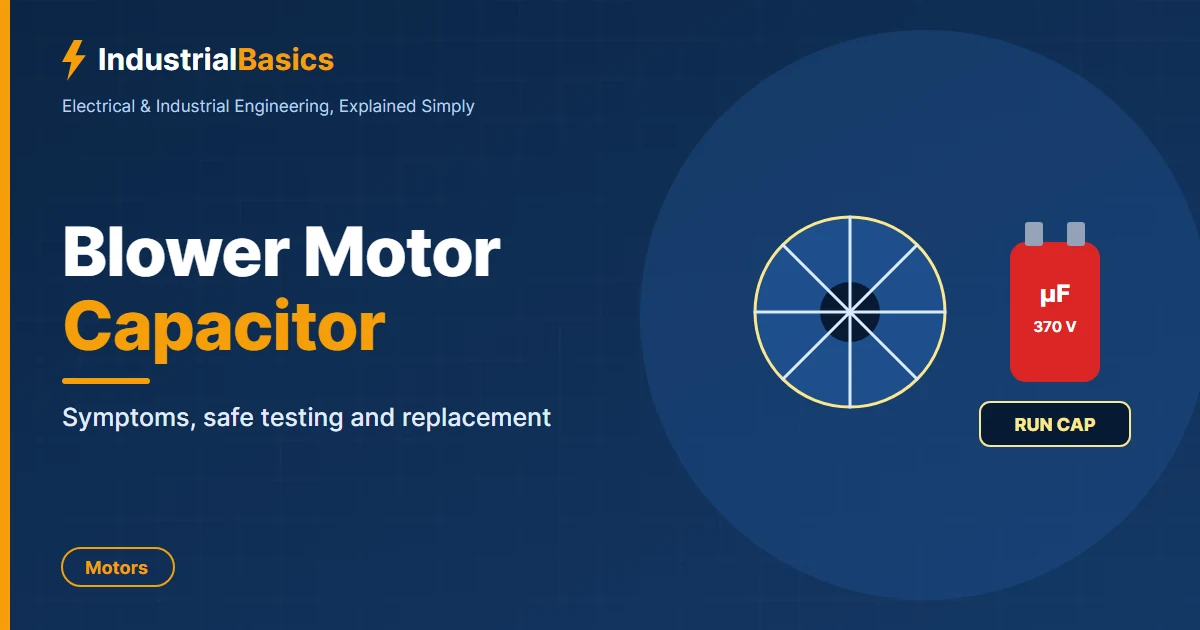
A blower motor capacitor is the run capacitor that lets a furnace or air handler’s PSC blower motor start and run. It sits in series with the motor’s auxiliary winding the whole time the motor is on, creating the phase shift that turns the rotor. When it weakens, the blower hums without starting, starts only if the wheel is spun by hand, runs slowly or overheats. Replace it with the same µF rating and an equal or higher voltage rating, normally 370 V or 440 V. A 440 V part can replace a 370 V part, but not the reverse (Wikipedia, Motor capacitor).
What the Capacitor Does in a Blower Motor
Most older and many current furnace blowers use a permanent split capacitor (PSC) motor. A single-phase supply produces a pulsating field, not a rotating one. The run capacitor shifts the current in the auxiliary winding so the two windings together create a rotating field. In a PSC motor the capacitor is never switched out, which is why it is called “permanent”. For the motor theory and wiring, see the PSC motor guide.
| Run capacitor (blower) | Start capacitor | |
|---|---|---|
| Duty | Continuous while the motor runs | Seconds, during starting only |
| Construction | Polypropylene film | Non-polarized electrolytic |
| Typical rating | 1.5–100 µF; 250, 370 or 440 V | Above 70 µF; 125, 165, 250 or 330 V |
| Switched out? | No | Yes, often by a centrifugal switch near 75% speed |
| Used on | Furnace blowers, condenser fans, PSC motors | Capacitor-start motors, compressors (hard start) |
Bad Blower Motor Capacitor Symptoms
- Hums, won’t start: without the phase shift the field cannot turn the rotor, so the motor buzzes and stalls.
- Starts with a push: spinning the wheel by hand gives the rotor the start the capacitor should provide.
- Slow or weak airflow: a weak capacitor, one that has lost capacitance over the years, leaves the motor below full power (Wikipedia).
- Overheating or tripping: a wrong or weak value makes the field uneven, so the rotor hesitates, gets noisy and runs hot (Wikipedia).
- Swollen or leaking can: a bulged top or sides means the capacitor has failed.
- After a storm: voltage spikes from lightning can weaken or damage a run capacitor (Wikipedia).
How to Test a Blower Motor Capacitor
- Turn off power at the furnace switch and breaker. Lock it out and confirm zero voltage with a meter.
- Discharge the capacitor. Fluke connects a 20,000 Ω, 5 W resistor across the terminals for five seconds, then confirms it is fully discharged.
- Photograph the wiring, then disconnect the capacitor so the rest of the circuit does not affect the reading.
- Set the multimeter to capacitance, connect the leads, and wait a few seconds for it to auto-range.
- Compare the reading with the label: µF and tolerance (for example 7.5 µF ±6%). OL means the value is out of range or the capacitor is faulty (Fluke).
Capacitor Test Calculator
Enter the label rating and your reading to see whether the capacitor is within tolerance. Technicians sometimes check a running capacitor instead: capacitance (µF) ≈ 2,652.6 × amps ÷ volts at 60 Hz, from C = I ÷ (2πfV). For example, 0.8 A at 300 V gives 7.07 µF.
Choosing a Replacement Capacitor
- Capacitance: match the µF (MFD) value on the motor label or old capacitor.
- Voltage: same or higher. 440 V can replace 370 V; 370 V cannot replace 440 V.
- Type: a run capacitor rated for continuous duty, not an electrolytic start capacitor.
- Dual capacitors (C, FAN, HERM terminals, for example 40 + 5 µF) serve an air conditioner’s compressor and condenser fan together, not a single blower motor (Wikipedia).
- Shape and mounting: round or oval both work if the strap fits.
- Safety class: IEC/EN 60252-1 marks protection levels from S0 (none) to S3 (fails open only).
ECM Blowers: No Capacitor
Many high-efficiency furnaces use an electronically commutated motor (ECM), a brushless DC motor with its own control board. It has no run capacitor, so capacitor checks do not apply. Wikipedia notes the HVAC industry is moving to brushless motors mainly because they use less power, especially in variable-speed systems. If a blower has no run capacitor, check whether it is an ECM before ordering parts; faults there are in the motor module or its control signals. For motor fault finding in general, see motor failure causes and megging a motor.
Frequently Asked Questions
What does a blower motor capacitor do?
It feeds the motor’s second (auxiliary) winding with a phase-shifted current, creating the rotating magnetic field that starts and runs a permanent split capacitor (PSC) motor. In a PSC motor it stays connected the whole time the motor runs (Wikipedia, Motor capacitor).
What are the symptoms of a bad blower motor capacitor?
The motor hums but will not start, starts only when the blower wheel is spun by hand, runs slowly with weak airflow, or overheats. The capacitor may look swollen or bulged. Wikipedia notes that a weak capacitor can make a motor fail to start or run below full power.
What size capacitor does a furnace blower motor need?
The size printed on the motor label or the old capacitor, in µF (or MFD) and volts. Run capacitors range from 1.5 to 100 µF, rated 250, 370 or 440 V (Wikipedia). Blower motors commonly use small values, but always match the label.
Can I use a 440 V capacitor instead of 370 V?
Yes. A 440 V capacitor can replace a 370 V one, but never the other way round (Wikipedia). The µF value must match.
Can I use a slightly different µF value?
No. Wikipedia says a dual run capacitor’s capacitance must stay within 5% of the original. A wrong value makes the field uneven, so the motor runs rough and noisy, uses more energy and overheats.
How do you test a blower motor capacitor?
Turn off and lock out the power, verify zero voltage, discharge the capacitor through a resistor (Fluke uses 20,000 Ω, 5 W for five seconds), disconnect it, then measure it on a meter’s capacitance setting. Compare the reading with the label tolerance.
What does MFD mean on a capacitor?
Microfarads. MFD is an older marking for µF, still common on motor capacitors (Wikipedia).
Can a blower motor run without its capacitor?
A PSC motor with a failed capacitor usually hums and will not start, or runs weakly and overheats. Do not run it that way, because the windings can burn out.
Do all furnace blower motors have a capacitor?
No. Many newer furnaces use electronically commutated (ECM, brushless DC) blower motors with built-in electronics and no run capacitor. Wikipedia notes the HVAC trend toward brushless motors because they use less power.
Is a blower capacitor dangerous?
It can hold a charge after the power is off, so always verify and discharge it before touching the terminals (Fluke). Some run capacitors are designed to break internally if pressure builds, which makes the top bulge (Wikipedia).
Sources and Further Reading
- Wikipedia: Motor capacitor: run, start and dual capacitors, ratings, failure modes.
- Fluke: How to measure capacitance with a digital multimeter: discharge and test steps.
- Wikipedia: Brushless DC electric motor: ECM use in HVAC.