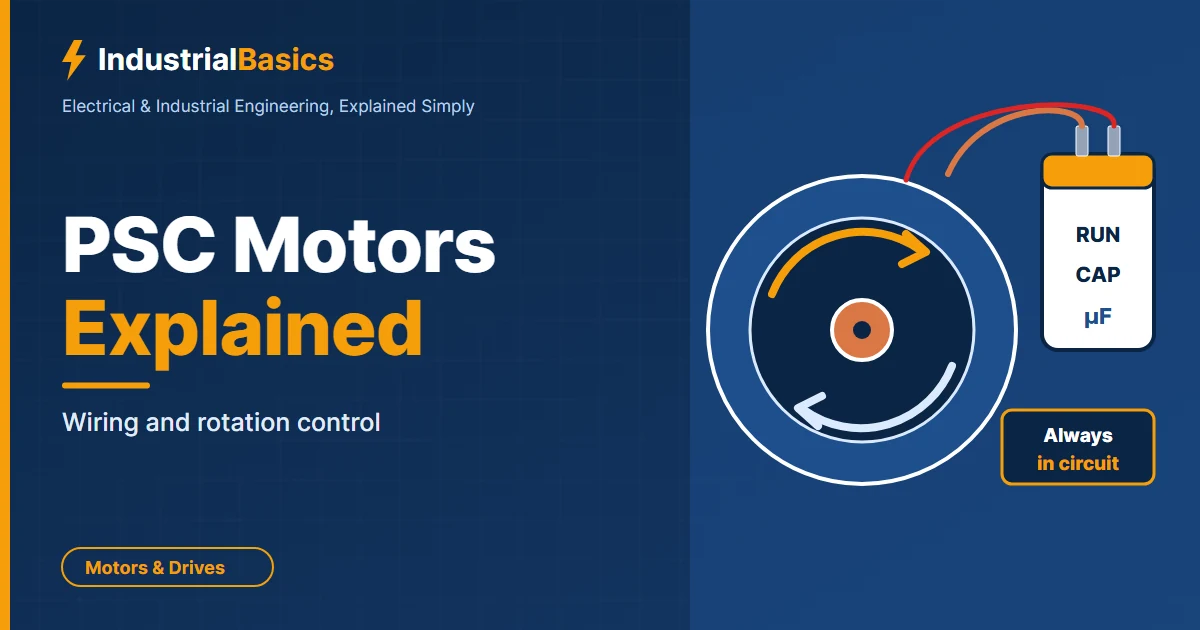
A PSC motor is a single-phase induction motor with a run capacitor permanently connected in series with its auxiliary winding. To reverse it, swap the auxiliary winding connections relative to the main winding, or use the reversing connections on the motor’s diagram. PSC motors have no centrifugal switch and low starting torque, so they suit fans and similar easy-starting loads.
| Feature | PSC motor |
|---|---|
| Capacitor | Oil-filled, continuous-duty run capacitor |
| Centrifugal switch | None |
| Starting torque | Small |
| Frequent starting | Better than a capacitor-start motor |
| Typical load | Fans and other low-starting-torque loads |
| Reversing | Change auxiliary connections relative to main winding |
How a PSC Motor Works
Single-phase current alone does not create a rotating magnetic field. A PSC motor adds an auxiliary winding in series with a capacitor, which shifts that winding’s current relative to the main winding. Oriental Motor describes the capacitor’s job as creating a poly-phase supply from a single-phase source, setting rotation direction and providing torque.
Because the capacitor stays in circuit, it must be rated for continuous duty. Its value is much lower than a capacitor-start motor’s capacitor, so starting torque is small. In exchange, there is no switch to wear out and the motor can be started much more often.
PSC vs Other Single-Phase Motors
| Type | Capacitor | Starting switch | Starting torque |
|---|---|---|---|
| PSC | Run capacitor, always connected | No | Small |
| Capacitor-start | Start capacitor, short duty | Yes, centrifugal | Moderate |
| Shaded pole | None | No | See our guide |
PSC Motor Wiring
Lead colors are not universal. The examples below are for Bodine stock motors. Always use the connection diagram for your own motor.
3-wire reversible PSC motor
| Direction | Hot and first capacitor lead | Second capacitor lead | Other side of line |
|---|---|---|---|
| Clockwise | Black | Red | Blue |
| Counterclockwise | Red | Black | Blue |
4-wire reversible PSC motor
| Connection | Bodine lead |
|---|---|
| One side of capacitor | Blue |
| Other side of capacitor and one AC line | Black |
| Other AC line | Black-yellow and blue-yellow |
| Ground | Green-yellow |
| To reverse | Transpose black and black-yellow |
For a more general guide to terminal boxes and supply connections, see how to wire a single phase motor. UK and other non-US supplies use different colors and voltages, so check that the motor is rated for your supply.
Rotation Control and Reversing
Michigan State’s tech note gives the general rule: rotation is reversed by reversing the auxiliary winding leads with respect to the running winding leads. Some motors bring out only three leads, so the direction is changed by moving the line connection between the capacitor terminals.
Using a reversing switch
Bodine’s diagrams use a double-throw switch with a center-off position. The center-off position brings the gearmotor to a complete stop before reversing, which prevents gearing damage. Bodine shows single- or double-pole switches for 3-wire motors, and three- or four-pole switches for 4-wire motors. The switch must be rated for the motor’s voltage and current.
Choosing and Checking the Capacitor
Use the capacitor value on the motor nameplate. Bodine’s model 0670, for example, uses a 15 µF, 350 VAC capacitor. A different value changes the motor’s performance, and a capacitor used above its rated voltage may be damaged.
| Check | What to look for |
|---|---|
| Capacitance | Same µF as the motor label |
| Voltage | Not lower than specified. Oriental Motor says it is typically about double the motor’s rated input voltage |
| Duty | Continuous-duty run capacitor |
| Age | Oriental Motor recommends replacement after the rated conduction time, 40,000 hours as standard on its capacitors |
| Condition | Replace if swollen, leaking or burned |
Our guide to capacitor value codes explains how capacitance is marked on smaller parts.
Troubleshooting
| Symptom | Likely cause | Check |
|---|---|---|
| Hums but will not start | Failed capacitor, open winding or jammed load | Isolate, turn the shaft by hand, test the capacitor |
| Runs in the wrong direction | Line on the wrong capacitor terminal | Compare with the motor diagram |
| Slow or weak | Wrong or failing capacitor, or low voltage | Capacitor value and motor voltage |
| Overheats | Overload, wrong capacitor or poor airflow | Current, capacitor and ventilation |
| Trips protection | Winding fault or overload | Test with a megger and review the overload setting |
If the motor keeps failing, read our guide to common motor failure causes. For starting and control options, see motor starter types.
Furnace and air handler blowers are a common PSC application; see blower motor capacitor symptoms and testing.
Frequently Asked Questions
What is a PSC motor?
A PSC, or permanent split capacitor, motor is a single-phase induction motor with a run capacitor in series with its auxiliary winding. The capacitor stays connected during starting and running.
Does a PSC motor have a centrifugal switch?
No. The auxiliary winding stays energized, so no starting switch is needed.
Can a PSC motor run without a capacitor?
It will not operate properly. Bodine states that PSC motors need the correct run capacitor.
How do you reverse a PSC motor?
Reverse the auxiliary winding connections relative to the main winding, or follow the reversing connections on the motor’s diagram.
Do I have to stop a PSC motor before reversing?
Usually, yes. Bodine uses a center-off switch to stop gearmotors and prevent gearing damage. Only reverse instantly if the maker rates the motor for it.
What capacitor does a PSC motor need?
Use the capacitance and voltage specified on the motor nameplate or wiring diagram. For example, one Bodine model uses 15 µF at 350 VAC.
Are PSC motors good for high starting loads?
No. Their starting torque is small, so they suit loads such as fans. Hard-starting loads may need a different motor type.
Does a run capacitor have polarity?
The Bodine run capacitors in these instructions are non-polarized, so either terminal may be used. Follow the motor’s diagram for what connects to each side.
Sources and Further Reading
- Michigan State University: Electrical Tech Note 313, Single-Phase Induction Motor Types: operation, torque and reversal.
- Bodine: How to Wire a 3-Wire Reversible PSC Motor: lead connections.
- Bodine: How to Wire a 4-Wire Reversible PSC Motor: lead connections and capacitor example.
- Bodine: How to Connect a Reversing Switch: center-off reversing.
- Oriental Motor: What Does a Capacitor Do?: capacitor function, rating and safety.