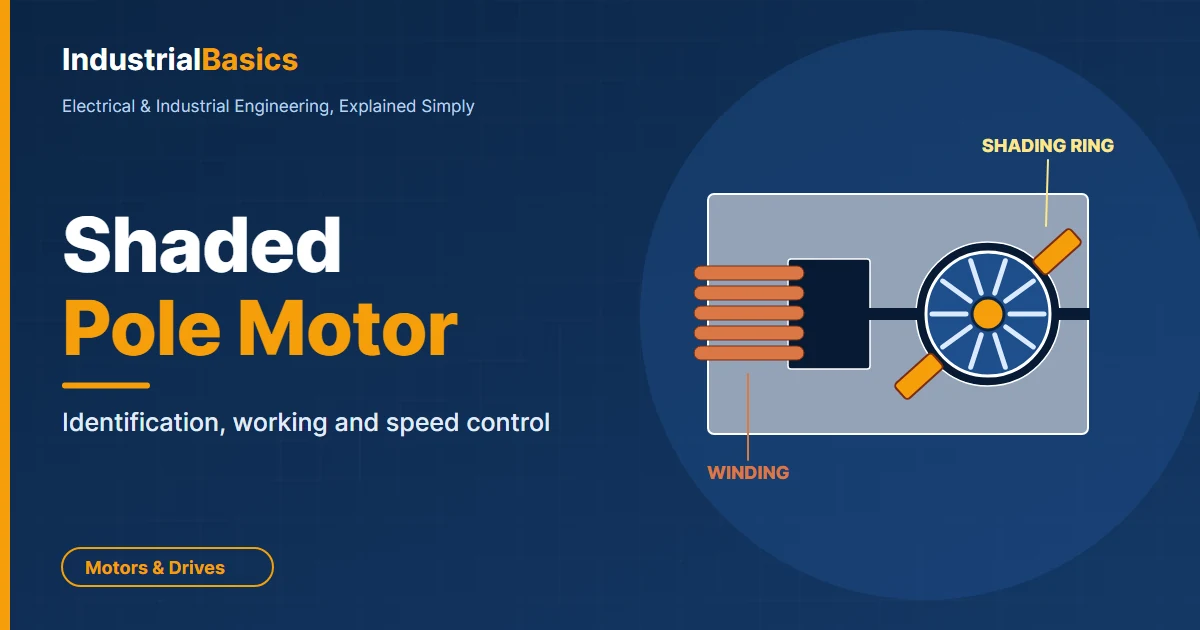
A shaded pole motor is a small single-phase AC induction motor that uses a copper ring around part of each stator pole to start itself. You can identify one by that copper shading ring, a single main winding and the absence of a capacitor. It is cheap, simple and reliable, but it has low efficiency and low starting torque, so it is normally found on small fans and other light loads, generally below about 40 W.
| Feature | Shaded pole motor |
|---|---|
| Motor type | Single-phase AC induction |
| How it starts | Copper shading ring on each pole |
| Capacitor | None |
| Typical size | Generally below about 40 W (0.05 HP) |
| Starting torque | Low |
| Efficiency | Low |
| Speed control | Limited, by reducing voltage |
| Reversible? | Not electrically |
How to Identify a Shaded Pole Motor
Most shaded pole motors can be identified in under a minute once the housing is open. Disconnect the power first and check these features.
| Check | Shaded pole | PSC motor |
|---|---|---|
| Copper ring on the pole | Yes | No |
| Run capacitor | No | Yes |
| Windings | One main winding | Main and auxiliary |
| Typical leads | Two | Three or more |
| Common frame | Open C-frame or skeleton | Usually enclosed round frame |
| Reversal | Not by rewiring | Often possible by rewiring |
How a Shaded Pole Motor Works
A single-phase winding produces a field that pulses but does not rotate, so a plain single-phase motor has no starting torque. The shading ring solves that with a simple trick. As the main flux changes, it induces a current in the short-circuited copper ring, and that current opposes the change. Flux in the shaded part of the pole therefore lags the flux in the unshaded part.
That delay makes the point of strongest flux sweep across the pole from the unshaded side to the shaded side. The squirrel-cage rotor is dragged in the same direction. Because the shift is small, the resulting torque is weak, but it is enough to start a fan or other light load.
Synchronous speed
Like any induction motor, a shaded pole motor runs below synchronous speed. The speed depends on the supply frequency and the number of poles.
| Poles | 50 Hz | 60 Hz |
|---|---|---|
| 2-pole | 3000 rpm | 3600 rpm |
| 4-pole | 1500 rpm | 1800 rpm |
| 6-pole | 1000 rpm | 1200 rpm |
Speed Control Options
A shaded pole motor has limited speed control. The usual method is to reduce the voltage. Lower voltage weakens the torque, the rotor slips more, and the speed falls until the torque balances the load. This works best with fans, because their load drops quickly as they slow down.
| Method | How it works | Suitability |
|---|---|---|
| Tapped winding | Selects part of the winding for low, medium or high speed | Common in multi-speed fans, built in at the factory |
| Motor-rated voltage controller | Reduces the RMS voltage | Usable on fan loads if the motor allows it |
| Series resistor or reactor | Drops voltage before the motor | Simple but wasteful |
| Household light dimmer | Chops the AC waveform | Avoid unless rated for motor loads |
| VFD | Changes frequency and voltage | Not a normal match, so replace the motor instead |
If a load needs real speed control, a different motor is usually the better choice. Our guide to VFDs and soft starters explains the options for larger motors, and our overview of motor starters shows how they are switched and protected.
Shaded Pole vs PSC vs EC Motors
| Choose | When |
|---|---|
| Shaded pole | Very small load, low duty, lowest purchase cost |
| PSC | Larger fans, better efficiency, simple tapped speeds |
| EC / BLDC | Long running hours, variable speed, energy savings |
For a fan that runs all day, the cheapest motor to buy is often not the cheapest to own. The energy lost in a shaded pole motor can outweigh its low purchase price over several years.
Advantages and Disadvantages
| Advantages | Disadvantages |
|---|---|
| Very simple construction | Low efficiency |
| Low cost | Low starting torque |
| No capacitor to fail | Limited speed control |
| No brushes or centrifugal switch | Not electrically reversible |
| Quiet on light loads | Runs warm for its size |
Troubleshooting a Shaded Pole Motor
| Symptom | Likely cause | What to do |
|---|---|---|
| Hums but will not start | Dry or seized bearing | Check that the shaft spins freely, then clean, lubricate or replace |
| Starts only when pushed | Worn bearing or low voltage | Check bearings and supply |
| No sound at all | No supply, open winding or thermal fuse | Check supply, then winding continuity |
| Runs slowly and hot | Bearing drag, dirt or low voltage | Clean the motor and check the load |
| Rattles or vibrates | Loose fan blade or worn bearing | Tighten or replace |
Bearing and heat problems are the same issues that shorten the life of larger machines. See our guide to motor failure causes for the wider picture, and use an insulation resistance test to check a suspect winding.
Frequently Asked Questions
What is a shaded pole motor?
It is a small single-phase AC induction motor that uses a copper ring around part of each stator pole to create a weak rotating field, so it can start without a capacitor or a separate start winding.
How can I tell if a motor is shaded pole?
Look for a copper band around part of each pole face, a single main winding, usually two supply leads and no capacitor. A missing capacitor alone is a clue, not proof, so confirm with the ring or the datasheet.
Can you control the speed of a shaded pole motor?
Yes, to a limited extent, by reducing the applied voltage. This also reduces torque, so it suits fan-type loads and a controller rated for motors. A VFD is not a normal choice for this motor.
Can a shaded pole motor be reversed?
Not by swapping the supply leads. Rotation runs from the unshaded to the shaded side of the pole, so reversing usually means physically flipping the stator, where the design allows it, or fitting a motor built for the opposite rotation.
Does a shaded pole motor have a capacitor?
No. The shading ring does the job a capacitor does in a PSC motor. If a small motor has a run capacitor, it is not a shaded pole motor.
Why is a shaded pole motor inefficient?
Current is continuously induced in the copper shading ring, and that energy is lost as heat. Published efficiency figures vary widely by size and design, but they are low compared with PSC and EC motors.
What is a shaded pole motor used for?
Typical uses are small fans, bathroom extractors, appliance cooling fans, small pumps and other light loads that are easy to start.
Why does my shaded pole motor hum but not turn?
The usual cause is dried or seized bearings, because the motor has very little starting torque. Disconnect power and check whether the shaft spins freely by hand.
Sources and Further Reading
- Linquip: Shaded Pole Induction Motors: construction, rotation and typical ratings.
- Electrical Volt: Shaded Pole Induction Motor: operation, limits and speed adjustment.
- Longwell: Shaded-Pole vs PSC and BLDC Fan Motors: how the motor types compare on fans.
- Longwell: Shaded-Pole vs PSC vs EC Cost and Energy: cost and energy considerations.
- US Patent 4234810: Shaded pole motors: shading coil design and purpose.