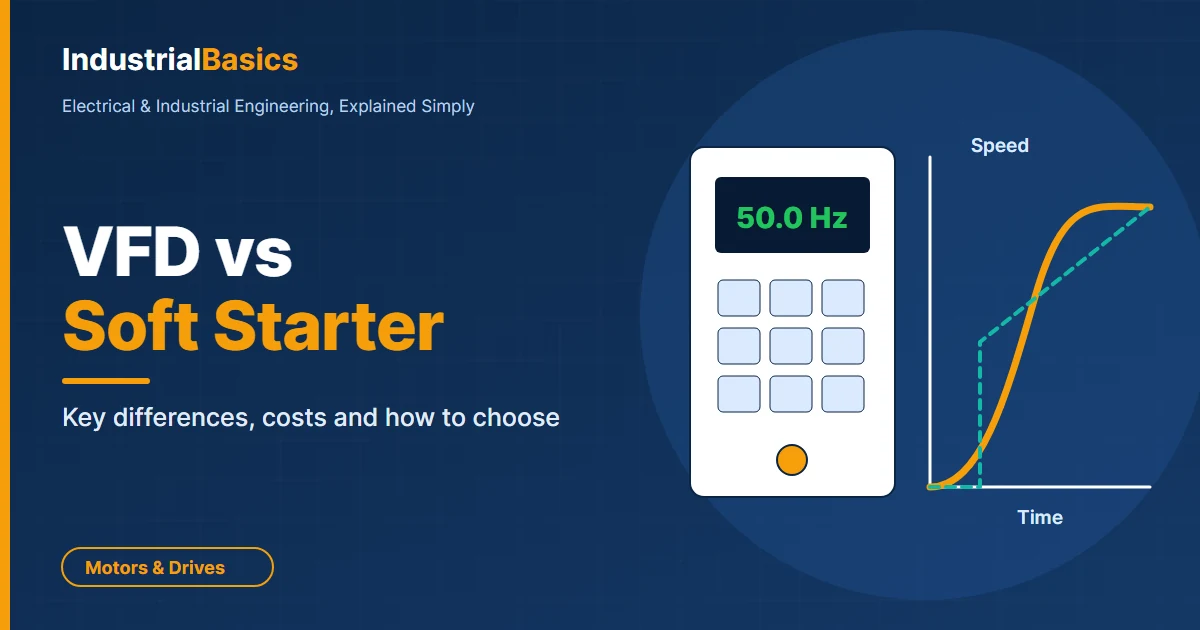
A soft starter controls how a motor starts and stops. A VFD (variable frequency drive) does that too, but it also lets you change the motor speed while it runs. That one difference decides most buying choices.
Quick answer
- Choose a VFD if the motor must run at different speeds, or if running a pump or fan slower would save energy.
- Choose a soft starter if the motor always runs at full speed and you only want a gentler start and stop at a lower cost.
- Both cut the starting current compared with direct-on-line (DOL) starting. Only the VFD can save energy while the motor is running.
Last reviewed: 4 November 2026. Electrical work must be done by qualified people. See the safety note at the end.
VFD vs soft starter: quick comparison
| Factor | VFD | Soft starter |
|---|---|---|
| Main job | Controls motor speed and torque | Starts and stops the motor smoothly |
| What it changes | Voltage and frequency | Voltage only |
| Starting current | About 1 to 1.5 times full-load current (FLC) | About 2 to 4 times FLC |
| Starting torque | High and adjustable | Reduced (falls with voltage squared) |
| Speed control while running | Yes | No |
| Energy saving | Yes, on pumps and fans run below full speed | No meaningful saving |
| Harmonics | Continuous, may need a reactor or filter | Only during the short start and stop |
| Purchase cost | Higher | Lower |
| Installation | More settings, more care over cables and earthing | Simpler |
| Typical uses | Variable-flow pumps, fans, HVAC, compressors, lifts | Fixed-speed pumps, conveyors, crushers, fans |
How each device works
Soft starter
A soft starter uses thyristors (also called SCRs), which are electronic switches fitted in each phase. At the start they let through only part of each voltage wave, then slowly let through more. The motor sees a rising voltage, so current and torque build up smoothly.
Once the motor reaches full speed, a bypass contactor normally closes and takes the thyristors out of the circuit. From then on the motor runs straight from the supply at 50 Hz, so its speed is fixed.
VFD
A VFD turns the incoming AC into DC (rectifier), smooths it (DC bus capacitors), then builds a new AC supply using fast switches called IGBTs (inverter). It changes the frequency and voltage together, so the motor keeps its torque at lower speeds.
Motor speed follows frequency. A 4-pole motor runs at about 1,500 rpm on 50 Hz and about 750 rpm on 25 Hz. VFD, VSD, AC drive and inverter all mean the same thing in practice.
Key differences explained
Starting current
FLC is the current the motor draws at full load. A DOL start can pull 6 to 8 times FLC, which causes voltage dips, nuisance trips and mechanical shock. A soft starter holds the current at a limit you set, usually 2 to 4 times FLC. A VFD starts at very low frequency, so the current stays near 1 to 1.5 times FLC.
Starting torque
With a soft starter, torque falls with the square of the voltage. At half voltage you get only about a quarter of the torque. That is fine for an unloaded fan, but a loaded conveyor or crusher may struggle to turn while still drawing high current. A VFD keeps near-rated torque from low speed, and vector control improves this further.
Speed control and stopping
A soft starter has no say over speed once the motor is running. Its soft stop ramps the voltage down, which helps on pumps by reducing water hammer (the pressure surge when flow stops suddenly). A VFD controls speed continuously, and also gives controlled deceleration, DC injection braking and braking resistors for fast stops.
Energy use
This is where a VFD earns its cost. For centrifugal pumps and fans, the affinity laws say flow changes with speed, pressure changes with speed squared, and power changes with speed cubed. Slow the motor to 80% speed and power drops to about 51%.
Here is what that means for a 30 kW pump running 6,000 hours a year, compared with running at full speed. The tariff of INR 8 per kWh is only an example; replace it with your own.
| Pump speed | Power drawn | Energy saved per year | Cost saved per year (INR 8/kWh) |
|---|---|---|---|
| 100% | 30.00 kW | 0 kWh | INR 0 |
| 90% | 21.87 kW | 48,780 kWh | INR 390,240 |
| 80% | 15.36 kW | 87,840 kWh | INR 702,720 |
| 70% | 10.29 kW | 118,260 kWh | INR 946,080 |
| 60% | 6.48 kW | 141,120 kWh | INR 1,128,960 |
| 50% | 3.75 kW | 157,500 kWh | INR 1,260,000 |
Real savings are usually lower. A system with high static head (for example, pumping up a tall building) cannot slow down as far, so the cubic rule applies less. A soft starter saves nothing here, because after the start the motor simply runs at full speed.
Harmonics and motor insulation
A VFD draws current in short pulses, which creates harmonics that can distort the supply. Common fixes are a line reactor or DC choke, a multi-pulse drive, an active front end or a filter. Limits at the point of common coupling usually follow IEEE 519 or your supplier’s own rules. A soft starter only creates harmonics during the short start and stop.
A VFD also switches its output very fast. On long motor cables this can create voltage spikes (high dv/dt and reflected waves) that stress the winding insulation of ordinary motors. Use an inverter-duty motor, an output reactor or a dv/dt or sine filter. Good earthing system design and screened cable also keep electrical noise (EMC) under control. A soft starter has no such cable-length issue, because its output stays at supply frequency.
If you suspect winding damage after a fault, a megger insulation resistance test is the usual first check. Disconnect the drive or soft starter from the motor first, because the test voltage can damage the electronics.
Protection, duty and starts per hour
Both devices offer overload, phase-loss and phase-imbalance protection, so they can often replace a separate thermal overload. VFDs add more: stall and ground-fault protection, PID control, fieldbus communication and Safe Torque Off. If you are comparing this with traditional protection relays, the drive or starter covers the motor only, not the upstream cable or panel.
A soft starter heats up during every ramp, so it has a limit on starts per hour. Datasheets give this under the AC-53a or AC-53b ratings in IEC 60947-4-2, and the figure is often a handful to around ten per hour for standard duty. A VFD can start far more often, but it has normal-duty and heavy-duty ratings. Heavy duty usually allows a higher overload for 60 seconds, at the cost of a larger drive for the same motor.
Whichever you pick, the fuses or breakers upstream must be chosen to suit it. Our guides on protection coordination and MCB, MCCB and ACB explain how.
Size, maintenance and lifespan
A VFD is bigger and needs more cooling space in the panel. Its electrolytic capacitors and cooling fans wear out, and heat shortens their life. Capacitors often last roughly 5 to 8 years in warm conditions and longer when kept cool; follow the maker’s manual. A soft starter has fewer parts in the power path once bypassed. Its usual wear points are the cooling fan and the bypass contactor.
Cost: purchase price and running cost
A VFD costs more to buy. Vendor guidance often puts it at two to four times the price of a soft starter of the same rating, and it may also need a reactor, filter or longer screened cable. A soft starter is cheaper and quicker to install.
Over the life of a motor, though, the purchase price is small. Energy agencies commonly quote that electricity makes up well over 90% of the lifetime cost of a motor that runs almost all the time. That is why a VFD can repay its extra cost quickly on a pump or fan, and why it is a poor buy on a motor that always needs full speed.
Simple payback example
Payback in years is the extra purchase cost divided by the yearly saving. Take the 30 kW pump at 80% speed from the table above, which saves INR 702,720 a year. If the VFD costs INR 150,000 more than a soft starter (an assumed figure), payback is 150,000 ÷ 702,720, or about 0.21 years. That is roughly 2.6 months.
Treat that as a best case. It assumes the pump really runs at 80% speed all year. Use your own running hours, tariff and quotes before deciding.
Price in India
There is no single price. It depends on motor kW, brand, duty rating, enclosure (IP) rating, built-in bypass or filters, GST and installation. Ask two or three distributors for quotes for the same kW and duty, and ask what is included.
VFD vs soft starter vs DOL vs star-delta
DOL connects the motor straight to the supply. Star-delta starts the windings in star, then switches to delta, which cuts both current and torque to about a third of DOL during the start. Our guide to the types of motor starters covers all of them in more detail.
| Factor | DOL | Star-delta | Soft starter | VFD |
|---|---|---|---|---|
| Starting current | 6 to 8× FLC | About 2 to 3× FLC | 2 to 4× FLC | 1 to 1.5× FLC |
| Starting torque | Full | About one third of DOL | Reduced, adjustable | High, adjustable |
| Speed control | No | No | No | Yes |
| Running energy saving | No | No | No | Yes, on variable loads |
| Relative cost | Lowest | Low | Medium | Highest |
| Best for | Small motors | Fixed-speed motors that start unloaded | Fixed-speed motors needing a smooth start | Variable speed or energy saving |
Which is better for your application?
| Load | Usually better | Why |
|---|---|---|
| Centrifugal pump, flow changes | VFD | Speed sets the flow, and the affinity laws save energy |
| Centrifugal pump, fixed flow | Soft starter | Gentle start and stop avoids water hammer at lower cost |
| Submersible or borewell pump | Soft starter, or VFD with a filter | Long cables stress insulation on a VFD unless filtered |
| Fan or blower | VFD | Power drops sharply at lower speed |
| Screw compressor, varying demand | VFD | Matches output to air demand |
| Screw compressor, steady demand | Soft starter | Lower cost, no speed control needed |
| Conveyor | VFD for loaded starts and speed control; soft starter for light, fixed-speed belts | VFD gives torque at low speed |
| HVAC fans and pumps | VFD | Airflow and temperature control plus energy saving |
| Crusher or mill | Heavy-duty soft starter | Cheaper at high power; use a VFD if speed control is needed |
| Lift or hoist | VFD | Needs precise torque and speed control |
Standards and regional notes
| Region | Soft starters | VFDs | Also check |
|---|---|---|---|
| India | IS/IEC 60947-4-2 | IEC 61800 series | Your electricity supplier’s starting-current rules, current BEE and BIS motor efficiency notices (IE3 motors are required for many ratings), IEEE 519 for harmonics |
| UK and Europe | BS EN versions of IEC 60947-4-2 | BS EN versions of IEC 61800 | CE or UKCA marking, BS 7671 wiring regulations |
| USA | UL 60947-4-1 | UL 61800-5-1 | NEC, IEEE 519, NEMA MG1 Part 31 for inverter-duty motors |
How to choose
Start with the flowchart, then check the points below it.
Choose a VFD when
- Speed must follow the process, such as flow, pressure or temperature.
- A pump or fan spends long hours below full speed.
- You need full torque at low speed, or tight control and automation.
Choose a soft starter when
- The motor always runs at full speed.
- You mainly want less starting current and less mechanical shock.
- Budget, panel space or long motor cables rule out a VFD.
Information to gather before you buy
- Motor kW, voltage, FLC and whether it is inverter-duty.
- Load type (variable or constant torque), breakaway torque and inertia.
- Starts per hour and running hours per year.
- Supply limits for starting current, voltage dip and harmonics.
- Ambient temperature, altitude, enclosure rating and motor cable length.
- Space in the panel. Soft starters and drives usually sit with other starters inside switchgear panels, so check ventilation and clearances.
Common problems and likely causes
| Problem | Likely cause | What to check |
|---|---|---|
| Motor trips during a soft start | Current limit too low, so the motor accelerates slowly and the overload trips | Ramp time, current limit, overload class, supply voltage dip |
| Soft starter cannot start a heavy load | Reduced voltage gives too little torque | Initial voltage, kick-start option, or move to a VFD |
| Soft starter overheats | Too many starts per hour, no bypass, or undersized unit | AC-53 rating, start frequency, bypass |
| VFD overheats | Blocked cooling, high ambient temperature, dust or undersized drive | Airflow, filters, derating, duty rating |
| Motor winding failure on a VFD | Non-inverter-duty motor, long cable, no filter, or poor cooling at low speed | Motor rating, cable length, output filter |
| Electrical noise from a VFD | Poor earthing or unscreened motor cable | Earthing, screened cable, EMC filter |
Common misconceptions
- “Soft starters save electricity.” Not while running. After the start, the motor draws the same power as on DOL.
- “A VFD always saves energy.” Only if the motor can usefully run slower. At full speed it adds a small loss, typically 2 to 4%.
- “Any motor works with a VFD.” Older motors can fail early from voltage spikes and poor cooling at low speed.
If you control a VFD from a panel knob, the wiring and settings decide how well it responds. Our guide to potentiometer speed control covers connections, scaling, response tuning and noise.
Replacing a small part on a control board? Our guide to the value of capacitor 104 explains how to read 103, 104 and 105 capacitor codes.
Setting a drive for a required process speed? Our RPM to FPM guide includes a calculator that converts line speed into the VFD frequency you need.
Only have single-phase power? Our guide to the static phase converter compares it with rotary converters and VFDs, including power limits and sizing.
A VFD changes speed by changing frequency. Our Hz and RPM conversion guide shows how to calculate motor speed and set up the drive display.
For fan, pump and compressor applications in buildings, see our guide to VFDs in HVAC, with an energy savings calculator.
FAQs
What is the main difference between a VFD and a soft starter?
A soft starter ramps up the voltage to start the motor gently, then leaves it running at fixed speed. A VFD changes both voltage and frequency, so it controls starting and running speed. In short, a soft starter is for starting; a VFD is for starting and speed control.
Can a soft starter control motor speed?
No. A soft starter only controls voltage while the motor starts and stops. When the start finishes, the motor runs at supply frequency and its speed cannot be changed. If you need adjustable speed, you need a VFD.
Do soft starters save energy?
Not in any meaningful way. A soft starter reduces the starting surge, but once the motor is up to speed it uses the same power as a DOL starter. Real energy savings come from running a pump or fan more slowly with a VFD.
Can a VFD be used as a soft starter?
Yes. A VFD ramps frequency and voltage up from zero, which gives a very gentle start with low current. It costs more and takes more space than a soft starter, so it makes sense only if you also want speed control or the extra torque.
Which is better for a centrifugal pump?
Use a VFD if the flow changes, because slowing the pump saves energy. Use a soft starter if the pump always runs at full speed and you only want to avoid water hammer and high starting current.
Do VFDs create harmonics?
Yes. A VFD draws current in pulses, which distorts the supply. Line reactors, DC chokes, multi-pulse drives, active front ends or filters reduce this. Check the limits that apply at your supply connection, which often follow IEEE 519.
Do I need a bypass contactor on a soft starter?
It is strongly advised. The bypass takes the thyristors out of circuit once the motor is at speed, so they stop producing heat and the unit runs cooler. Many soft starters have one built in, but check the datasheet for your model.
Is a soft starter cheaper than a star-delta starter?
Usually not. Star-delta is normally the cheaper of the two. A soft starter costs more but gives a smoother start, adjustable current and a soft stop, and avoids the current jump when star-delta switches over.
Which gives more starting torque?
A VFD. It can hold high torque from low speed while limiting current. A soft starter reduces the voltage, and torque falls with voltage squared, so it gives less torque during the start.
How long do they last?
It depends on heat, dust and duty, so follow the maker’s guidance. VFD capacitors and fans are the usual wear parts and are replaced during maintenance. Soft starters often last longer in the power path once bypassed, with fans and bypass contactors the usual wear points.
Conclusion: which one should you choose?
Pick a VFD when speed needs to change or when a pump or fan will spend long hours below full speed, because the energy saving usually pays for the extra cost. Pick a soft starter when the motor runs at one speed and you want a gentler, cheaper start and stop. Neither is better in every case. Match the device to the load, the supply and the number of hours the motor runs.
Safety note: Sizing, installation, parameter setting, commissioning and maintenance of VFDs and soft starters must be carried out by qualified electrical personnel. Follow the manufacturer’s manual and local rules, such as the Indian Electricity Rules, BS 7671 or the NEC. This article is general guidance, not a design. Examples use illustrative figures.
Further reading
- IEC for IEC 60947-4-2 and the IEC 61800 series
- IEEE Standards Association for IEEE 519 harmonic limits
- Bureau of Energy Efficiency (India) for motor efficiency guidance