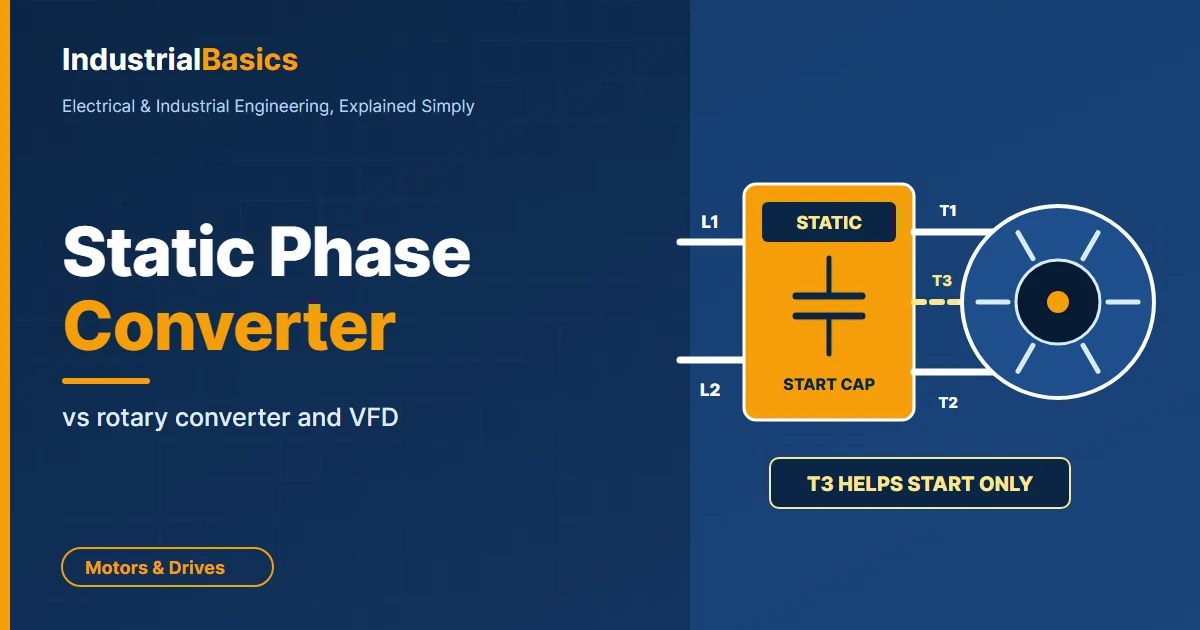
A static phase converter uses capacitors to start a three-phase motor on single-phase power, then disconnects and leaves the motor running mainly on two legs. It is cheap and simple, but the motor cannot deliver full power. Phoenix Phase Converters puts usable output at about 50–70% of rated capacity. Use a static converter only for a single, light, fixed-speed load. Choose a VFD for speed control, or a rotary converter for several motors or full power.
| Factor | Static converter | Rotary converter | VFD |
|---|---|---|---|
| How it works | Capacitors start the motor | Idler motor helps generate three-phase | Rectifies to DC, then creates AC output |
| Motor power | About 50–70% (Phoenix) | Full rated power | Depends on drive rating |
| Speed control | No | No | Yes |
| Multiple motors | Generally no | Yes | Generally one motor per drive |
| Typical price (Phoenix) | $200–$600 | $500–$15,000 | $300–$3,000 |
| Best for | One light fixed-speed load | Workshops and full power | One motor needing speed control |
Phase Converter Estimate
Enter your largest motor and the total of any other motors to see a first estimate.
How a Static Phase Converter Works
A three-phase motor cannot create its own starting torque from a single-phase supply. The static converter’s capacitor circuit provides a phase-shifted current to the third terminal so the rotor starts turning. Once the motor is up to speed, the start circuit disconnects.
The motor then keeps running, but mainly on two legs. That is why its available power falls. If you need a refresher on motor connections, read our guide to star and delta connections.
Worked example: 10 HP motor
If the driven machine needs 8 HP, a static converter on that 10 HP motor is the wrong choice, even though the motor is larger than the load. This uses Phoenix’s published range, so treat it as an estimate.
Static vs Rotary Phase Converter
A rotary converter adds a three-phase idler motor that keeps spinning and helps produce the missing phase. American Rotary says rotary and digital converters can run motors at their full power capacity. They can also supply several machines, which makes them popular in workshops.
| Choose static if | Choose rotary if |
|---|---|
| One motor | Several machines |
| Light load | Full power is needed |
| Easy starting | Hard-starting load |
| Lowest upfront cost matters most | Long-term shop use |
For sizing, Phoenix’s rule of thumb is twice the largest motor, plus the other motors. A shop with 5 HP, 3 HP and 2 HP machines would need (2 × 5) + 3 + 2 = 15 HP. Hard-starting loads such as compressors may need more.
Static Phase Converter vs VFD
A VFD rectifies the single-phase supply to DC and then creates a variable-frequency output for the motor. It suits a single motor that needs speed control or a softer start. Phoenix and American Rotary both describe common single-phase VFD use as being around 3 HP or smaller, and each drive normally runs one motor.
| Question | Static | VFD |
|---|---|---|
| Need speed control? | No | Yes |
| Soft starting? | No | Yes |
| Single-phase input? | Yes | Only if the drive allows it |
| Wiring | Motor and start circuit | Directly from drive to motor |
| Watch out for | Reduced power and imbalance | Harmonics and long cable runs |
Which Loads Should Avoid a Static Converter?
| Load | Static suitable? | Better option |
|---|---|---|
| Small fan or light fixed-speed tool | Possibly | Static or VFD |
| Air compressor | Avoid | Rotary converter |
| CNC machine | No | Follow the CNC maker’s power requirements |
| Several machines | No | Rotary converter |
| Fully loaded motor | No | Rotary converter or suitable VFD |
| HVAC compressor | Check first | Follow the equipment warranty |
Warranty is worth checking before you buy. Phoenix says static converters void the warranty on most industrial motors and that several HVAC manufacturers restrict VFD use on compressors.
Protecting the Motor
- Keep the load within the reduced capacity.
- Measure current on all three motor leads.
- Watch for overheating, noise or slow starting.
- Fit suitable motor overload protection.
- Confirm that the motor voltage matches the supply.
A phase converter does not normally change voltage. If the motor is running hot, check the overload relay and full load amps, and review common motor failure causes.
Frequently Asked Questions
What is a static phase converter?
It is a device that uses capacitors to start a three-phase motor from a single-phase supply. After starting, the start circuit disconnects and the motor keeps running mainly on two legs.
How much power do you lose with a static phase converter?
Phoenix Phase Converters says a motor runs at 50 to 70 percent of its rated capacity. Actual results depend on the motor and load.
Can a static phase converter run a motor at full load?
It should not be relied on for that. Choose a rotary converter or suitable VFD if the motor needs its full rated power.
Is a static phase converter bad for a motor?
It can be if the motor is overloaded, because it runs unbalanced on two legs. Keep the load light and monitor motor temperature and current.
Can one static converter run several motors?
Generally no. Phoenix notes that each motor needs its own start circuit.
Should I use a VFD or a static phase converter?
A VFD is usually better for a single motor that needs speed control or smoother starting. A static converter is a low-cost option only for a light, fixed-speed load.
What size rotary phase converter do I need?
Phoenix’s rule of thumb is twice the largest motor plus the other motors. A 5 HP, 3 HP and 2 HP group would need about 15 HP.
Does a phase converter change the voltage?
Normally no. The output voltage matches the input voltage unless a transformer is added, so the motor must suit the supply.
Sources and Further Reading
- Phoenix Phase Converters: How a Phase Converter Works: static output, rotary operation, sizing and prices.
- Phoenix Phase Converters: VFDs vs Phase Converters: VFD limits and warranty cautions.
- American Rotary: Rotary Phase Converter vs VFD: rotary and VFD comparison.
- Global Electronic Services: Phase Converter vs VFDs: static converter operation.