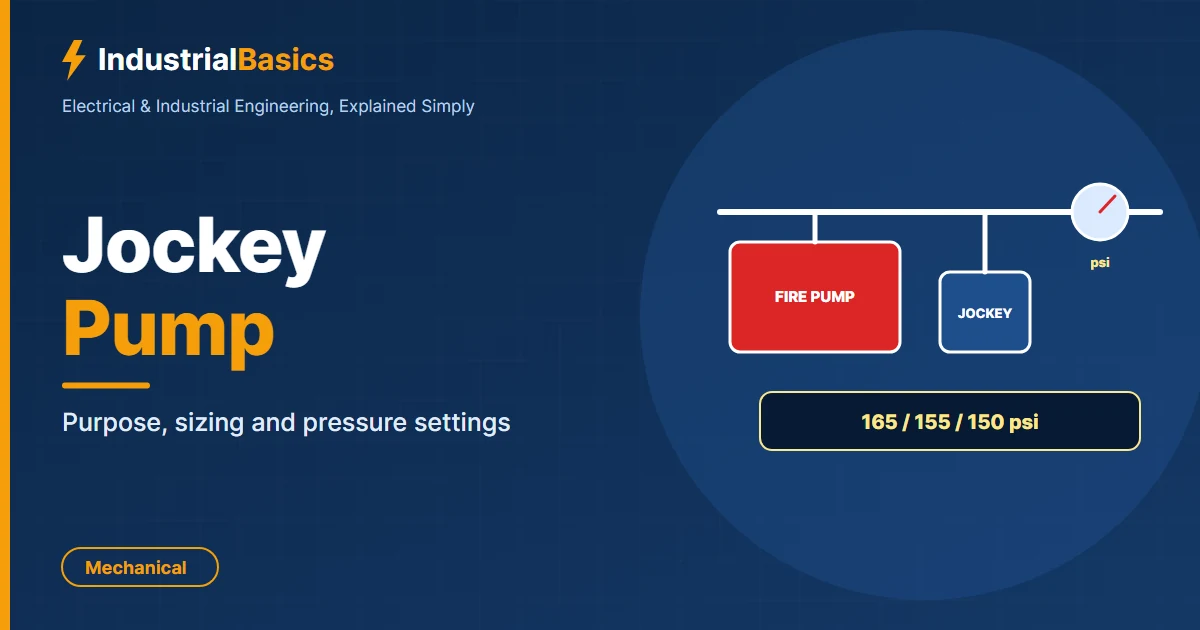
A jockey pump is a small pressure-maintenance pump that keeps a fire sprinkler or standpipe system at standby pressure. It makes up small losses from leaks, temperature changes or trapped air, so the main fire pump only starts on a real demand. It is sized for less than one sprinkler’s flow. Under the NFPA 20 annex method, the jockey stop pressure equals fire pump churn plus minimum static supply. The jockey starts at least 10 psi lower, and the fire pump starts 5 psi below that. For a 115 psi churn and 50 psi minimum static, that is 165/155/150 psi.
What a Jockey Pump Does
Wikipedia describes the jockey pump as essentially part of the fire pump’s control system. Fire pumps start automatically when sprinkler system pressure falls below a set threshold. Because water is nearly incompressible, a tiny leak or a temperature drop can lower system pressure. Without a jockey pump, the large fire pump would start on these minor losses. The jockey pump restores pressure first, and when an outlet really opens, such as a fused sprinkler, a hose valve or a deluge valve, pressure falls faster than the jockey can supply. The fire pump then starts.
Pressure Settings
| Setting | Rule (NFPA 20 annex) | Example |
|---|---|---|
| Jockey pump stop | Fire pump churn + minimum static supply | 115 + 50 = 165 psi |
| Jockey pump start | At least 10 psi below jockey stop | 165 − 10 = 155 psi |
| Fire pump stop | Churn + minimum static (if automatic stop is used) | 165 psi |
| Fire pump start | 5 psi below jockey start; 10 psi steps for each additional pump | 155 − 5 = 150 psi |
| Maximum churn | Churn + maximum static supply | 115 + 60 = 175 psi |
Pressure Settings Calculator
Sizing and Selection
- Flow: less than one sprinkler, so a single operating sprinkler still drops pressure enough to start the fire pump (Wikipedia).
- Pressure: able to reach the jockey stop setting (churn plus minimum static) at its low flow.
- Type: usually a small multistage centrifugal pump, not required to be listed for fire service; its controller may be approved (Wikipedia).
- Controls: a pressure-sensing controller with start/stop settings and, often, a minimum run timer to prevent short-cycling.
Fire Pumps in Brief
Fire pumps raise water-supply pressure when hydraulic calculations show the supply cannot meet the system design, such as in tall buildings, high-pressure systems, large-demand storage occupancies or static water sources. They are listed for fire service by agencies such as UL or FM Global. They are driven by electric motors or diesel engines, sometimes with an emergency generator through a listed transfer switch (Wikipedia). For pump power, see how to calculate motor horsepower. For motor starting, see types of motor starters.
Frequently Asked Questions
What is a jockey pump?
A small pressure-maintenance pump connected to a fire sprinkler or standpipe system near the fire pump. It makes up gradual pressure losses from temperature changes, trapped air escaping or very small leaks, so the main fire pump does not start unnecessarily (Wikipedia).
What is the purpose of a jockey pump?
To keep the system pressurized at its standby setting and prevent the large fire pump from cycling on minor pressure drops; the main pump should start only on a real demand such as an open sprinkler or hose valve.
How is a jockey pump sized?
For a flow less than one sprinkler, so that an operating sprinkler causes a pressure drop large enough to start the fire pump (Wikipedia). Wikipedia also cites an Indian rule (IS 15105) of 3% of fire pump flow and 10 psi more pressure.
What pressure should a jockey pump be set at?
Using the NFPA 20 annex method: jockey stop = fire pump churn pressure + minimum static supply; jockey start at least 10 psi lower; fire pump start 5 psi below the jockey start (FPS).
Does a jockey pump need to be listed?
No. Jockey pumps are typically small multistage centrifugal pumps and do not have to be listed for fire service, though their controllers may carry approvals (Wikipedia).
What standard covers jockey pumps?
In the US, NFPA 20 covers their application with stationary fire pumps, and NFPA 25 covers inspection and testing (Wikipedia).
Why does my jockey pump keep cycling?
Frequent starts usually mean a leak, a failing check valve or relief valve, incorrect pressure settings or a too-small differential. Investigate rather than widening the settings; excessive cycling hides real leaks.
What happens if the jockey pump is too big?
An oversized jockey pump can hold pressure even with a sprinkler open, delaying or preventing the fire pump start — exactly what the “less than one sprinkler” sizing avoids.
Is a jockey pump the same as a booster pump?
No. The fire pump boosts pressure and flow for firefighting; the jockey pump only maintains standby pressure and has no firefighting capacity.
What is a minimum run timer?
A controller setting that keeps a pump running for a set time after starting so it does not short-cycle; with minimum run times the pump continues past its stop pressure until the timer expires (FPS, NFPA 20 annex).
Sources and Further Reading
- Wikipedia: Fire pump: jockey pump purpose and sizing, NFPA 20 and 25.
- Fire Protection Specialists: Fire pump settings (NFPA 20): annex pressure-setting rules and worked example.