
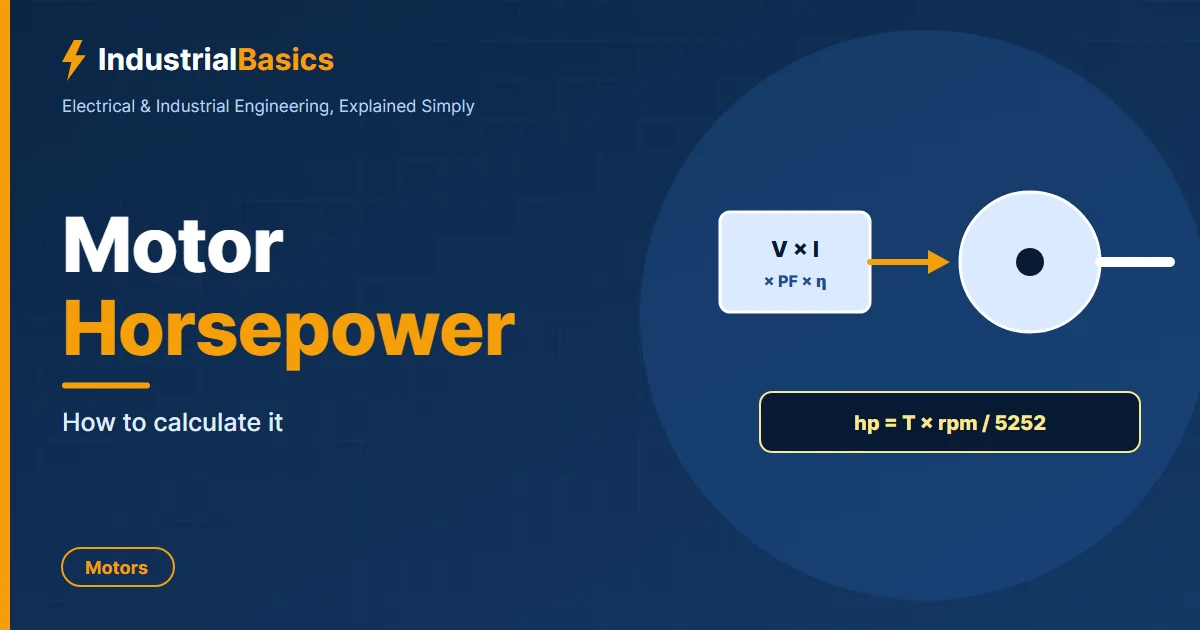
To calculate electric motor horsepower, use shaft torque and speed, hp = torque (lb·ft) × rpm ÷ 5252, or electrical input times efficiency. For three-phase, hp = √3 × volts × amps × power factor × efficiency ÷ 746. For single-phase, drop the √3. A motor’s nameplate horsepower is its rated shaft output, not the power it draws. Example: a 460 V three-phase motor at 14 A, PF 0.85 and 90% efficiency delivers about 11.4 hp (8.53 kW).
Motor Horsepower Calculator
Method 1: Read the Nameplate
Motor nameplates show the available shaft power output, not the electrical input. In the US that output is stated in horsepower (Wikipedia). The nameplate also lists rated volts, full-load amps, rpm, frame, efficiency and service factor. For frame meaning, see the motor frame size chart, and for nameplate amps, FLA meaning.
Method 2: From Torque and Speed
The 5252 constant is 33,000 ft·lbf/min divided by 2π (Wikipedia). Engineering ToolBox gives the equivalent forms, torque in lb·in = hp × 63,025 / rpm and torque in N·m = W × 9.549 / rpm, with examples. A 100 hp motor at 1,000 rpm produces 6,302.5 lb·in (525 lb·ft), and a 750 W motor at 2,000 rpm produces 3.58 N·m. An electric motor produces torque from zero speed, while power is zero at standstill.
Method 3: From Volts, Amps and Efficiency
Electrical input is √3 × V × I × PF for three-phase (see 3-phase calculations). Multiplying by efficiency η gives shaft output, and dividing by 746 W per electrical horsepower gives hp. Use current measured under the actual load to find what the motor is really delivering. The nameplate amps only represent full load.
Method 4: Pump and Hydraulic Horsepower (BHP)
Wikipedia gives hydraulic horsepower as pressure in psi times flow in US gpm divided by 1714. A pump needs more shaft power than it delivers to the fluid, so brake horsepower is hydraulic horsepower divided by pump efficiency. Brake horsepower is measured at the shaft with a brake-type (load) dynamometer, such as a water-brake dyno. For pumps and fans on drives, see VFDs in HVAC.
Horsepower Units Compared
| Unit | Watts | Use |
|---|---|---|
| Mechanical (imperial) hp | ≈ 745.7 | US motor and engine ratings |
| Electrical hp | 746 (exact) | Electrical machinery |
| Metric hp (PS, cv) | ≈ 735.5 | European engine ratings |
| Boiler hp | ≈ 9,809.5 – 9,811 | Steam boiler output (see boiler horsepower) |
For the full-load current used in NEC conductor and overload sizing, use the NEC motor FLA table rather than the formula.
For pressure-maintenance pumps in fire protection systems, see our guide to the jockey pump.
Frequently Asked Questions
How do you calculate the horsepower of an electric motor?
Three ways: read the nameplate (rated shaft output), measure torque and speed (hp = T × rpm ÷ 5252, with T in lb·ft), or calculate from electrical input: shaft hp = √3 × V × I × PF × efficiency ÷ 746 for three-phase.
What is the formula for motor hp from amps and volts?
Three-phase: hp = 1.732 × V × I × PF × eff ÷ 746. Single-phase: hp = V × I × PF × eff ÷ 746. Use measured current under the actual load to find the actual output.
What does the 5252 constant mean?
It is 33,000 ft·lbf/min divided by 2π: at 5,252 rpm, torque in lb·ft and horsepower are numerically equal (Wikipedia).
How many watts are in one horsepower?
One mechanical (imperial) horsepower is about 745.7 W; one electrical horsepower is exactly 746 W; one metric horsepower (PS) is about 735.5 W (Wikipedia).
Does the nameplate hp mean input power?
No. Motor nameplates state the available shaft power output, not the electrical input (Wikipedia). Input is higher by the losses.
What is brake horsepower (bhp)?
Power measured with a brake-type (load) dynamometer at the shaft (Wikipedia). For pumps, brake horsepower is the shaft power the pump needs: hydraulic hp divided by pump efficiency.
How do I calculate pump horsepower?
Hydraulic hp = psi × gpm ÷ 1714 (Wikipedia). Divide by pump efficiency for brake horsepower, then choose a motor at or above it.
How much current does a 10 hp 480 V motor draw?
For sizing conductors and protection, use the NEC tables rather than the formula: see our NEC motor FLA table. The formula gives actual current only if you know the real efficiency and power factor.
Is hp to bhp a conversion?
Not a fixed one. Brake horsepower is measured output at the shaft; the difference from other horsepower figures depends on where and how power is measured.
What is a fractional horsepower motor?
A motor rated below 1 hp, such as 1/4, 1/3 or 1/2 hp, typically small single-phase motors.
Sources and Further Reading
- Wikipedia: Horsepower: unit definitions, 5252 constant, electrical, hydraulic and brake horsepower.
- Engineering ToolBox: Electric motors, torque vs power and speed: torque equations and examples.



