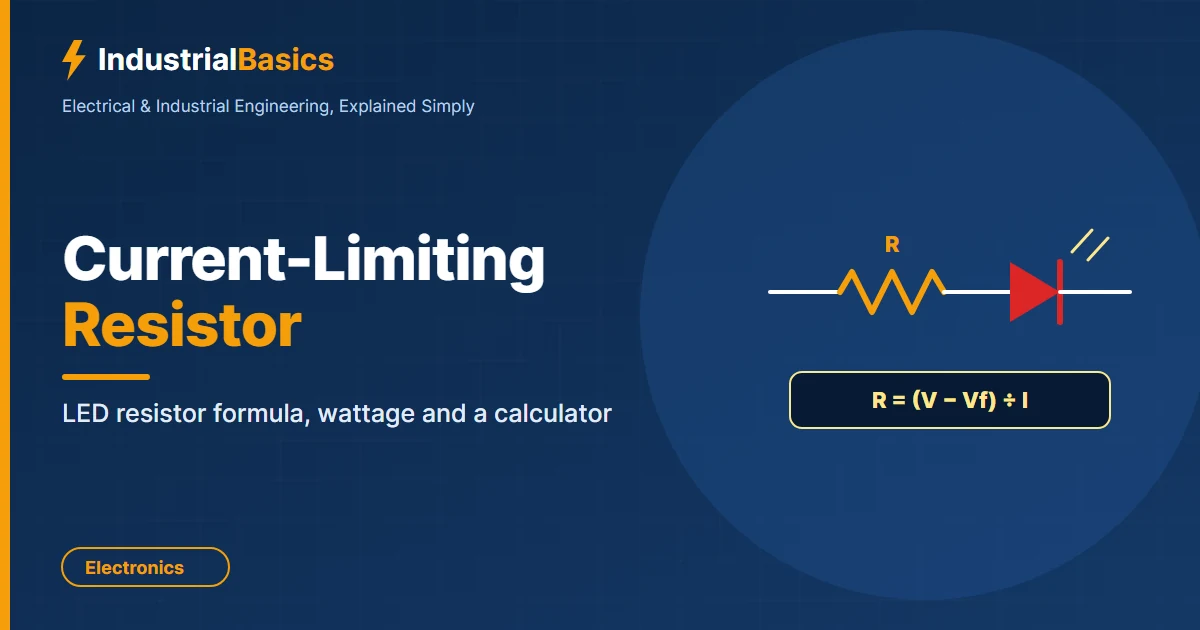
A current-limiting resistor is a resistor in series with an LED (or another load) that sets and caps the current. Size it with R = (Vsupply − Vf) ÷ I, then round up to the next standard value and check the power P = I² × R. An LED’s forward voltage stays almost constant, so without a resistor a small rise in supply voltage causes a large rise in current that can destroy it (Wikipedia, LED circuit). For example, a 2 V red LED at 10 mA needs 300 Ω (use 330 Ω) on 5 V and 2,200 Ω on 24 V.
Why an LED Needs a Current-Limiting Resistor
An LED behaves like any diode: current rises roughly exponentially with voltage (the Shockley diode equation). Below the threshold it stays dark. Just above it, a small increase in voltage pushes the current past the rating, and the LED overheats. As an LED warms, its voltage drop falls, which encourages even more current. A series resistor makes the current depend mainly on the resistor, not on the LED’s steep curve. That is why the series resistor is the standard way to drive indicator LEDs.
Current-Limiting Resistor Formula
Wikipedia gives the full form, including the drop across a switching transistor (VCE(sat) for a BJT, or zero for a mechanical switch). Its worked examples, with Vf = 1.8 V:
| Supply | Current | Calculation | Result |
|---|---|---|---|
| 12 V | 5 mA | (12 − 1.8) ÷ 0.005 | 2,040 Ω → 2 kΩ |
| 9 V | 5 mA | (9 − 1.8) ÷ 0.005 | 1,440 Ω → 1.5 kΩ |
| 5 V | 1 mA | (5 − 1.8) ÷ 0.001 | 3,200 Ω → 3.3 kΩ |
| 3.3 V | 1 mA | (3.3 − 1.8) ÷ 0.001 | 1,500 Ω |
| 24 V (PLC) | 10 mA | (24 − 2.0) ÷ 0.010 | 2,200 Ω, 0.22 W |
LED forward voltage by color
| LED | Typical Vf (V) |
|---|---|
| Infrared | ≈ 1.2 |
| Red | 1.7–2.0 |
| Violet | 2.8–4.0 |
| Other colors | Between red and violet: Vf rises with photon energy (shorter wavelength) |
Current-Limiting Resistor Calculator
Choosing a Standard Value and Wattage
Calculated values rarely match a stock resistor. The E12 series (10% steps) gives 1.0, 1.2, 1.5, 1.8, 2.2, 2.7, 3.3, 3.9, 4.7, 5.6, 6.8 and 8.2 in every decade, and E24 halves the steps (Wikipedia, E series). Rounding up keeps the current at or below your target. LEDs are bright well below their maximum, and Wikipedia notes that many circuits run them under the 20 mA rating to save power or reduce brightness.
Then check heat. The resistor dissipates P = I² × R, all of it wasted. On 24 V a single 10 mA indicator loses about 0.22 W in the resistor, more than a typical 1/4 W through-hole part should run continuously. That waste is why a series resistor is fine for indicators but not for lighting.
Series and Parallel LEDs
- Series strings: one resistor per string. The supply must exceed the sum of the forward voltages; Wikipedia notes the LED voltages often add up to about two-thirds of the supply.
- Parallel: give every LED or string its own resistor. Forward voltages vary between parts, so a shared resistor lets one LED hog the current.
- Multiplexed displays: each segment line needs its own resistor; see the 7 segment display pinout guide.
- Built-in resistors: some LEDs and most panel pilot lights include one. Adding another dims them.
Other Meanings of “Current Limiting”
- Burden resistor: a precision resistor that turns a loop current into a voltage. 250 Ω converts 4–20 mA to 1–5 V; see 4–20 mA control loops.
- Inrush current limiter: a resistor or NTC thermistor that limits switch-on surge into capacitors and transformers (Wikipedia).
- Active current limiting: power supplies sense current with a small resistor and throttle the output; with 0.65 V across a 0.33 Ω sense resistor the limit is about 2 A (Wikipedia).
- Current-limiting fuses and breakers: overcurrent devices that cut fault current well below the prospective value; see fuse vs circuit breaker.
Frequently Asked Questions
What is a current-limiting resistor?
A resistor placed in series with a load, usually an LED, to keep the current below a safe level. The voltage across an LED stays almost constant, so a small rise in supply voltage would greatly increase the current without it (Wikipedia, LED circuit).
How do you calculate a current-limiting resistor?
R = (Vsupply − Vf) ÷ I. For a 12 V supply, an LED with Vf of 1.8 V and 5 mA: (12 − 1.8) ÷ 0.005 = 2,040 Ω, so a 2 kΩ resistor (Wikipedia).
What resistor do I need for an LED on 5 V?
With a red LED (about 2 V) at 10 mA: (5 − 2) ÷ 0.010 = 300 Ω, so use 330 Ω. SparkFun suggests 330 Ω as a good starting value for most LEDs.
What resistor do I need for an LED on 24 V?
At 10 mA with a 2 V LED: (24 − 2) ÷ 0.010 = 2,200 Ω, dissipating 0.22 W, so use at least a 1/2 W resistor. Many PLC pilot lights have the resistor built in, so check before adding one.
Is a 220 Ω resistor OK for an LED?
On 5 V with a 2 V red LED it gives (5 − 2) ÷ 220 ≈ 13.6 mA, within the 20 mA rating common for small LEDs. On 3.3 V it gives about 5.9 mA. On 12 V it would be about 45 mA, which is too much.
Does the resistor go before or after the LED?
Either. In a series circuit the same current flows through both, so the resistor works on the anode or cathode side.
Can one resistor serve several LEDs?
Yes for LEDs in series: subtract all their forward voltages. For LEDs in parallel, give each its own resistor, because unmatched forward voltages make the currents uneven (Wikipedia).
What wattage resistor do I need?
Calculate P = I² × R (or VR × I) and choose a rating comfortably above it. 20 mA through 470 Ω is 0.19 W, so a 1/4 W part would run near its limit, and 1/2 W is better.
What is a 250 Ω burden resistor for?
It converts a 4–20 mA current loop into a voltage: by Ohm’s law, 4 mA × 250 Ω = 1 V and 20 mA × 250 Ω = 5 V, the 1–5 V signal many analog inputs read.
What is a current-limiting fuse or breaker?
A different meaning in power systems: an overcurrent device that, within its current-limiting range, cuts fault current to much less than would otherwise flow. The 2020 NEC defines the term (Wikipedia, Current limiting).
Sources and Further Reading
- Wikipedia: LED circuit: series resistor formula, examples, forward voltages, LED arrays.
- Wikipedia: Current limiting: inrush limiting, active limiting, NEC definition.
- Wikipedia: E series of preferred numbers: E12 and E24 values.
- SparkFun: Light-Emitting Diodes (LEDs): data sheet ratings and the 330 Ω starting value.