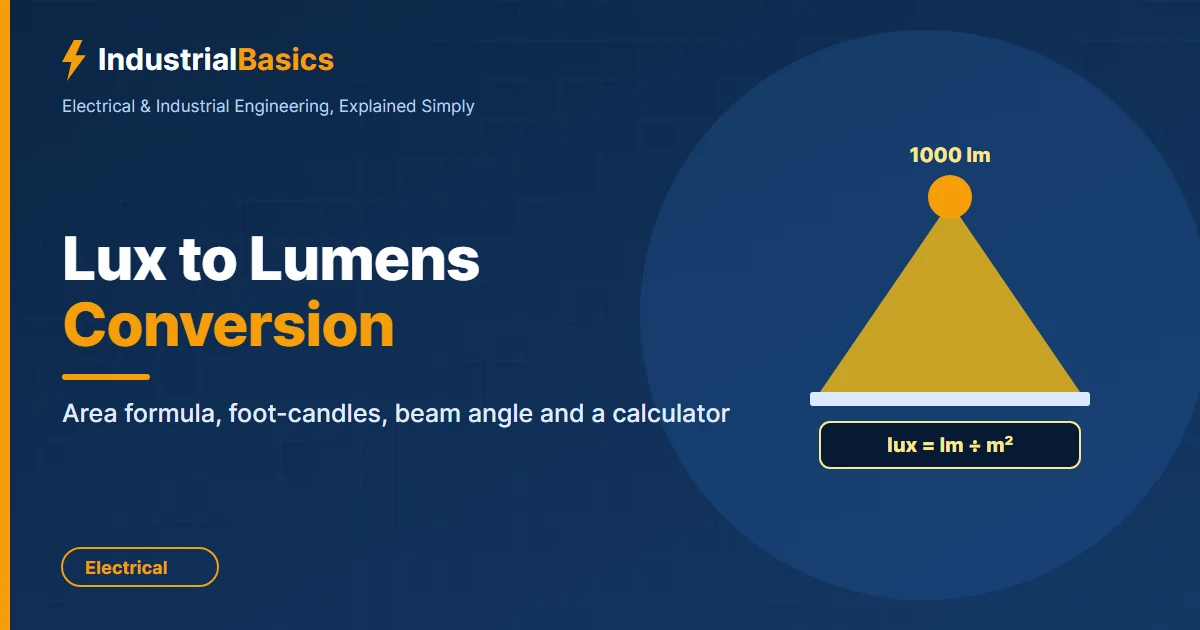
To convert lumens to lux, divide by the area in square meters: lux = lumens ÷ m². To convert lux to lumens, multiply: lumens = lux × m². One lux is one lumen per square meter, so 1,000 lumens spread over 1 m² gives 1,000 lux, and the same 1,000 lumens over 10 m² gives only 100 lux (Wikipedia). There is no conversion without an area. Lumens are the total light emitted, while lux is how much falls on each square meter. In US units, lumens ÷ ft² gives foot-candles, and 1 fc = 10.764 lux.
Lux vs Lumens
| Lumen (lm) | Lux (lx) | Foot-candle (fc) | |
|---|---|---|---|
| Measures | Luminous flux: total visible light from a source | Illuminance: light falling on a surface | Illuminance (US unit) |
| Definition | 1 cd × 1 sr | 1 lm/m² | 1 lm/ft² |
| Depends on area? | No | Yes | Yes |
| Where you see it | Lamp and fixture ratings | Lux meters, lighting design (SI) | US lighting design |
Wikipedia gives a practical example: a home kitchen might reach 500 lux with a single fluorescent fixture of about 12,000 lumens. A factory floor many times larger needs proportionally more fixtures to reach the same lux. Lighting a larger area to the same illuminance takes more lumens.
Lumens to Lux with a Beam Angle
Spotlights and high-bay fixtures concentrate their lumens in a cone. To find the lux on a surface, first find the solid angle of the cone. For a full beam angle θ, Ω = 2π(1 − cos(θ/2)) steradians (Wikipedia, Solid angle). The intensity in candela is lumens ÷ Ω, and the illuminance straight below is candela ÷ distance². An 800 lm lamp with a 60° beam covers 0.842 sr, giving 950 cd and about 238 lux at 2 m. At 4 m it falls to a quarter, about 59 lux. This is the inverse-square law.
Lux and Lumens Calculator
Typical Illuminance Levels
| Condition | Lux | Foot-candles (approx.) |
|---|---|---|
| Full moon, clear night | 0.05–0.3 | 0.00–0.03 |
| Public areas, dark surroundings | 20–50 | 2–5 |
| Office hallway / toilet | 80 | 7 |
| Very dark overcast day | 100 | 9 |
| Railway platform | 150 | 14 |
| Office lighting | 320–500 | 30–46 |
| Sunrise or sunset, clear day | 400 | 37 |
| Overcast day; TV studio | 1,000 | 93 |
| Full daylight (not direct sun) | 10,000–25,000 | 929–2,323 |
| Direct sunlight | 32,000–100,000 | 2,973–9,290 |
Why PAR and Watts Don’t Convert Directly to Lux
Lux and lumens are photometric units. They weight each wavelength by the luminosity function, a model of human brightness perception that peaks at 555 nm (green). Radiometric units such as W/m² weight all wavelengths equally. Wikipedia notes there is no single conversion between lux and W/m²: at 555 nm, 1 W/m² gives 683 lux, and every other wavelength gives less. PAR is different again. It counts photons between 400 and 700 nm as PPFD in μmol/m²/s, because plants do not see light the way people do. Converting PAR to lux therefore needs the spectrum of the specific lamp.
Practical Tips
- Measure at the work plane, such as a desk, bench or floor, with a lux meter; that is the number design levels refer to.
- Allow for losses: lumens from the fixture are more than lumens on the surface. Add margin for dirt and lamp aging.
- Use the right unit: US plans often give foot-candles. Divide lux by 10.764, or roughly by 10.
- Electrical rooms: working space around panels must be lit; see electrical panel clearance.
- Machine safety: ambient light can affect optical safety devices; see light curtain safety relays.
Frequently Asked Questions
How do you convert lumens to lux?
Divide lumens by the area in square meters: lux = lm ÷ m². 1,000 lumens spread evenly over 10 m² gives 100 lux (Wikipedia). For square feet, lm ÷ ft² gives foot-candles.
How do you convert lux to lumens?
Multiply lux by the area in square meters: lm = lx × m². Lighting a 20 m² room to 500 lux needs 10,000 lumens reaching the work surface, and more from the fixtures to cover losses.
Is 1 lux equal to 1 lumen?
Only over one square meter. A lux is one lumen per square meter, so the conversion always needs an area. Lumens measure the total light a source emits. Lux measures how much of it lands on each square meter.
How many lux is a foot-candle?
One foot-candle is about 10.764 lux, and one lux is 0.0929 fc (Wikipedia). For rough room measurements, 1 fc ≈ 10 lux is usually close enough.
How many lumens are in a candela?
A candela is a lumen per steradian. An isotropic 1 cd source emits 4π ≈ 12.57 lumens in total (Wikipedia). For a beam, multiply candela by the beam’s solid angle in steradians.
How do I find lux from a bulb’s lumens and beam angle?
Work out the solid angle of the beam, Ω = 2π(1 − cos(θ/2)) where θ is the full beam angle, then candela = lm ÷ Ω and lux = cd ÷ distance². For 800 lm in a 60° beam at 2 m that is about 238 lux.
Can you convert PAR to lux?
Not with a single factor. PAR (PPFD, μmol/m²/s) counts photons from 400–700 nm equally, while lux weights light by the human eye’s green-biased sensitivity (Wikipedia). The conversion depends on the light’s spectrum, so it differs between sunlight and each grow lamp.
Can you convert lux to watts per square meter?
Only if you know the spectrum. At 555 nm, 1 W/m² = 683 lux, the maximum. White light gives far fewer lux per W/m² (Wikipedia).
How many lux does an office need?
Wikipedia lists office lighting at about 320–500 lux. Design levels for a given task should come from the applicable lighting standard or code.
Why does a meter read less than lumens ÷ area?
Fixtures lose light in reflectors and lenses, not all of it reaches the work surface, and dirt and lamp aging reduce output. Designers allow for these with utilization and maintenance factors.
Sources and Further Reading
- Wikipedia: Lux: definition, example levels, lux vs W/m².
- Wikipedia: Lumen (unit): lumen, candela and steradian.
- Wikipedia: Foot-candle.
- Wikipedia: Solid angle: solid angle of a cone.
- Wikipedia: Photosynthetically active radiation: PAR and PPFD.