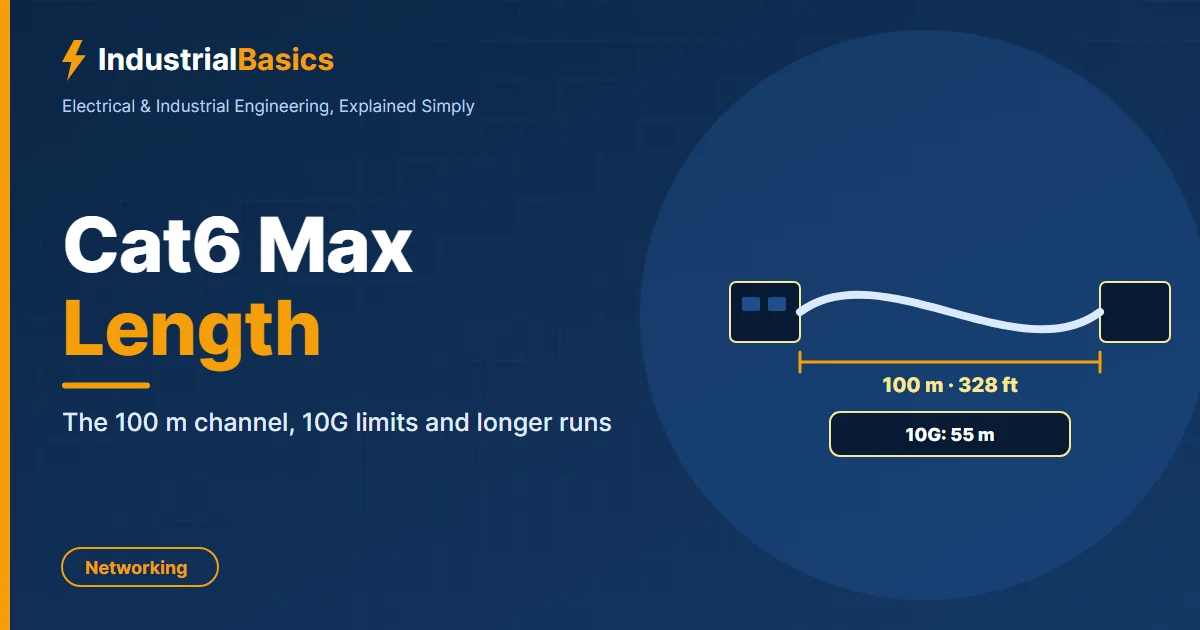
The maximum length of a Cat6 cable run is 100 meters (328 ft) for 10/100/1000BASE-T Ethernet. That is up to 90 m (295 ft) of solid horizontal cable plus 10 m (33 ft) of patch cords in total. At 10 Gb/s (10GBASE-T), Cat6 is limited to 55 m (180 ft). For 10 Gb/s over the full 100 m, use Cat6A. These limits come from the TIA-568 cabling standard as summarized on Wikipedia. They assume compliant pure-copper cable that is installed and terminated correctly.
Cat6 Maximum Length by Speed
| Ethernet standard | Speed | Cat 5e | Cat 6 | Cat 6A |
|---|---|---|---|---|
| 10BASE-T / 100BASE-TX / 1000BASE-T | 10 Mb/s – 1 Gb/s | 100 m (328 ft) | 100 m (328 ft) | 100 m (328 ft) |
| 2.5GBASE-T | 2.5 Gb/s | 100 m (328 ft) | 100 m (328 ft) | 100 m (328 ft) |
| 5GBASE-T | 5 Gb/s | Expected to work in most cases | 100 m (328 ft) | 100 m (328 ft) |
| 10GBASE-T | 10 Gb/s | Not specified | 55 m (180 ft) | 100 m (328 ft) |
Cat 6 is specified to 250 MHz, compared with 100 MHz for Cat 5e, with tighter crosstalk and noise limits. Cat 6A doubles that to 500 MHz and adds an alien crosstalk specification. That is why it carries 10GBASE-T the full 100 m, while Cat 6 manages 55 m (Wikipedia). Lower-grade cable can work at shorter lengths: Wikipedia notes 10GBASE-T on Cat 6 up to 55 m, and 5GBASE-T is expected to work on Cat 5e in most cases.
How the 100 m Limit Is Made Up
The standard measures a channel, the whole path from the switch port to the device. The permanent link is the solid horizontal cable between two connectors, usually the patch panel and the wall jack, and it may be up to 90 m. The remaining 10 m is shared by the patch cords at both ends. A 95 m horizontal run with short cords is therefore out of spec even if the total stays under 100 m.
Cat6 Run Length Checker
Going Beyond 100 Meters
- Add a switch: each twisted-pair Ethernet link is point-to-point, so a switch partway along starts a fresh 100 m segment. Remember it needs power and a protected location.
- Use fiber: the usual choice between buildings, along long conveyor lines or through electrically noisy areas. Many switches have SFP uplink ports for this; see uplink ports.
- Extenders: some products push Ethernet farther, but they operate outside the TIA standard (Wikipedia notes manufacturer claims beyond 100 m), so check their rated speed and PoE budget.
Installation Rules That Affect Distance
- Bend radius: larger than four times the cable’s outer diameter; no kinks.
- Terminations: keep pairs twisted to the connector and strip the jacket back no more than 13 mm (0.51 in).
- Matched components: use Cat 6 rated jacks, patch panels and cords; mixing grades degrades performance.
- Pure copper: Cat 6 requires pure copper conductors; copper-clad aluminum (CCA) is non-compliant.
- Same scheme both ends: T568A or T568B work equally well if both ends match.
All of these come from Wikipedia’s Category 6 article. A cable certifier can verify an installed link against the standard. For protocols that run on these links, see PROFINET and Modbus TCP; for longer serial runs, RS-485 wiring reaches much farther at low data rates.
Frequently Asked Questions
What is the maximum length of Cat6 cable?
100 meters (328 ft) for 10/100/1000BASE-T: up to 90 m (295 ft) of solid horizontal cable plus 10 m (33 ft) of patch cords in total (Wikipedia, citing TIA-568.2-D).
How far can Cat6 run at 10 Gb/s?
55 meters (180 ft) for 10GBASE-T. For 10 Gb/s over the full 100 m, use Cat 6A, which is specified to 500 MHz with better alien crosstalk performance (Wikipedia).
Is the Cat6 limit 100 m or 328 ft?
Both: 100 m equals 328 ft. Some sources round to 330 ft.
What is Cat6e and how far can it run?
Cat 6e is not a recognized standard. It is a marketing name for cable claiming headroom above Cat 6 (Wikipedia). Plan it as Cat 6: 100 m, or 55 m for 10 Gb/s.
What happens if Cat6 is longer than 100 m?
The link may not come up, may fall back to a lower speed, or may show errors and drops. Manufacturer claims beyond 100 m fall outside the TIA standard (Wikipedia).
How do I run Ethernet farther than 100 m?
Break the run with a switch, since each Ethernet link is point-to-point between ports, or use fiber for long runs between buildings or noisy areas.
Why are patch cords limited to 10 m?
Patch cords are stranded for flexibility, while the permanent link is solid cable. The channel model allows 90 m of solid cable plus 10 m of cords to stay within 100 m (Wikipedia).
Does copper-clad aluminum (CCA) affect Cat6 distance?
Cat 6 requires pure copper conductors; CCA cable is non-compliant (Wikipedia), so it cannot be relied on to meet Cat 6 performance at full length, especially with PoE.
Why does a CCTV camera show video loss on a long cable?
Common causes are a run over 100 m, poor terminations, non-compliant cable or insufficient PoE power at the far end. Test the cable, shorten the run or add a switch or extender.
Does shielded Cat6 run farther?
No, the length limit is the same. Shielding helps in high-EMI environments such as plants, but the shield must be continuous and bonded, and ground loops can inject noise (Wikipedia).
Sources and Further Reading
- Wikipedia: Category 6 cable: maximum length, Cat 6A, Cat 6e, installation requirements.
- Wikipedia: Ethernet over twisted pair: cable categories and lengths for each speed.