
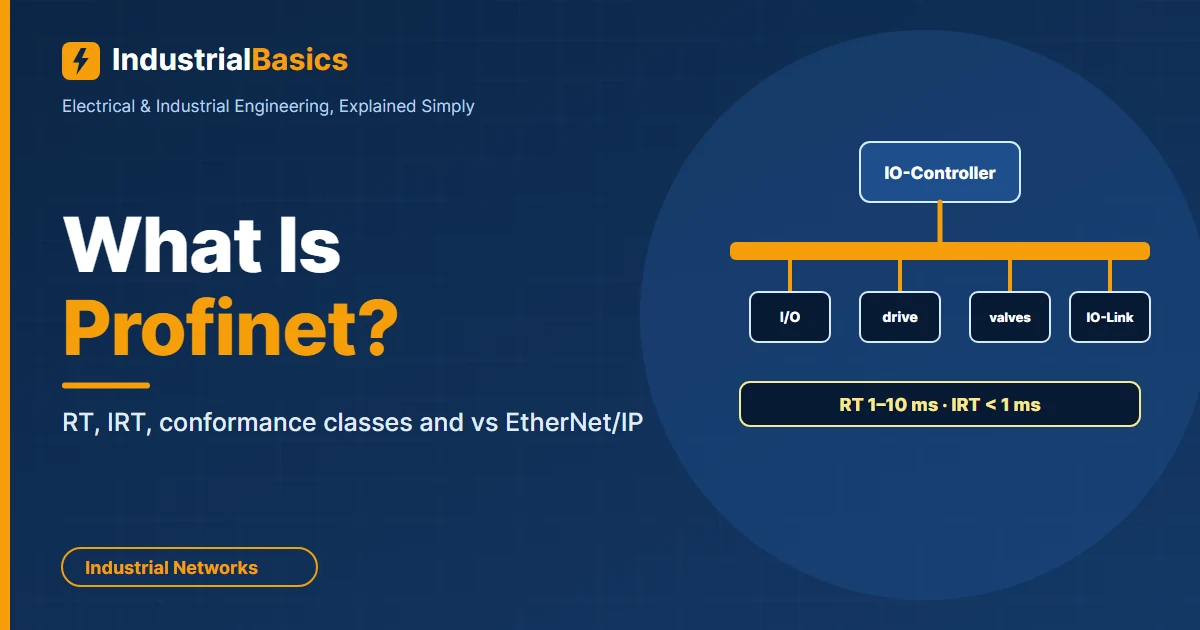
Profinet (Process Field Network) is an Industrial Ethernet standard, IEC 61158 and IEC 61784-2, for real-time data exchange between controllers (IO-Controllers) and field devices (IO-Devices). It runs on standard Ethernet hardware and adds real-time (RT, about 1–10 ms) and isochronous real-time (IRT, under 1 ms) communication, plus diagnostics, alarms, safety (PROFIsafe) and redundancy. It is the Ethernet successor to Profibus. Its main rival in the US is EtherNet/IP.
How Profinet Works
Wikipedia describes Profinet as defining the entire data exchange between controllers (IO-Controllers) and devices (IO-Devices), plus parameter setting and diagnostics. A minimal system has one IO-Controller and one or more IO-Devices; an IO-Supervisor PC connects when needed for engineering. The controller and each device set up an Application Relation. Within it, Communication Relations carry parameters, cyclic I/O data and alarms. A device can be both a controller and a device at once, which lets controllers exchange data.
| Protocol | Use | Typical cycle |
|---|---|---|
| RT (Real-Time) | Cyclic I/O for conformance classes A and B | About 1–10 ms |
| IRT (Isochronous Real-Time) | Class C: bandwidth reservation and synchronization | Below 1 ms (drives, motion) |
| TSN | Class D: Time-Sensitive Networking on layer 2 | Same functions as CC-C |
| RPC over UDP/IP | Connection setup, acyclic parameters and diagnostics | — |
Profinet Conformance Classes
| Class | What is certified | Communication | Typical use |
|---|---|---|---|
| CC-A | Devices only; any infrastructure (even WLAN) | RT, alarms | Infrastructure, building, simple machines |
| CC-B | Devices plus Profinet-structured, certified network | RT; managed switches, topology and diagnostics | Most factory automation |
| CC-C | As B, plus IRT-capable devices | RT + IRT bandwidth reservation | Positioning and motion control |
| CC-D | TSN-based | All traffic on Ethernet layer 2 via TSN | Converged networks |
Conformance Class Selector
Profinet vs EtherNet/IP vs Profibus vs Modbus TCP
| Profinet | EtherNet/IP | Profibus DP | Modbus TCP | |
|---|---|---|---|---|
| Organization | PROFIBUS & PROFINET International | ODVA | PROFIBUS & PROFINET International | Modbus Organization |
| Physical layer | Ethernet | Ethernet | RS-485 (EIA-485) | Ethernet |
| Speed | 100 Mbit/s Ethernet and up | Ethernet | 9.6 kbit/s–12 Mbit/s | Ethernet |
| Real-time data | Layer 2 RT / IRT | CIP implicit messaging over UDP 2222 | Token passing + master/slave | Polled over TCP 502 |
| Device description | GSDML file | Device profiles (CIP objects) | GSD file | Device register map |
| Under 1 ms sync | IRT / TSN (CC-C, CC-D) | — | — | Not designed for it |
Wikipedia notes EtherNet/IP is one of the leading industrial protocols in the US, with about 30% of the industrial Ethernet market in 2010 and 2018. It carries CIP over TCP port 44818 (explicit messaging) and UDP port 2222 (implicit I/O). In practice the choice is usually set by the PLC platform already used on site, and many field devices are offered in versions for more than one protocol. For a simpler open protocol, see Modbus RTU vs Modbus TCP.
Profinet Features
- Engineering: device properties come from the maker’s GSDML file, imported into the engineering tool. The workflow is nearly identical to Profibus.
- Diagnostics and topology: an extended LLDP lets devices report their neighbors and even cable propagation time. Wireshark can decode Profinet frames.
- Safety: PROFIsafe (IEC 61784-3-3) adds a safety layer on the same network and cables.
- Redundancy: MRP rings switch over in under 50 ms; system redundancy uses two controllers for one device.
- Profiles: PROFIdrive for drives, PROFIenergy for energy management, and integration profiles for IO-Link and other subsystems.
Before devices can talk Profinet or EtherNet/IP they need an IP address; see BOOTP vs DHCP for how addresses are assigned.
Profinet class B networks rely on managed switches; see managed vs unmanaged switches for what the difference means in practice.
Frequently Asked Questions
What is Profinet?
Profinet (Process Field Network) is an Industrial Ethernet standard (IEC 61158 / IEC 61784-2) for exchanging data between controllers and field devices, designed to deliver data under tight time constraints. It is maintained by PROFIBUS & PROFINET International (PI).
What is the difference between Profinet and Ethernet?
Ethernet is the cabling and frame standard; Profinet is a protocol that runs on it. Profinet uses standard Ethernet hardware but adds real-time (RT) and isochronous (IRT) communication, diagnostics and alarms for automation.
What is the difference between Profinet and EtherNet/IP?
Both are Industrial Ethernet protocols. Profinet comes from the PROFIBUS world (PI) and sends real-time data directly on Ethernet layer 2; EtherNet/IP, managed by ODVA, carries the Common Industrial Protocol (CIP) over TCP (port 44818) and UDP (port 2222). EtherNet/IP is one of the leading protocols in the US.
What is the difference between Profibus and Profinet?
Profibus is a serial fieldbus: Profibus DP runs on RS-485 at 9.6 kbit/s to 12 Mbit/s, and Profibus PA at 31.25 kbit/s for hazardous process areas. Profinet runs on Industrial Ethernet. Engineering “look and feel” is similar, with GSD files for both.
What are Profinet RT and IRT?
RT (real-time) is the standard cyclic exchange for conformance classes A and B, with cycle times of about 1–10 ms. IRT (isochronous real-time), used in class C, reserves bandwidth and synchronizes devices for cycle times below 1 ms, for example in drives and motion.
What are Profinet conformance classes?
IEC 61784-2 defines CC-A (certified devices on any infrastructure), CC-B (certified, Profinet-structured infrastructure with managed switches), CC-C (adds IRT bandwidth reservation and synchronization) and CC-D (Profinet over Time-Sensitive Networking).
What is a GSDML file?
The General Station Description file a device maker supplies, written in the XML-based GSDML language. The engineering tool imports it to know the device’s modules, parameters and diagnostics.
What is an IO-Controller and an IO-Device?
The IO-Controller (usually a PLC) runs the automation program; IO-Devices are field devices it controls, such as remote I/O, drives and valve islands. An IO-Supervisor is a PC used for setup and diagnostics.
Does Profinet support safety and redundancy?
Yes. PROFIsafe adds safety communication on the same network (IEC 61784-3-3). Media Redundancy Protocol (MRP) builds rings that switch over in under 50 ms, and system redundancy lets two controllers control the same device.
Can Profinet and Modbus TCP share a network?
Yes. Both run on standard Ethernet, so they can share infrastructure, though Profinet real-time traffic benefits from managed switches and a well-structured network.
Sources and Further Reading
- Wikipedia: PROFINET: standards, IO system, conformance classes, RT/IRT/TSN, GSDML, PROFIsafe, MRP, profiles.
- Wikipedia: EtherNet/IP: CIP, ODVA, ports 44818 and 2222, market share.
- Wikipedia: Profibus: DP and PA, RS-485 speeds, token passing.



