
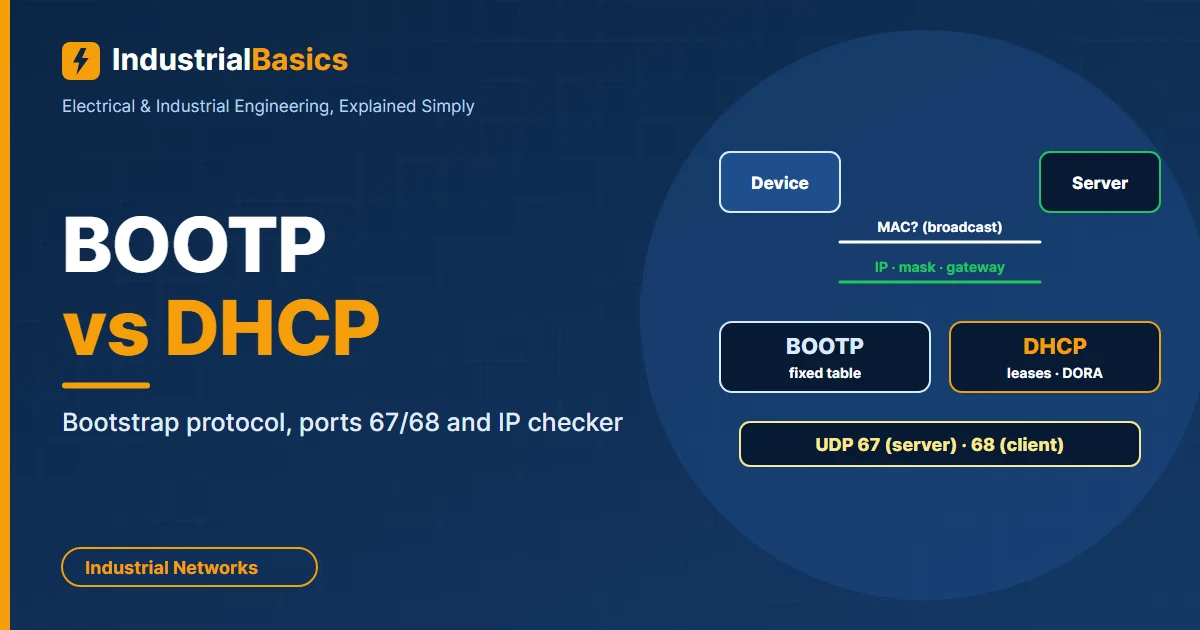
BOOTP (Bootstrap Protocol, RFC 951, 1985) and DHCP (Dynamic Host Configuration Protocol, 1993) both give a device its IP address automatically over UDP ports 67 and 68. BOOTP hands out addresses from a fixed MAC-to-IP table with no expiry. DHCP grew out of BOOTP and adds dynamic pools, leases, address reuse and many more options. DHCP servers can answer BOOTP clients. In industrial networks, BOOTP or DHCP is often used just to commission a device’s IP address, which is then kept fixed.
BOOTP vs DHCP Comparison
| BOOTP | DHCP | |
|---|---|---|
| Defined | RFC 951, 1985 | October 1993; IPv4 RFC 2131 |
| Address source | Administrator’s MAC-to-IP table | Dynamic pool, automatic or manual (reservation) |
| Leases | No: address kept until changed | Yes: time-limited, renewable, reclaimable |
| Messages | Request + reply | Discover, Offer, Request, Acknowledge (DORA) |
| Information returned | IP, mask, gateway, boot server and image | IP, mask, gateway, DNS and many options |
| Transport | UDP 67 (server) / 68 (client), IPv4 only | UDP 67 / 68 (IPv4); DHCPv6 for IPv6 |
| Compatibility | Clients can be served by many DHCP servers | Superset of BOOTP |
How BOOTP Works
A BOOTP client starts with no IP address, so it broadcasts a BOOTP request containing its MAC address. The BOOTP server picks it up and replies with the client’s IP address, subnet mask and default gateway, the BOOTP server’s address and host name, and the address of the server holding the boot image. The client configures its TCP/IP stack and can then load its operating system from the boot server (Wikipedia). BOOTP replaced RARP, which worked at the link layer and was harder to implement.
Because the request is a broadcast, routers drop it. A relay agent, often a router’s UDP helper address, listens on port 67 and forwards the request as a unicast datagram to the server, then returns the reply.
How DHCP Extends BOOTP
- Dynamic allocation: addresses come from a pool on a lease, so unused addresses return to the pool.
- Automatic allocation: permanent assignment from a range, with the server remembering past assignments.
- Manual allocation: also called static DHCP, fixed address, reservation or MAC/IP binding. This is effectively the BOOTP model.
- Options: BOOTP vendor extensions became DHCP option fields, so a DHCP server can still serve BOOTP clients.
IP Assignment Checker
BOOTP and DHCP on the Plant Floor
Many industrial Ethernet devices, such as PLC communication modules, remote I/O adapters, drives and HMIs, ship with BOOTP or DHCP enabled so a commissioning tool can assign the first IP address against the device’s MAC address. Controllers and I/O normally need fixed addresses because connections, HMI tags and programs refer to them. A common practice is to assign by BOOTP/DHCP once, then set the address to static in the device. Check the device manual for how it behaves if no server answers after a power cycle. For the network layer underneath, see what is Profinet and Modbus RTU vs TCP.
Plant networks almost always use private addresses; see private IP ranges for the RFC 1918 blocks and a subnet calculator.
Frequently Asked Questions
What is BOOTP?
The Bootstrap Protocol (RFC 951, 1985) lets a device with no IP address broadcast its MAC address and receive an IP address, subnet mask, default gateway and boot-server details from a BOOTP server. It runs over UDP on IPv4 only.
What is the difference between BOOTP and DHCP?
DHCP (1993) was built as an extension of BOOTP. BOOTP gives an address from a table the administrator maintains and has no leases; DHCP can allocate addresses dynamically from a pool, lease them for a set time and reclaim them, and carries many more options. DHCP servers can also answer BOOTP clients.
What ports do BOOTP and DHCP use?
Both use UDP port 67 on the server (bootps) and UDP port 68 on the client (bootpc).
Is BOOTP still used?
Yes, in places. Parts of BOOTP still underpin DHCP, some DHCP servers provide legacy BOOTP service, and many industrial devices offer BOOTP or DHCP for initial IP setup.
What is DORA in DHCP?
The four DHCP steps: Discover (client broadcast), Offer (server proposes an address), Request (client asks for it) and Acknowledge (server confirms the lease).
Can BOOTP work across routers?
Not directly, because the request is a broadcast and routers drop broadcasts. A relay agent (often a router “helper address”) listens on port 67 and forwards the request as unicast to the server.
What is a DHCP reservation?
Manual (static) allocation: the administrator maps a device’s MAC address or client ID to a fixed IP address, so the device always gets the same address. It behaves much like a BOOTP table.
What is a rogue DHCP server?
An unauthorized DHCP server handing out wrong addresses. DHCP snooping on managed switches blocks DHCP server replies on untrusted ports and builds a table of valid bindings.
Should PLCs and I/O use DHCP?
Controllers and I/O usually need fixed addresses because other devices and programs reference them. Use BOOTP/DHCP only to set the address during commissioning, or DHCP reservations, then follow the device manual for keeping the address static.
What does BOOTP stand for?
Bootstrap Protocol, from its original use: helping diskless computers get an address and the location of a boot image so they could load their operating system over the network.
Sources and Further Reading
- Wikipedia: Bootstrap Protocol: RFC 951, ports, request/reply contents, relay agents, relation to DHCP.
- Wikipedia: Dynamic Host Configuration Protocol: history, allocation methods, DORA.
- Wikipedia: DHCP snooping: protection against rogue DHCP servers.



