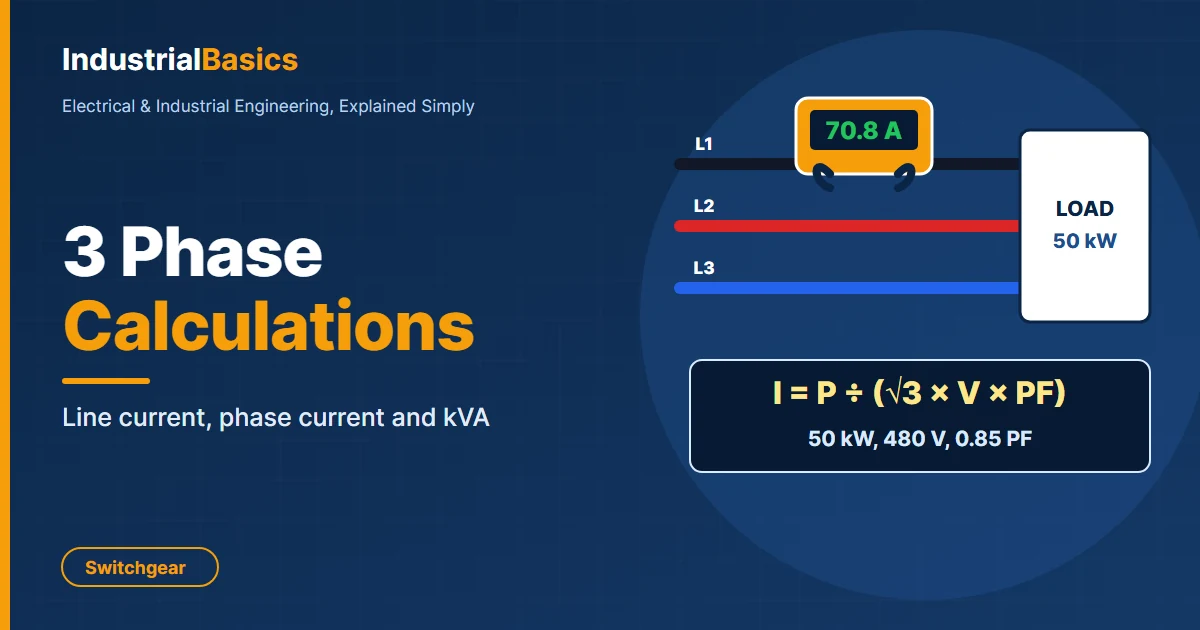
For a balanced load, three-phase line current is I = kW × 1000 ÷ (√3 × V × PF), where V is the line-to-line voltage. For example, 50 kW at 480 V and 0.85 power factor draws about 70.8 A. In a wye connection, phase current equals line current. In a delta connection, phase current is line current divided by √3.
| To find | Formula | Notes |
|---|---|---|
| Line current from kW | I = kW × 1000 ÷ (√3 × V × PF) | V is line-to-line |
| Line current from kVA | I = kVA × 1000 ÷ (√3 × V) | No PF needed |
| Real power | kW = √3 × V × I × PF ÷ 1000 | Balanced load |
| Apparent power | kVA = √3 × V × I ÷ 1000 | Also kW ÷ PF |
| Reactive power | kVAR = √(kVA² − kW²) | From the power triangle |
Three-Phase Calculator
Enter kW, kVA or line amps, along with voltage and power factor, to see the other values.
Line Current vs Phase Current
Line values are measured between or in the supply conductors. Phase values belong to each winding or load element. How they relate depends on whether the load is connected in wye or delta. Our guide to star vs delta connections explains the wiring in more detail.
| Quantity | Wye (star) | Delta |
|---|---|---|
| Line voltage | √3 × phase voltage | Equal to phase voltage |
| Phase voltage | Line voltage ÷ √3 | Equal to line voltage |
| Line current | Equal to phase current | √3 × phase current |
| Phase current | Equal to line current | Line current ÷ √3 |
| Line voltage | Wye phase voltage |
|---|---|
| 208 V | 120 V |
| 480 V | 277 V |
| 600 V | 347 V |
How to Calculate Three-Phase Current
From kW
A 50 kW balanced load at 480 V and 0.85 power factor:
From kVA
A 75 kVA load at 480 V. Power factor is not needed because kVA is already apparent power:
Finding phase current
If that 50 kW load is connected in wye, each phase carries 70.8 A at 277 V. If it is connected in delta, each phase carries 70.8 ÷ 1.732 = 40.8 A at 480 V. The line current is the same in both cases.
kW, kVA, kVAR and Power Factor
Real power (kW) does the useful work. Reactive power (kVAR) supports magnetic fields. Apparent power (kVA) is what the conductors and transformer must carry. For the 50 kW example, apparent power is 50 ÷ 0.85 = 58.8 kVA, and reactive power is 31.0 kVAR.
Worked Examples
| Load | Calculation | Result |
|---|---|---|
| 50 kW, 480 V, 0.85 PF | 50,000 ÷ (1.732 × 480 × 0.85) | 70.8 A |
| 75 kVA, 480 V | 75,000 ÷ (1.732 × 480) | 90.2 A |
| 45 kVA transformer, 208 V side | 45,000 ÷ (1.732 × 208) | 124.9 A |
| 45 kVA transformer, 480 V side | 45,000 ÷ (1.732 × 480) | 54.1 A |
| 5 kW heater, 208 V single-phase | 5,000 ÷ 208 | 24.0 A |
The transformer rows show current rising as voltage falls for the same kVA. For transformer connections, see our guide to the delta-wye transformer.
Common Mistakes
| Mistake | Result | Correct approach |
|---|---|---|
| Using phase voltage in the √3 formula | Current is too high | Use line-to-line voltage |
| Using 1.732 on a single-phase load | Current is too low | Divide by the applied voltage |
| Leaving out power factor from kW | Current is too low | Include the actual PF |
| Assuming delta phase current equals line current | Winding current is overstated | Divide line current by √3 |
| Applying balanced formulas to an uneven load | Some phases carry more current | Calculate or measure each phase |
Calculated current is only the start of an installation design. Conductors are covered in our AWG ampacity chart, protection in types of circuit breakers, and motor current in our guide to full load amps.
Need real power rather than current? Our kVA to kW guide converts apparent power to kW with the power factor, with a chart for common transformer and generator sizes.
Frequently Asked Questions
How do you calculate three-phase current?
For a balanced load, use I = kW × 1000 ÷ (√3 × V × PF). If you know kVA, use I = kVA × 1000 ÷ (√3 × V), with V as the line-to-line voltage.
What is the difference between line current and phase current?
Line current flows in the supply conductors. Phase current flows through each winding or load element. They are equal in wye, but line current is √3 times phase current in delta.
Why is 1.732 used in three-phase calculations?
It is the value of √3, which relates line and phase quantities in a balanced three-phase system.
How many amps is 50 kW at 480 V three-phase?
At a 0.85 power factor, it is about 70.8 A.
How many amps is 75 kVA at 480 V?
About 90.2 A per line. Power factor is not needed when starting from kVA.
Do I use 1.732 for a single-phase load on a three-phase system?
No. A single-phase load uses its own applied voltage. A 5,000 W heater at 208 V single-phase draws about 24.0 A.
Does wye or delta change the total power?
Not for the same line voltage and line current. The formula P = √3 × V × I × PF applies to both when the load is balanced.
Can I use this formula to size a motor circuit?
Not by itself. Motor circuits normally use the applicable code tables and nameplate data, so check the required method before selecting conductors or protection.
Sources and Further Reading
- EleCalculator: 3-Phase Formula Guide: wye, delta, current and power formulas.
- Tsai Electro: Three-Phase Power Calculations: worked kVA, amp and single-phase examples.