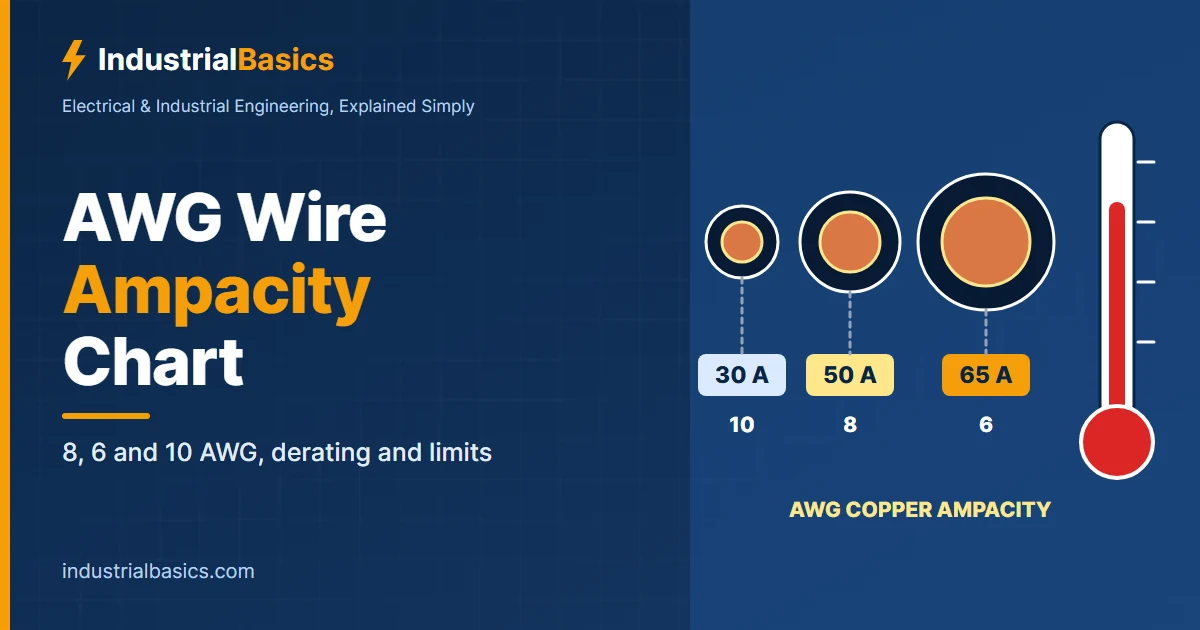
8 AWG copper wire is rated 40 A at 60°C, 50 A at 75°C and 55 A at 90°C under NEC Table 310.16. For THHN or THWN landed on standard 75°C terminals, the usual answer is 50 A. For 8 AWG NM-B (Romex) cable, it is 40 A. Those values assume no more than three current-carrying conductors and a 30°C (86°F) ambient, so hot locations and full conduits reduce them.
| Copper AWG | 60°C | 75°C | 90°C | Largest standard breaker within the 75°C value |
|---|---|---|---|---|
| 14 AWG | 15 A | 20 A | 25 A | 15 A |
| 12 AWG | 20 A | 25 A | 30 A | 20 A |
| 10 AWG | 30 A | 35 A | 40 A | 30 A |
| 8 AWG | 40 A | 50 A | 55 A | 50 A |
| 6 AWG | 55 A | 65 A | 75 A | 60 A |
| 4 AWG | 70 A | 85 A | 95 A | 80 A |
8 AWG, 6 AWG and 10 AWG Ampacity Compared
These three sizes cover many feeders, ranges, heaters, welders and EV circuits. Each has three table values because insulation can tolerate different temperatures. A higher column is not automatically usable, since the wire is only one part of the circuit.
| Wire | Common insulation | Typical usable value | Why |
|---|---|---|---|
| 10 AWG THHN | 90°C | 30 A | 240.4(D) limits the overcurrent device |
| 8 AWG THHN | 90°C | 50 A | 75°C terminals |
| 8 AWG NM-B | 90°C conductors | 40 A | 334.80 limits NM-B to the 60°C value |
| 6 AWG THHN | 90°C | 65 A | 75°C terminals |
| 6 AWG NM-B | 90°C conductors | 55 A | 334.80 limits NM-B to the 60°C value |
Why the NEC Has Three Temperature Columns
Ampacity is the current a conductor can carry continuously without exceeding its temperature rating. The column depends on the insulation, but NEC 110.14(C) adds a second limit: the conductor must not run hotter than the lowest-rated termination it connects to.
| Circuit or terminal | Default column | Exception |
|---|---|---|
| 100 A or less, or 14 to 1 AWG terminals | 60°C | 75°C or 90°C if the equipment is listed and identified for it |
| Over 100 A, or terminals larger than 1 AWG | 75°C | Higher only if the equipment is listed for it |
In practice, many modern breakers and lugs are listed for 75°C, which is why the 75°C column is so often used. Read the marking on the device instead of assuming. The same logic applies when you size a wire for a 50 amp circuit.
How to Calculate Real-World Ampacity
The table value holds only for its stated conditions. On a real job, work through these five steps.
Correct for ambient temperature
| Ambient °C | 60°C wire | 75°C wire | 90°C wire |
|---|---|---|---|
| 26–30 | 1.00 | 1.00 | 1.00 |
| 31–35 | 0.91 | 0.94 | 0.96 |
| 36–40 | 0.82 | 0.88 | 0.91 |
| 41–45 | 0.71 | 0.82 | 0.87 |
| 46–50 | 0.58 | 0.75 | 0.82 |
| 51–55 | 0.41 | 0.67 | 0.76 |
| 56–60 | Not usable | 0.58 | 0.71 |
Adjust for bundled conductors
| Current-carrying conductors | Percent of value |
|---|---|
| 4–6 | 80% |
| 7–9 | 70% |
| 10–20 | 50% |
| 21–30 | 45% |
| 31–40 | 40% |
| 41 and above | 35% |
Worked example: 8 AWG THHN in a hot conduit
Six current-carrying 8 AWG THHN conductors run through a 40°C space and land on 75°C terminals.
Terminal limit = 50 A
Usable ampacity = 40 A
The table below applies the same conditions to other sizes: THHN at 40°C with four to six current-carrying conductors.
| Copper AWG | 90°C base | After 0.91 × 0.80 | Usable with 75°C terminals |
|---|---|---|---|
| 14 AWG | 25 A | 18.2 A | 18.2 A |
| 12 AWG | 30 A | 21.8 A | 21.8 A |
| 10 AWG | 40 A | 29.1 A | 29.1 A |
| 8 AWG | 55 A | 40.0 A | 40.0 A |
| 6 AWG | 75 A | 54.6 A | 54.6 A |
| 4 AWG | 95 A | 69.2 A | 69.2 A |
Breaker Size and Continuous Loads
Ampacity and breaker size are separate checks. For 14, 12 and 10 AWG copper, NEC 240.4(D) generally caps the overcurrent device at 15 A, 20 A and 30 A, even though the table shows higher numbers. Specific equipment, such as motor circuits, has its own rules. Our guide to types of circuit breakers explains how the protective device itself works.
For a continuous load, one expected to run for three hours or more, branch circuit conductors are generally sized for 125% of that load under NEC 210.19.
Voltage Drop: The Limit Ampacity Does Not Show
Ampacity protects the wire from overheating, but it says nothing about the voltage reaching the load. On long runs, voltage drop often forces a larger wire. For a single-phase circuit, a simple estimate uses the DC resistance from NEC Chapter 9 Table 8.
| 40 A, 240 V, 100 ft one way | Resistance (Ω/1000 ft) | Voltage drop | Percent |
|---|---|---|---|
| 10 AWG | 1.24 | 9.92 V | 4.1% |
| 8 AWG | 0.778 | 6.22 V | 2.6% |
| 6 AWG | 0.491 | 3.93 V | 1.6% |
Long motor circuits deserve extra care, because low voltage at startup can cause nuisance trips and overheating. See our guides to motor failure causes and types of electrical cables when choosing a conductor for a demanding load.
Common Ampacity Mistakes
| Mistake | Why it is a problem | Correct approach |
|---|---|---|
| Using 55 A for 8 AWG on a 75°C breaker | The terminal can overheat | Limit the load to 50 A |
| Treating NM-B as 90°C wire | Its final ampacity is limited to 60°C | Use 90°C only as a derating start |
| Ignoring attic or rooftop heat | The conductor runs hotter than the table assumes | Apply the ambient correction factor |
| Counting only one circuit in a conduit | Heat from all conductors adds up | Count all current-carrying conductors |
| Forgetting continuous load | The conductor may be undersized | Apply 125% where required |
| Using chassis wiring charts | They assume different conditions | Use the NEC table for premises wiring |
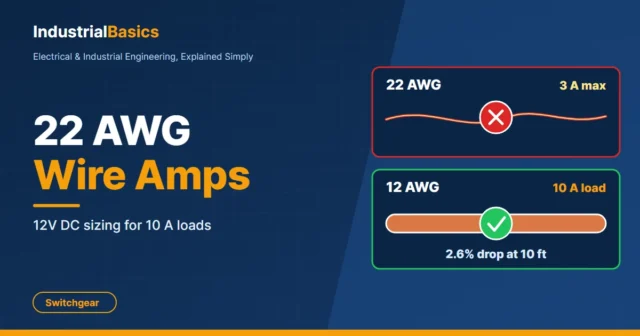
Small control wires need their own check. Our guide to 22 AWG amps at 12V DC explains its limit and includes a voltage drop calculator.
Once the wire size is chosen, make sure the box is big enough too: the NEC box fill chart gives the cubic-inch allowance for each conductor, device and ground.
Above 4/0, sizes are in kcmil: see our guide to 500 MCM wire and kcmil sizes.
Frequently Asked Questions
What is the ampacity of 8 AWG copper wire?
Under NEC Table 310.16, 8 AWG copper is rated 40 A in the 60°C column, 50 A in the 75°C column and 55 A in the 90°C column. For most breaker and lug connections rated 75°C, the usable value is 50 A before any derating.
Can 8 AWG wire carry 50 amps?
Yes, copper THHN or THWN can carry 50 A when both ends use terminals rated 75°C and no derating applies. 8 AWG NM-B cable cannot, because it is limited to the 60°C value of 40 A.
What is the ampacity of 6 AWG copper wire?
6 AWG copper is rated 55 A at 60°C, 65 A at 75°C and 75 A at 90°C.
What is the ampacity of 10 AWG copper wire?
10 AWG copper is rated 30 A at 60°C, 35 A at 75°C and 40 A at 90°C. NEC 240.4(D) generally limits its overcurrent protection to 30 A.
Why can’t I use the 90°C ampacity?
You can usually use it as the starting point for derating, but the final load is still limited by the lowest temperature rating in the circuit. Most terminals are rated 60°C or 75°C.
What size wire do I need for a 40 amp continuous load?
Size the conductor for 125% of the continuous load, which is 50 A. 8 AWG copper at 75°C meets that if no derating applies and the terminals are rated 75°C.
Does conduit fill reduce wire ampacity?
Yes. With more than three current-carrying conductors in a raceway or cable, the ampacity is reduced. For example, four to six conductors use 80% of the value.
Is NEC ampacity the same as the maximum current a wire can survive?
No. Ampacity is the continuous current a conductor can carry under its conditions of use without exceeding its temperature rating. It is a safe operating limit, not a melting or fusing point.
Sources and Further Reading
- WireSizing: NEC Table 310.16: copper ampacity values.
- WireSizing: NEC Table 310.15: correction and adjustment factors.
- eCalPro: NEC temperature correction factors: ambient correction values.
- ExpertCE: NEC 310.16 Ampacity Tables: terminals, 240.4(D) and continuous loads.
- Malfettone Electric: NEC 240.4(D): the small conductor rule.
- WireRef: NEC Article 334: the NM-B 60°C ampacity limit.
- PDH Online: Voltage Drop Tables: NEC Table 8 resistance values.
- NFPA 70, National Electrical Code: the official code page.