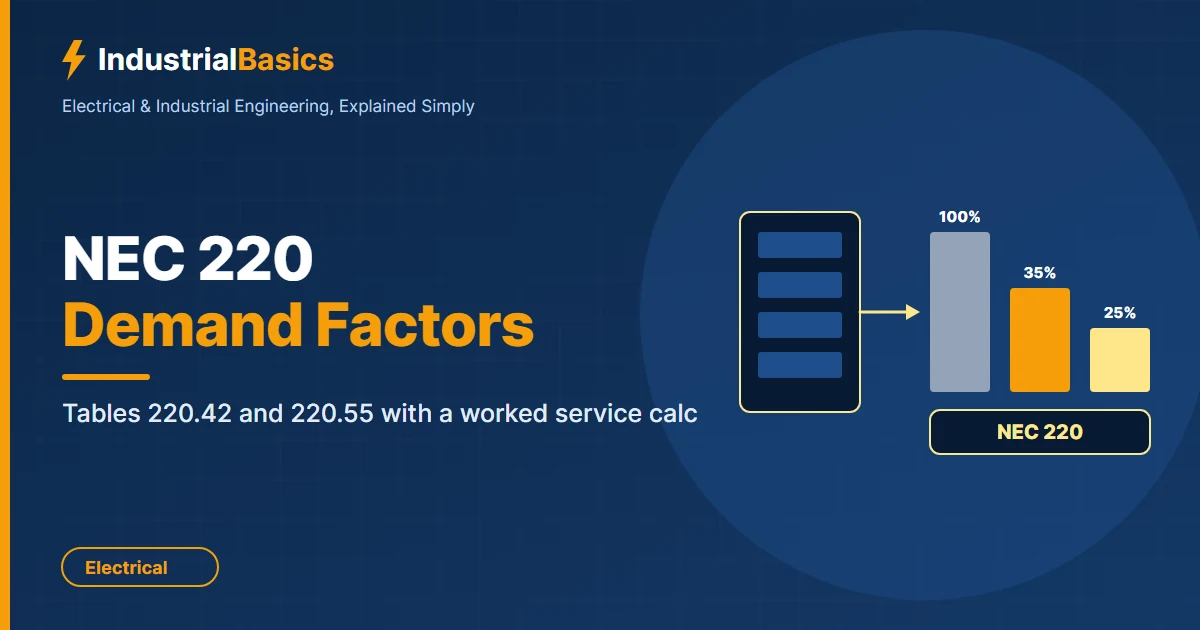
A demand factor is the ratio of the maximum load actually drawn to the total connected load. NEC Article 220 applies set demand factors to size feeders and services. For dwellings, Table 220.42 takes the first 3,000 VA of lighting, small-appliance and laundry load at 100%, the next amount up to 120,000 VA at 35%, and the rest at 25%. Table 220.55 Column C takes one household range of 12 kW or less as 8 kW. In a 2,000 sq ft worked example, 10,500 VA of connected lighting and receptacle load becomes 5,625 VA. The whole house comes to 35,575 VA, or 148.2 A at 240 V, which calls for a 150 A service.
What a Demand Factor Means
Wikipedia defines the demand factor as the peak load in a period divided by the full load the equipment could draw, so it is always 1 or less. Its example is a home that could draw 6,000 W with everything on but peaks at 3,000 W, giving a demand factor of 0.5. That is why a service is not sized for the sum of every nameplate. The load factor is a related ratio: average load divided by peak load.
The diversity factor looks at a system from the other side. It is the sum of the individual peak demands divided by the peak of the combined load. It is always 1 or more because individual peaks rarely happen at the same moment. Its reciprocal is the coincidence factor. The NEC turns these ideas into fixed tables, so every designer gets the same answer for the same house.
NEC Table 220.42: Dwelling Lighting Demand Factors
| Portion of load (dwelling units) | Demand factor |
|---|---|
| First 3,000 VA or less | 100% |
| 3,001 to 120,000 VA | 35% |
| Remainder over 120,000 VA | 25% |
The general lighting load for a dwelling is 3 VA per square foot (220.14(J) in the 2020 NEC). Measure the floor area from the outside dimensions. Leave out open porches, garages and unfinished spaces that can’t be adapted for future use (220.11). Add 1,500 VA for each 2-wire small-appliance circuit and each laundry circuit (220.52). A dwelling needs at least two 20 A small-appliance circuits and one laundry circuit, so the minimum is 4,500 VA. Add these loads to the lighting load before applying the table.
NEC 220.55: Household Electric Range Demand
Table 220.55 sets a reduced demand load for household ranges, wall-mounted ovens and counter-mounted cooking units. For one range rated 12 kW or less, Column C gives 8 kW. Above 12 kW, up to 27 kW, Note 1 raises the Column C value by 5% for each additional kW, or major fraction of a kW, above 12. Using the table is permitted, not required, but it is the usual method.
| Range nameplate | kW over 12 (rounded) | Demand load (Column C) |
|---|---|---|
| 8 kW | – | 8 kW |
| 10 kW | – | 8 kW |
| 12 kW | – | 8 kW |
| 13 kW | 1 | 8.4 kW |
| 14 kW | 2 | 8.8 kW |
| 15 kW | 3 | 9.2 kW |
| 16 kW | 4 | 9.6 kW |
| 18 kW | 6 | 10.4 kW |
| 20 kW | 8 | 11.2 kW |
Standard Method Dwelling Service Calculation, Step by Step
- General lighting: floor area × 3 VA/ft² (220.14(J)).
- Small-appliance and laundry: 1,500 VA per circuit (220.52), added to the lighting load.
- Apply Table 220.42: 100% of the first 3,000 VA, 35% up to 120,000 VA, 25% above.
- Range: Table 220.55 (8 kW for one range up to 12 kW).
- Dryer: 5,000 W or the nameplate, whichever is larger (220.54).
- Fixed appliances: 75% of the total when there are four or more (220.53). Exclude cooking equipment, dryers, heat and A/C.
- Heat or A/C: use only the larger, since they are noncoincident (220.60). Fixed electric space heating is taken at 100% (220.51).
- Largest motor: add 25% of the largest motor load (220.50 and 430.24).
- Convert to amps: total VA ÷ 240 V. A one-family dwelling service is never less than 100 A (230.79(C)).
Worked example: 2,000 sq ft house
| Load | Calculation | VA |
|---|---|---|
| General lighting | 2,000 ft² × 3 VA | 6,000 |
| Small-appliance circuits | 2 × 1,500 VA | 3,000 |
| Laundry circuit | 1 × 1,500 VA | 1,500 |
| Demand: first 3,000 VA | 3,000 × 100% | 3,000 |
| Demand: remaining 7,500 VA | 7,500 × 35% | 2,625 |
| Range, 12 kW | Table 220.55, Column C | 8,000 |
| Dryer, 5.5 kW | Nameplate exceeds 5,000 W | 5,500 |
| Fixed appliances (4) | 8,100 × 75% | 6,075 |
| Heat 10 kW vs A/C 5,000 VA | Larger: heat | 10,000 |
| Largest motor (well pump) | 1,500 × 25% | 375 |
| Total | 35,575 ÷ 240 V = 148.2 A | 35,575 |
The connected load in this house is far more than 35,575 VA, but the demand factors account for loads that do not all run at once. For three-phase and commercial feeders, see three-phase calculations.
Demand Load Calculator
Common Mistakes
- Applying Table 220.42 before adding the small-appliance and laundry circuits.
- Using the range nameplate where Table 220.55 applies.
- Adding both heating and air conditioning.
- Taking 75% for only three fixed appliances, or counting the range or dryer as one of the four.
- Forgetting the extra 25% of the largest motor.
- Using lighting demand factors to size a branch circuit; they are for feeders and services.
Frequently Asked Questions
What is a demand factor?
The ratio of the maximum load in a period to the maximum possible (connected) load. Wikipedia gives the example of a home that could draw 6,000 W but peaks at 3,000 W: demand factor 3,000 / 6,000 = 0.5. It is always 1 or less.
What is NEC Article 220?
The article of the National Electrical Code (NFPA 70) for branch-circuit, feeder and service load calculations. Part III covers the standard feeder and service method, including the demand factor tables.
What are the Table 220.42 demand factors for dwellings?
First 3,000 VA at 100%, 3,001 to 120,000 VA at 35%, and anything over 120,000 VA at 25%. They apply to the general lighting load plus small-appliance and laundry circuits, for feeders and services.
What is NEC Table 220.12?
In the 2020 NEC, Table 220.12 lists general lighting unit loads for non-dwelling occupancies only. The 3 VA per square foot dwelling load moved to 220.14(J) (JCR Productions). Check which edition your jurisdiction has adopted.
What is the NEC 220.55 demand for one household range?
Under Column C, one range rated 12 kW or less is taken as 8 kW. Over 12 kW (up to 27 kW), add 5% for each kW, or major fraction of a kW, above 12. A 14 kW range is 8.8 kW.
What load do I use for an electric dryer?
5,000 W (VA) or the nameplate rating, whichever is larger (220.54). One to four dryers are taken at 100%.
When can I take 75% for fixed appliances?
When four or more appliances fastened in place, each ¼ hp or 500 W or more, are on the same feeder or service (220.53). The range and other fastened-in-place cooking equipment, dryers, space heating and air conditioning do not count.
Do I add both heating and air conditioning?
No. They are noncoincident loads, so you may use only the larger of the two (220.60).
Do demand factors apply to branch circuits?
Not the Table 220.42 factors: they are for feeders and services. Each branch circuit is sized for the load it actually serves.
What is the difference between demand factor and diversity factor?
Demand factor compares one load group’s peak to its connected load (1 or less). Diversity factor is the sum of individual peak demands divided by the combined peak of the whole system, which is 1 or more; its reciprocal is the coincidence factor (Wikipedia).
Sources and Further Reading
- JCR Productions: Dwelling service load calculation (2020 NEC): standard method, Table 220.42, Table 220.55 Column C, worked example.
- Wikipedia: Demand factor: definition and load factor.
- Wikipedia: Diversity factor: diversity and coincidence factors.
- NFPA 70, National Electrical Code, Article 220 (the governing text; check the edition your jurisdiction has adopted).