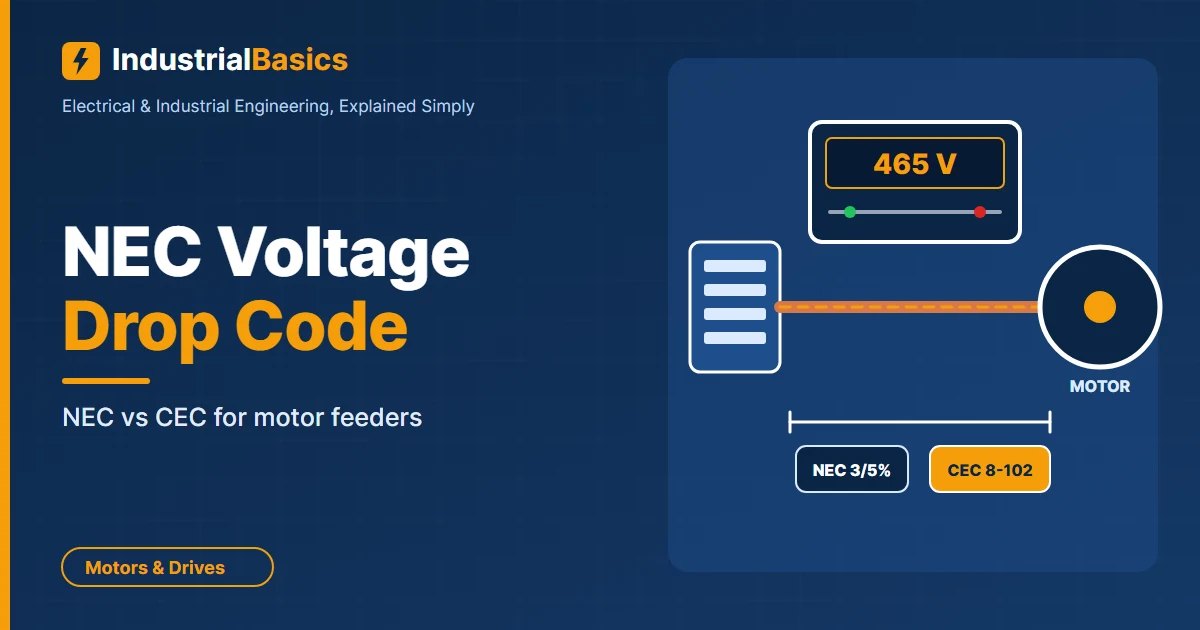
The NEC does not generally make voltage drop mandatory. Informational notes in 210.19(A) and 215.2(A) suggest no more than 3% on a feeder or branch circuit and 5% in total, but they are explanatory only. The Canadian Electrical Code is different: Rule 8-102 sets mandatory voltage drop limits. For motor feeders, check running drop against these figures and the motor’s voltage tolerance, then check the larger drop during starting.
| Point | NEC (US) | CEC (Canada) |
|---|---|---|
| Status of the limit | Informational notes, not enforceable (90.5(C)) | Mandatory, Rule 8-102 |
| Typical figures | 3% feeder or branch, 5% total (suggested) | Set in Rule 8-102 of the adopted edition |
| Load used | Calculated load | Connected load, or 80% of the protective device rating (per Ontario ESA) |
| Where it is mandatory | e.g. 647.4(D), 695.7, and maker instructions via 110.3(B) | All installations within the rule’s scope |
What the NEC Says
IAEI explains that voltage drop is “only mentioned in some sections of the NEC as informational notes, and is required to be calculated in other sections”. It lists 210.19(A), 215.2(A)(1), 310.15(A)(1), 647.4(D), 310.60(B), 455.6(A) and 695.7, and says permitted or required amounts “may range from 1.5 to 15 percent”, with 5% maximum generally suggested on a circuit.
The key point is 90.5(C): informational notes are explanatory material, not requirements. An inspector cannot fail an installation solely for exceeding the 3% or 5% suggestion. But IAEI stresses a second rule that does apply. Section 110.3(B) requires listed equipment to be installed according to its instructions, and those instructions often set a minimum operating voltage. Its example is a 240 V luminaire that needs at least 228 V, which is exactly a 5% drop.
What the CEC Says
In Canada, Rule 8-102 of the Canadian Electrical Code, Part I, is a mandatory rule. Ontario’s Electrical Safety Authority describes Rule 8-102 of the Ontario code as setting “the maximum voltage drop limits on all types of electrical installations including residential”. Its May 2025 bulletin also says Subrule 8-102 1) was amended to base the calculation on the connected load, if known, or 80% of the rating of the overcurrent device.
Provinces adopt the CEC with their own amendments. Manitoba’s Regulation 30/2026 adopts the 26th edition (CSA C22.1:24) and amends Subrule 8-102 1) to apply to “the branch circuit” rather than “the feeder or branch circuit”. That shows why you must read the rule in the edition and province that apply to your job. This guide does not quote the CEC percentages because we could not verify them from a readable copy of the code.
Why Motor Feeders Need Extra Care
The DOE’s motor tip sheet says motors are designed to operate within ±10% of nameplate voltage, and that reduced voltage lowers torque by the square of the voltage ratio. It also notes that low voltage caused by high system impedance is worse during starting, when current is four to eight times the full-load value. A feeder that drops 3% while running can drop well over 10% while a large motor starts.
Estimate starting current from the nameplate code letter with our locked rotor amps calculator, and running current from the NEC motor FLA table. Reduced voltage starting, covered in our FVNR and DOL guide, is one way to cut the starting dip.
The Calculation
IAEI uses the K-factor method, based on DC resistance from NEC Chapter 9, Table 8 at 75°C. K is 12.9 for copper and 21.2 for aluminum.
Three phase: VD = 1.732 × K × I × L ÷ CM
L is the one-way length in feet, I is the current, and CM is the conductor area in circular mils. Percent drop is VD ÷ system voltage × 100. IAEI notes that Table 8 DC values are close to the AC values in Table 9 for these purposes. For large conductors or low power factor loads, an AC impedance method is more accurate.
Voltage Drop Calculator
Worked Example: 50 HP Motor Feeder
| Item | Value |
|---|---|
| System | 480 V, three phase |
| Running current | 65 A (example) |
| Starting current | 390 A, about 6 times running (example) |
| Length | 400 ft one way, copper |
| 4 AWG (41,740 cmil) running drop | 1.732 × 12.9 × 65 × 400 ÷ 41,740 = 13.9 V (2.90%) |
| 4 AWG starting drop | 83.5 V (17.4%) |
| 2 AWG (66,360 cmil) running drop | 8.8 V (1.82%) |
On 4 AWG the running drop of 2.9% sits just inside the NEC’s 3% suggestion for a feeder, but it leaves only about 2% for the branch circuit within the 5% total, and the starting drop of 17.4% is large before the branch circuit and supply add their share. Going up to 2 AWG brings running drop to 1.8% and starting drop to 10.9%. Remember that increasing the phase conductors for voltage drop also affects the equipment grounding conductor size, which must be increased in proportion.
For the basics of current and power in three-phase systems, see 3 phase calculations.
Frequently Asked Questions
Is voltage drop a code requirement in the NEC?
Generally no. IAEI explains that the 3% and 5% figures are informational notes, which are explanatory and not mandatory under 90.5(C). A few articles do require it, such as 647.4(D) and 695.7.
What is the NEC recommended voltage drop?
The informational notes suggest no more than 3% on a feeder or branch circuit and no more than 5% in total from the service to the farthest outlet.
Is voltage drop mandatory in the Canadian Electrical Code?
Yes. Rule 8-102 sets maximum voltage drop limits. Ontario’s ESA describes it as setting “the maximum voltage drop limits on all types of electrical installations”. Read the limits in your adopted edition.
What current is used for CEC voltage drop?
Ontario’s ESA bulletin says the calculation is based on the connected load if known, or 80% of the rating of the overcurrent device protecting the circuit.
Can a manufacturer make voltage drop mandatory in the US?
In effect, yes. NEC 110.3(B) requires listed equipment to be installed per its instructions, and IAEI notes these often set a minimum operating voltage.
How do I calculate voltage drop on a 3-phase motor feeder?
IAEI gives VD = 1.732 × K × I × L ÷ CM, where K is 12.9 for copper or 21.2 for aluminum, L is the one-way length in feet and CM is the conductor area in circular mils.
Why does voltage drop matter more for motors?
Motors draw several times running current while starting, so the drop is much larger then. The DOE notes reduced voltage cuts torque by the square of the voltage ratio.
What voltage should a motor see?
The DOE says motors are designed to operate within ±10% of nameplate voltage. Feeder and branch drop eat into that margin.
Sources and Further Reading
- IAEI Magazine: Voltage Drop Formulas: NEC sections, informational notes, K-factor formulas.
- IAEI Magazine: Voltage-Drop Requirements Cannot Be Ignored: 110.3(B) and manufacturer limits.
- Ontario ESA: Bulletin 8-6-5, Voltage Drop in Dwelling Units, Rule 8-102 (May 2025): mandatory limits, load basis.
- Manitoba Regulation 30/2026: Manitoba Electrical Code: CEC 26th edition adoption and Rule 8-102 amendment.
- PacifiCorp Engineering Handbook 1C.2.1: Voltage Level and Range (2024): 3% feeder, 3% branch and 5% combined recommendations.
- U.S. DOE Motor Systems Tip Sheet #9: motor voltage tolerance and starting current.