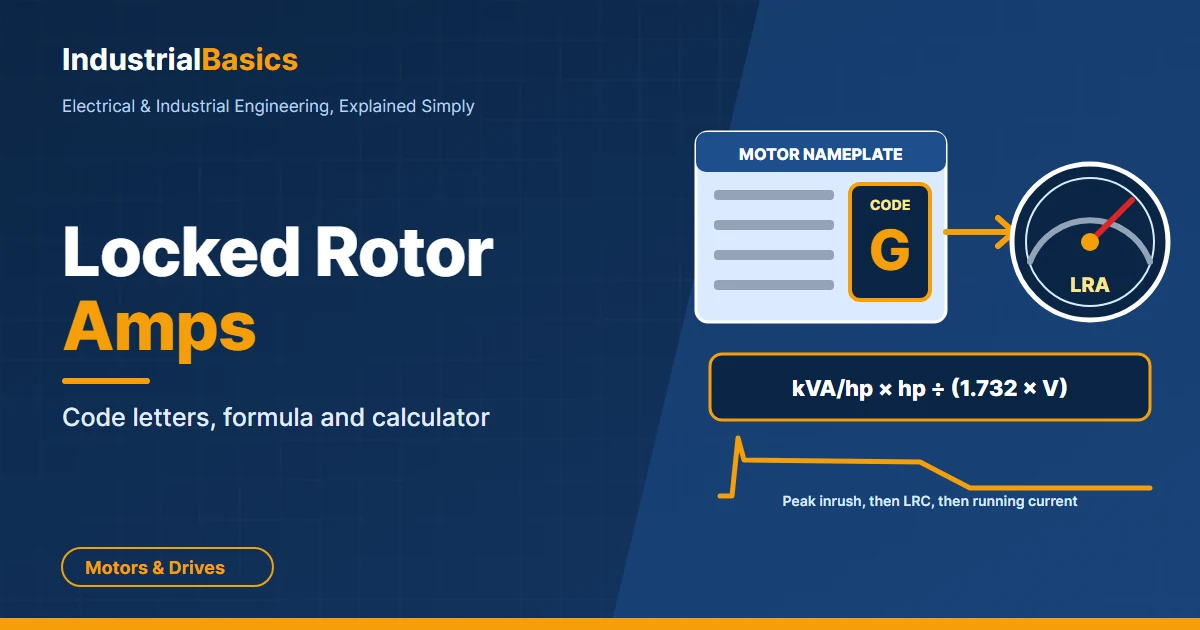
Locked rotor amps (LRA) are the current a motor draws at rated voltage before the rotor starts turning. To estimate it, take the kVA/hp band for the nameplate code letter from NEC Table 430.7(B), multiply by horsepower, and divide by 1.732 × voltage. A 30 hp, 460 V, Code G motor draws about 211 to 237 A at the moment of a full-voltage start.
Locked Rotor Amps Calculator
The calculator covers three-phase motors. Where the motor’s data sheet gives a locked rotor current, use that figure. The code letter only tells you the band it falls in.
NEC Table 430.7(B) Code Letters
The code letter on the nameplate is the locked rotor indicating code. Each letter covers a range of locked rotor kilovolt-amperes per horsepower. The right-hand column shows what each band means for a 10 hp, 460 V motor.
| Code letter | kVA per hp (locked rotor) | LRA for 10 hp at 460 V |
|---|---|---|
| A | 0.00 to 3.14 | 0 to 39 A |
| B | 3.15 to 3.54 | 40 to 44 A |
| C | 3.55 to 3.99 | 45 to 50 A |
| D | 4.00 to 4.49 | 50 to 56 A |
| E | 4.50 to 4.99 | 56 to 63 A |
| F | 5.00 to 5.59 | 63 to 70 A |
| G | 5.60 to 6.29 | 70 to 79 A |
| H | 6.30 to 7.09 | 79 to 89 A |
| J | 7.10 to 7.99 | 89 to 100 A |
| K | 8.00 to 8.99 | 100 to 113 A |
| L | 9.00 to 9.99 | 113 to 125 A |
| M | 10.00 to 11.19 | 126 to 140 A |
| N | 11.20 to 12.49 | 141 to 157 A |
| P | 12.50 to 13.99 | 157 to 176 A |
| R | 14.00 to 15.99 | 176 to 201 A |
| S | 16.00 to 17.99 | 201 to 226 A |
| T | 18.00 to 19.99 | 226 to 251 A |
| U | 20.00 to 22.39 | 251 to 281 A |
| V | 22.4 and up | 281 A and up |
Engineering ToolBox notes that small motors generally need more starting kVA per hp than large ones. Its typical values for standard three-phase motors run from Code L below 1 hp down to Code G above 15 hp. Always read the actual nameplate.
Code Letter vs NEMA Design Letter
These are two different markings, and mixing them up is the most common mistake. The DOE motor tip sheet states that the locked rotor code “is not the same as the motor design letter code”.
| NEMA design | Characteristic | Typical use |
|---|---|---|
| Design A | High pullout torque; no locked rotor current limit (DOE) | Specialist uses, such as injection molding |
| Design B | Reasonable starting torque, moderate starting current | Standard industrial duty |
| Design C | High starting torque | Hard-to-start loads |
| Design D | High torque, poor full load efficiency | Punch presses, hoists, elevators |
DOE notes that many premium efficiency Design A motors meet Design B torque requirements but exceed Design B locked rotor current limits. That matters when a replacement motor starts tripping a breaker that never tripped before.
Locked Rotor Current vs Peak Inrush
NEMA recognises two parts of starting current, according to DOE. Peak inrush is a transient within half a cycle of contact closure. Locked rotor current is the RMS current that follows and stays near that value during acceleration. DOE says peak inrush can reach 2.8 times the RMS locked rotor current, and it can trip instantaneous magnetic-only circuit protectors even when the LRA itself is within limits.
Worked Examples
30 hp, 460 V, Code G
| Step | Value |
|---|---|
| kVA/hp band | 5.6 to 6.29 |
| Locked rotor kVA | 5.6 × 30 = 168 to 6.29 × 30 = 188.7 kVA |
| Divide by 1.732 × 460 | 210.9 A to 236.8 A |
100 hp, 460 V, Code C
Code C is 3.55 to 3.99 kVA/hp. The maximum is 3.99 × 100 × 1000 ÷ (1.732 × 460) = 501 A. The DOE tip sheet works the same motor with a rounded 4.0 kVA/hp and gets 502 A.
What LRA Is Used For
- Starter and protection selection: the inrush must not trip the breaker or fuses. See inverse time vs instantaneous trip breakers.
- Voltage dip: a large LRA on a weak supply causes dips. Reduced voltage starting, covered in our FVNR and DOL terminology guide, is one fix.
- Generator sizing: the generator must supply the locked rotor kVA without collapsing voltage.
- Comparing with running current: LRA is several times full load amps. For code table values of FLC, see the NEC motor FLA table.
For an overview of starting methods, see types of motor starters and VFD vs soft starter.
Frequently Asked Questions
What are locked rotor amps?
Locked rotor amps (LRA) are the current a motor draws from the supply when energized at rated voltage with the rotor not turning. It is the current at the instant of a full-voltage start.
How do you calculate locked rotor amps?
Multiply the code letter’s kVA per hp by the horsepower and by 1,000, then divide by 1.732 times the line voltage for a three-phase motor.
What does the code letter on a motor nameplate mean?
It is the locked rotor indicating code from NEC Table 430.7(B). Each letter covers a band of locked rotor kVA per horsepower. Letters I and O are not used.
Is the code letter the same as the NEMA design letter?
No. The DOE tip sheet stresses that the locked rotor code is not the design letter. Design (A, B, C, D) describes the torque and current characteristics.
What is the locked rotor current of a 30 hp, 460 V Code G motor?
About 211 A to 237 A, using 5.6 to 6.29 kVA/hp.
Why do premium efficiency motors draw more starting current?
DOE says they have slightly higher locked rotor current and code letters. Most are still Design B and must meet the same maximum allowable locked rotor current.
Is peak inrush the same as locked rotor current?
No. Peak inrush is a transient in the first half cycle. DOE says it can be as high as 2.8 times the RMS locked rotor current, and no standard limits it.
Do IEC motors have code letters?
No. The DOE tip sheet notes IEC or metric motors do not use NEMA-defined code letters. Use the manufacturer’s locked rotor current ratio instead.
Sources and Further Reading
- Electrical Association of Minnesota: Motor Installation Requirements Based on 2020 NEC: Table 430.7(B), design letters, worked example.
- U.S. DOE Motor Systems Tip Sheet #6: Avoid Nuisance Tripping with Premium Efficiency Motors: peak inrush, design letters, example.
- Southern Illinois University: ET 332b Lesson 14, Motor Nameplate Data: code letter range method.
- Engineering ToolBox: Locked Rotor Design Code Letters: codes R to V and typical letters by size.