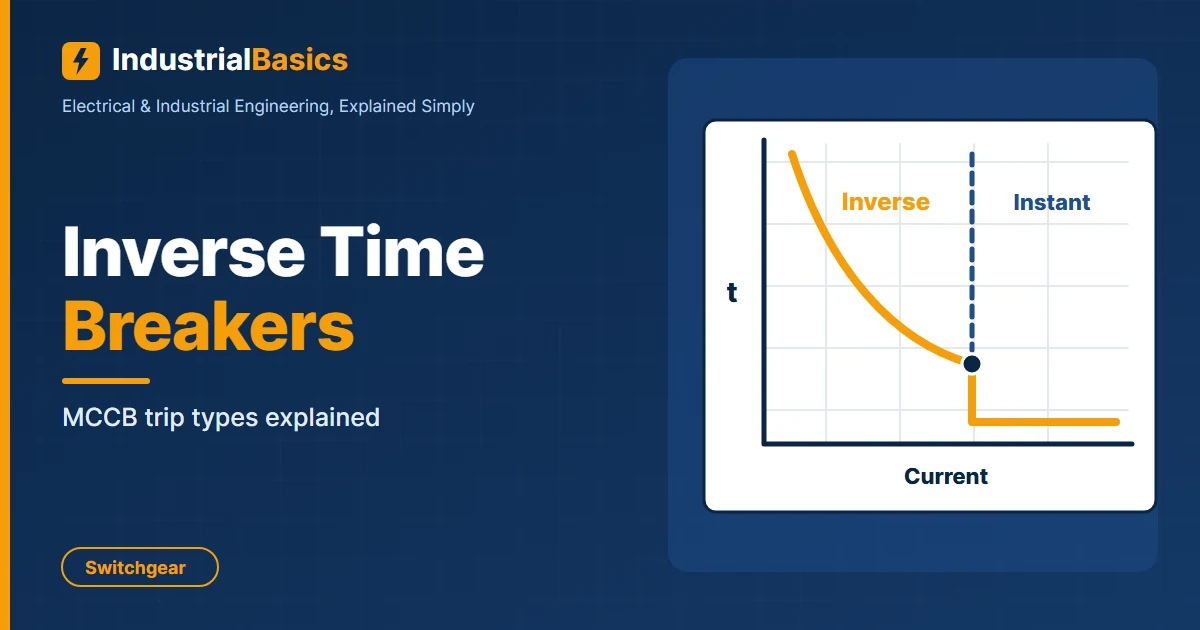
An inverse time breaker trips faster as current rises, so it can ride through a brief overload but clear a heavy one quickly. An instantaneous-only breaker has no overload delay and trips as soon as current reaches its magnetic setting. Most standard molded case circuit breakers (MCCBs) combine both actions. A magnetic-only motor circuit protector does not, and it needs a separate overload device.
| Trip type | Overload protection | Short-circuit protection | Typical use |
|---|---|---|---|
| Thermal-magnetic | Yes, inverse time | Yes, instantaneous | Conductor and feeder protection |
| Electronic LI / LSI / LSIG | Yes, adjustable long delay | Yes, by function | Feeders needing adjustment or selectivity |
| Magnetic only (MCP) | No | Yes, instantaneous | Motor branch circuits with an overload relay |
| Molded case switch (MCS) | No | Not intended for circuit protection | Isolation and switching |
Inverse Time vs Instantaneous Trip
Inverse time means time and current move in opposite directions. In a thermal-magnetic breaker, the thermal element responds to sustained overload. This lets normal short-duration current pass while still protecting the conductor from overheating.
Instantaneous trip has no intentional delay. Once current reaches the pickup, the magnetic element opens the breaker. Schneider Electric summarizes the difference simply: a thermal-magnetic breaker has both overload and instantaneous elements and is used primarily for conductor protection, while a magnetic-only device has no thermal protection and is mainly used for motor protection.
The Main MCCB Trip Types
Thermal-magnetic
ABB’s UL 489 catalog shows how much adjustment can vary within this one family:
| ABB code | Thermal setting | Magnetic setting |
|---|---|---|
| TMF | Fixed | Fixed (I3 = 10 × In) |
| TMD | Adjustable (I1 = 0.7-1 × In) | Fixed (I3 = 10 × In) |
| TMA | Adjustable (I1 = 0.7-1 × In) | Adjustable (I3 = 5-10 × In) |
Electronic trip units
Electronic units measure current and apply programmed trip functions. They are commonly described by the letters they include, such as LI, LSI or LSIG.
The short delay is valuable for selectivity, because it allows a downstream device time to clear a fault first. On one ABB trip unit, the long-delay pickup can be set from 0.4 to 1 × In. Ground fault functions are covered in our guide to ground fault relay trips.
Magnetic-only motor circuit protectors
A motor draws a high inrush current at start, so a device set just above that peak can give fast short-circuit protection without tripping on each start. Siemens describes its ETI motor circuit protector this way, and adds the critical limit: it “has no time-delay trip element. Therefore it must be used in conjunction with, and immediately ahead of, the motor-running overcurrent protective device.”
That is why an MCP is normally part of a combination starter with a contactor and thermal overload relay. See also our motor starter guide.
Molded case switches
ABB lists molded case switches for use as isolators or switching devices. They look like breakers, so do not assume one provides overload protection. Check the label before relying on it.
How to Identify the Trip Type
- Read the catalog number and label. Catalog codes usually include the trip unit type.
- Look at the adjustments. Dials or a display labelled L, S, I or G indicate an electronic unit.
- Check for a thermal rating. A device showing only an instantaneous range is probably magnetic only.
- Look at what is downstream. A breaker feeding a contactor and overload relay may be an MCP.
- Confirm with the maker’s catalog before relying on your reading.
Worked Example: Reading TMA Settings
A breaker has a 200 A TMA trip unit. The thermal dial is at 0.8 and the magnetic dial is at 8.
| Setting | Calculation | Result |
|---|---|---|
| Thermal pickup, I1 | 0.8 × 200 A | 160 A |
| Magnetic pickup, I3 | 8 × 200 A | 1600 A |
| Available magnetic range | 5-10 × 200 A | 1000-2000 A |
A sustained current above the thermal pickup falls on the inverse time part of the curve, so the trip time depends on how large it is. A fault current above 1600 A reaches the magnetic element and trips with no intentional delay. Published tolerances still apply, so use the maker’s curve for real studies.
For a magnetic-only example, ABB lists an adjustable range of 6 to 12 × In on its MCP. A 100 A unit could therefore be set from 600 A to 1200 A, and it would give no overload protection at any of those settings.
Ambient Temperature
Thermal elements react to heat from the surroundings as well as from current. ABB sets its thermomagnetic elements for a reference temperature of 40 °C (104 °F) and publishes tables for other temperatures. Siemens also lists options calibrated for 40 °C and 50 °C. If the enclosure runs hot, check the derating data. For the wider comparison, read types of circuit breakers.
Frequently Asked Questions
What is an inverse time breaker?
It is a circuit breaker whose trip time shortens as current rises. A small overload may take a long time to trip, while a large overload trips much faster.
What is the difference between inverse time and instantaneous trip?
Inverse time trips with a delay that depends on current. Instantaneous trip has no intentional delay and acts once current reaches the pickup setting.
Is a thermal-magnetic breaker an inverse time breaker?
Yes. The thermal element gives the inverse time overload response, and the magnetic element provides instantaneous short-circuit tripping.
What is a motor circuit protector?
It is a magnetic-only device for motor branch circuits. It has no time-delay trip element, so it must be used with a motor overload device.
Can an instantaneous-only breaker protect a motor from overload?
No. It has no overload element. Use it with a properly selected overload relay.
What does LSIG mean on a breaker?
LSIG stands for long delay, short delay, instantaneous and ground fault trip functions.
How do I tell which trip type an MCCB has?
Read the label and catalog number, then check the maker’s catalog. Terms such as TMA, LSI, MCP and MCS identify the type on many products.
Does ambient temperature affect an inverse time breaker?
Yes. Thermal elements are calibrated to a reference temperature, commonly 40 °C on the ABB and Siemens products cited here, so the trip point shifts at other temperatures.
Sources and Further Reading
- ABB: Molded Case Circuit Breakers, UL 489 and CSA C22.2 Technical Catalog: trip unit types, settings and ambient reference.
- Siemens: Molded Case Circuit Breakers Catalog: trip function terms and motor circuit protector application.
- Schneider Electric: Thermal/Magnetic vs Mag Only Breaker: the difference between the two.