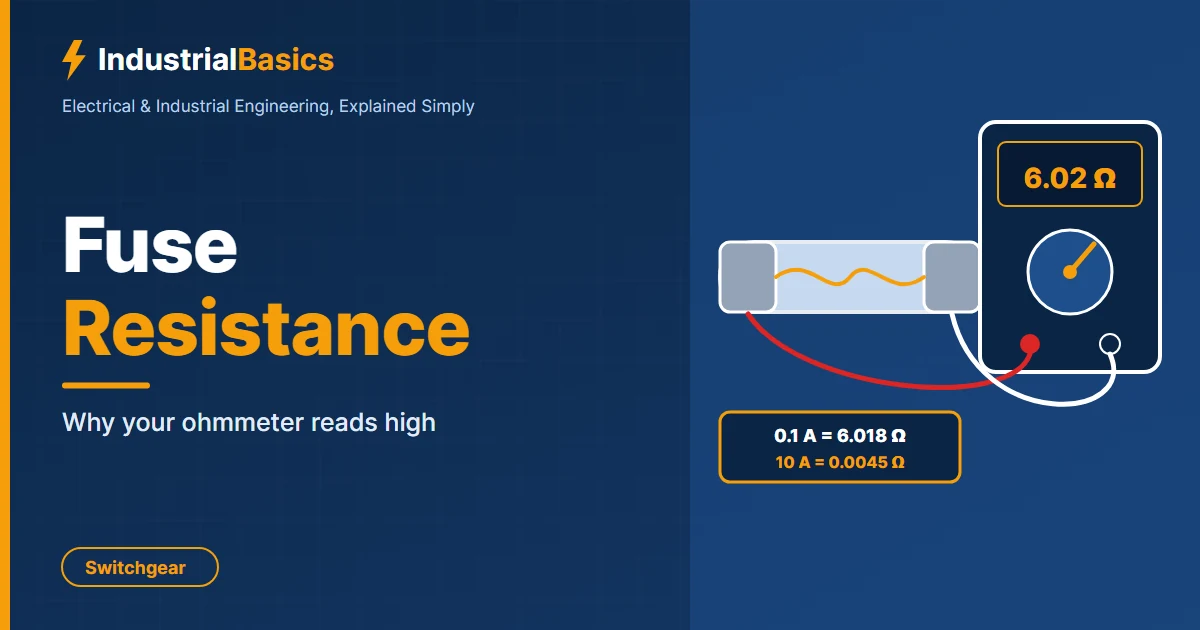
A fuse that reads “high” on an ohmmeter is usually fine. Large fuses read a few milliohms, but small ones are genuinely resistive: a Littelfuse 218 series 0.1 A fuse has a nominal cold resistance of 6.018 Ω, and a 32 mA fuse 48.258 Ω. Compare your reading with the datasheet for that exact rating, after subtracting your meter lead resistance and cleaning the end caps. An open fuse reads OL; only a reading well above the datasheet value, after those checks, means the fuse should be replaced.
| 218 series rating | Nominal cold resistance | Max voltage drop at rated current | Hot resistance (from drop) |
|---|---|---|---|
| 0.032 A | 48.258 Ω | 5,000 mV | 156.2 Ω |
| 0.1 A | 6.018 Ω | 2,000 mV | 20 Ω |
| 0.5 A | 0.37 Ω | 300 mV | 0.6 Ω |
| 1 A | 0.0613 Ω | 150 mV | 0.15 Ω |
| 5 A | 0.0104 Ω | 100 mV | 0.02 Ω |
| 10 A | 0.0045 Ω | 100 mV | 0.01 Ω |
Why Small Fuses Read High
Littelfuse’s Fuseology design guide explains that a fuse’s resistance is usually an insignificant part of the circuit, but “the resistance of fractional amperage fuses can be several ohms”, which should be considered in low-voltage circuits. The thin element that lets a 100 mA fuse open at low current is the same reason it has measurable resistance.
So a 6 Ω reading on a 100 mA fuse is normal, while 6 Ω on a 10 A fuse would be far too high. Always look up the exact rating and series.
Cold vs Hot Resistance
Littelfuse says most fuses use materials with positive temperature coefficients, so it is common to quote two values:
- Cold resistance: measured using a current of no more than 10% of the fuse’s rated current. The Littelfuse 526 series datasheet, for example, states resistance measured at 10% of rated current and 25 °C.
- Hot resistance: calculated from the stabilised voltage drop with rated current flowing.
Actual operation sits somewhere between the two. In the 218 series, the 0.1 A fuse’s maximum voltage drop of 2,000 mV at rated current works out to 20 Ω hot, against 6.018 Ω cold. A handheld ohmmeter uses a small test current, so it reads close to the cold value.
Troubleshooting a High Reading
- Isolate and remove the fuse. Lock out the circuit first; see our lockout/tagout procedure.
- Zero the meter. Short the probes and note the reading, then subtract it, or use the meter’s relative/zero function. On low-ohm fuses the leads can be more than the fuse itself.
- Clean the end caps and press the probes firmly onto clean metal.
- Let it cool. A fuse that just carried current reads higher because of its positive temperature coefficient.
- Compare with the datasheet for the exact series and rating, allowing for the nominal tolerance.
- Check the holder. Littelfuse notes that in UL fuseholder tests most of the heat comes from the contact resistance of the clips. Loose or corroded clips can overheat even when the fuse is fine.
Fuse Resistance Calculator
Worked Example
| Step | 0.1 A fuse | 10 A fuse |
|---|---|---|
| Meter reading | 6.40 Ω | 0.25 Ω |
| Leads shorted | 0.20 Ω | 0.20 Ω |
| Fuse resistance | 6.20 Ω | 0.05 Ω |
| Datasheet cold value (218 series) | 6.018 Ω | 0.0045 Ω |
| Verdict | Normal (103% of nominal) | About 11 times nominal: clean, re-test, replace if it stays high |
For a reading as low as a 10 A fuse’s, a four-wire (Kelvin) low-resistance meter gives far better results than a handheld two-wire meter.
Why It Matters in the Circuit
In a 5 V or 12 V control circuit, a small fuse’s voltage drop can be significant. Using the 218 series maximum of 2,000 mV at rated current, a 0.1 A fuse could drop up to 2 V, 40% of a 5 V rail. Littelfuse’s guide says the parameter should be discussed with the maker if it is critical. For control and PLC circuits, see our PLC I/O fuse protection guide, and for sizing transformer fuses see transformer fuse.
For how fuses compare with breakers, read fuse vs circuit breaker.
Frequently Asked Questions
What should a good fuse read on an ohmmeter?
Close to its datasheet cold resistance. For large fuses that is a few milliohms, so the meter shows near zero. Small fuses read much higher: a Littelfuse 218 series 0.1 A fuse is 6.018 Ω nominal.
Why does my small fuse read several ohms?
Because fine fuse elements have real resistance. Littelfuse notes that fractional-amp fuses can be several ohms, which matters in low-voltage circuits.
What is cold resistance?
Littelfuse defines it as the resistance measured with a current of no more than 10% of the fuse’s rated current, so the element does not heat.
What is hot resistance?
The resistance calculated from the stabilised voltage drop at rated current. Because fuse materials have positive temperature coefficients, hot resistance is higher than cold.
Does a high reading mean the fuse is bad?
Not necessarily. First subtract lead resistance, clean the end caps and compare with the datasheet for that exact rating. Replace it if it stays well above nominal.
Can I test a fuse in circuit?
Remove it. In circuit, other components in parallel can make the reading look lower, and you cannot be sure the fuse is cold and isolated.
What does an open fuse read?
Open circuit, shown as OL or 1 on most meters. Any steady low reading means the element is intact.
Does fuse resistance cause voltage drop?
Yes. The 218 series datasheet lists a maximum voltage drop at rated current of 2,000 mV for 0.1 A and 150 mV for 1 A, so small fuses can drop a noticeable share of a low-voltage supply.
Sources and Further Reading
- Littelfuse: Fuseology Design Guide: cold and hot resistance definitions, fuseholder heating.
- Littelfuse: 218 Series 5×20 mm Time-Lag Fuse datasheet (rev. 08/26/20), copy hosted by CERN: cold resistance and voltage drop by rating.
- Littelfuse: 526 Series Cartridge Fuse datasheet: resistance measured at 10% of rated current, 25 °C.