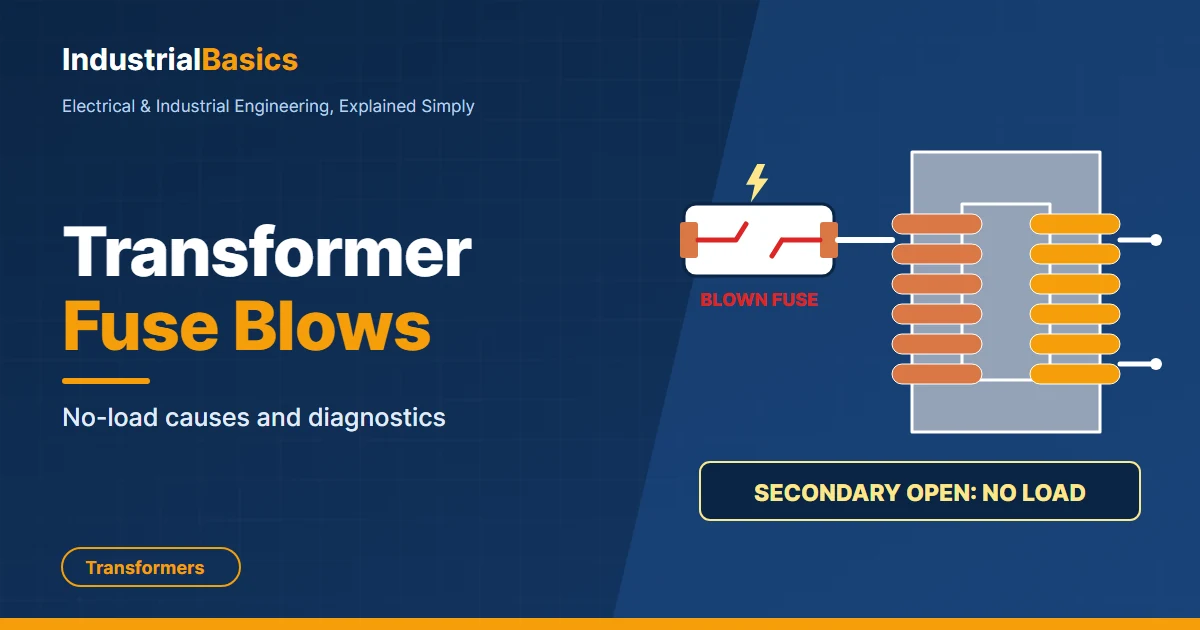
A transformer fuse that blows with no load is usually caused by magnetizing inrush on the wrong fuse, a wrong primary jumper or tap, a secondary wiring fault, or a shorted or grounded winding. Do not simply fit a larger fuse. Isolate the transformer, check the fuse type and supply voltage, verify the jumpers, disconnect the secondary and test the windings before you energize it again.
| Symptom | Likely cause | First check |
|---|---|---|
| Blows only at switch-on, transformer tests good | Inrush on a fast-acting or undersized fuse | Fuse class and rating |
| Blows instantly | Wrong jumper or shorted winding | Primary jumpers and winding resistance |
| Blows with secondary connected only | Secondary wiring fault | Disconnect the secondary and test |
| Blows after a voltage change | Wrong tap or supply voltage | Nameplate and supply voltage |
| Repeated blowing, smell or heat damage | Internal winding fault | Remove from service and test |
Why a Fuse Can Blow With No Load
A healthy transformer draws very little current once it is running with an open secondary. The risky moment is switch-on. As the core magnetizes, the transformer can draw a short inrush current of several times its full-load rating. Published magnitudes and durations vary by transformer, so use the manufacturer’s data for the exact unit.
| Cause | Why it blows the fuse | How to confirm |
|---|---|---|
| Inrush | Fuse cannot ride through the brief peak | Transformer tests good, fuse is fast-acting or small |
| Wrong jumper or tap | Winding sees too much voltage | Compare with the nameplate diagram |
| Wrong supply voltage | Core saturates and draws high current | Measure the supply safely |
| Secondary fault | A short is reflected to the primary | Disconnect the secondary and retest |
| Shorted turns | High current even with no load | Winding resistance and further testing |
| Ground fault | Winding or wiring touches ground | Insulation resistance test |
How to Diagnose It Step by Step
- Isolate and prove dead. Inspect for burn marks, heat damage or moisture.
- Check the fuse. Confirm its class, ampere rating and voltage rating.
- Check the supply. Compare the measured voltage with the nameplate.
- Check jumpers or taps against the transformer diagram.
- Disconnect the secondary load wiring.
- Measure winding resistance. Compare phases, the manufacturer’s data or an identical unit.
- Test insulation resistance from each winding to ground and between windings.
- Re-energize with the correct fuse and the secondary still disconnected. Then measure the secondary voltage.
If the fuse holds with the secondary disconnected but blows when it is reconnected, the fault is downstream. If it still blows, suspect the transformer or its primary wiring. Our guide to insulation resistance testing explains the insulation check.
Check dual-voltage jumpers
On a common 480/240 V control transformer, 480 V uses a series link from H2 to H3, while 240 V uses parallel links from H1 to H3 and H2 to H4. Connecting a unit jumpered for 240 V to a 480 V supply can blow the fuse at once. If a 120 V secondary reads about 60 V, look for single-phasing or a loose H2 to H3 jumper.
Check the Fuse Size
Use this to check whether a fuse is within common NEC limits. For a fault-free transformer, a time-delay or dual-element fuse is the usual way to ride through inrush.
| Primary current | Primary-only maximum | Primary with secondary protection |
|---|---|---|
| 9 A or more | 125% | 250% |
| 2 A to under 9 A | 167% | 250% |
| Under 2 A | 300% | 250% |
Where the 250% primary option is used, the secondary device is limited by the secondary current: 125% at 9 A or more, and 167% below 9 A.
Worked example: 15 kVA, 480/120 V
At 125%, the primary-only value is 39.06 A. VoltCalcs notes that the next-size rule lets this round up to a 40 A fuse. With proper secondary protection, the primary limit is 250%, or 78.1 A. Sources disagree on whether the 250% value may be rounded up, so stay at or below it, for example with a 70 A fuse, unless your code edition clearly allows more.
For more on the protective devices themselves, see fuse vs circuit breaker and protection coordination. For transformer basics, see types of transformers.
Frequently Asked Questions
Why does a transformer fuse blow with no load?
Common causes are magnetizing inrush on an unsuitable fuse, a wrong primary jumper or tap, the wrong supply voltage, a fault on the secondary wiring, or a shorted or grounded winding.
Can inrush current blow a transformer fuse?
Yes. A transformer can draw several times its full-load current briefly when energized. A fast-acting or undersized fuse may open even though the transformer is healthy.
What type of fuse should a transformer primary use?
Time-delay or dual-element fuses are commonly recommended because they tolerate short inrush while still protecting against sustained overload.
Can I just install a bigger transformer fuse?
No. First find the cause. A larger fuse can hide a real fault and may exceed the transformer or conductor protection limits.
What is the NEC limit for a transformer primary fuse?
For transformers up to 1000 V with primary-only protection, Table 450.3(B) is commonly summarized as 125% at 9 A or more, 167% from 2 A to under 9 A and 300% below 2 A.
How do I test a transformer after a fuse blows?
Isolate it, disconnect the secondary, check jumpers, compare winding resistance and test insulation resistance before re-energizing.
What does 0 ohms across a transformer primary mean?
A true zero reading points to a short. Small transformers can have very low winding resistance, so compare with the manufacturer’s data or an identical unit.
Why is my 120 V secondary reading 60 V?
On a series-connected dual-voltage control transformer, this can indicate single-phasing or a loose H2 to H3 jumper.
Sources and Further Reading
- VoltCalcs: Transformer Fuse Sizing, the NEC 450.3 Method: percentages and worked example.
- ExpertCE: Transformer Overcurrent Protection: inrush and time-delay fuses.
- ElectricalFlux: Wiring Transformer Control Circuits: jumpers, power-up faults and checks.
- Power Transformer Technical Guide: Transformer Fuse Size Chart: NEC 450.3 percentages.