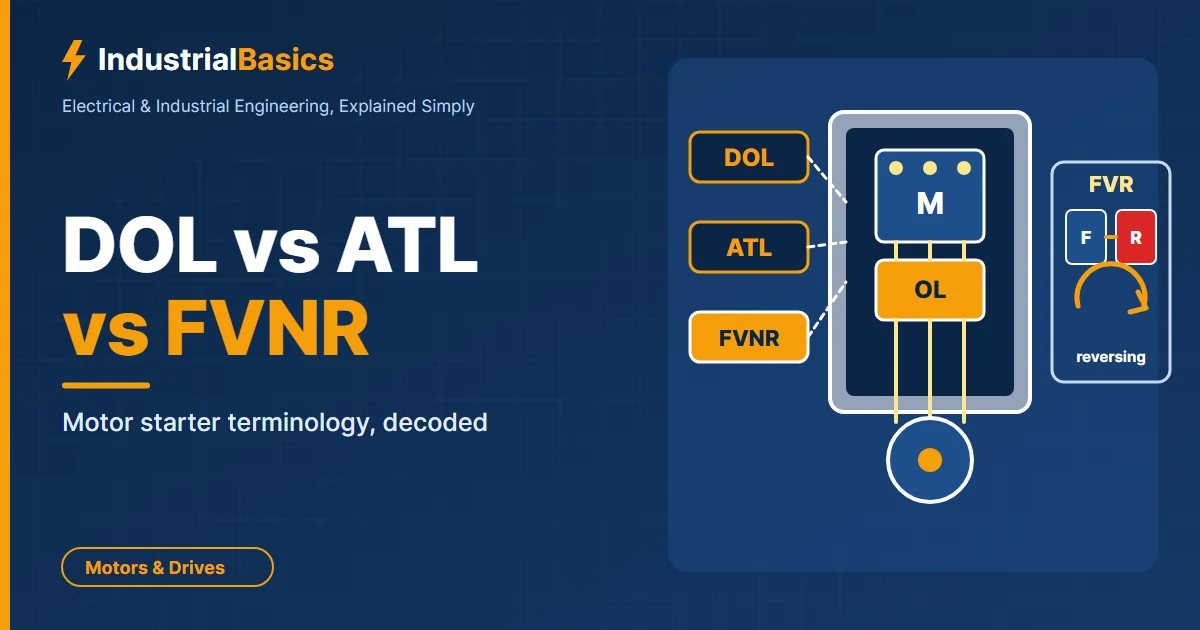
An FVNR starter (full voltage non-reversing) connects a motor straight to line voltage and runs it in one direction. DOL (direct-on-line) and ATL (across-the-line) describe exactly the same method. Add a second, interlocked contactor to swap two phases and the starter becomes FVR, full voltage reversing. The names change with region and document type, not with the circuit.
| Term | Stands for | Where you see it | Reverses? |
|---|---|---|---|
| DOL | Direct-on-line | IEC catalogues, UK and international drawings | No, unless a reversing DOL |
| ATL | Across-the-line | North American site and shop usage | No |
| FVNR | Full voltage non-reversing | NEMA starter catalogues, MCC and motor schedules | No |
| FVR | Full voltage reversing | NEMA catalogues, conveyor and hoist schedules | Yes |
| Combination | Starter plus disconnect and short-circuit protection | MCC buckets, enclosed starters | Either |
Why One Starter Has Three Names
ABB’s motor starting guide states it directly: direct-on-line, also known as across-the-line or Full Voltage Non-Reversing (FVNR) / Full Voltage Reversing (FVR), is the simplest, most compact and most cost-effective way to start a squirrel cage motor. Benshaw’s white paper uses “full voltage direct-on-line (DOL) or across-the-line starter” for the same thing.
The difference is the audience. IEC catalogues and international drawings say DOL. North American catalogues follow the NEMA naming, so Siemens Canada lists its SIRIUS starters as “Full Voltage Non-Reversing” and “Full Voltage Reversing”, and Schneider lists “Full Voltage Non-Reversing Controllers” in its Class 8536 modifications. Electricians on site often just say “across-the-line”. If you are new to the hardware itself, start with our guide to types of motor starters.
What Is Inside an FVNR Starter
Siemens describes its FVNR starters as an assembly of a 3RT contactor and a 3RU bimetal overload relay, designed for full-voltage across-the-line starting of single or three-phase squirrel cage motors. That pairing is the whole circuit:
- Contactor: the switching device. Its coil is energized by a start-stop station, a selector switch or a PLC output. See contactor vs relay for how it differs from a control relay.
- Overload relay: trips the contactor coil circuit when the motor draws too much current for too long. Our thermal overload relay guide covers setting it.
- Control power and pilot devices: often a control transformer, push buttons, a Hand-Off-Auto switch and pilot lights. These are listed as factory modifications in both the Siemens and Schneider catalogues.
A starter on its own has no short-circuit protection. When the disconnect and fuses or a circuit breaker are added in the same enclosure, it becomes a combination starter. Siemens offers both fusible switch and circuit breaker combination types.
FVNR vs FVR: Reversing Starters
An FVR starter has a forward contactor and a reverse contactor. The reverse contactor swaps two of the three supply phases, which reverses the rotating field and the shaft. ABB’s example is a conveyor that must change the direction of material flow.
If both contactors close at once, two phases are shorted together. Siemens builds its FVR starters from a 3RA reversing contactor assembly that includes both an electrical and a mechanical interlock. One acts in the control circuit and the other is a physical block, so a single failure does not let both close.
What Full Voltage Starting Means for the Supply
Benshaw’s white paper explains that a motor started direct-on-line always draws locked rotor current first, typically 600% to 900% of full load current, and that starting an unloaded motor is just as severe on the supply as starting a loaded one. It also produces a torque jolt from zero to locked rotor torque. Find the running current on the nameplate or in our full load amps guide.
ABB lists when DOL is the right choice: small motors (typically under 15 kW or 20 hp), motors that are not started too often, tight space, low cost, high break-away torque or a fast run-up. It also notes that some utilities restrict DOL starting for motors of 5.5 kW (7.5 hp) or higher, while plants with their own supply run DOL motors of 250 kW (350 hp) or more.
Reduced Voltage Alternatives
When FVNR is not allowed, the schedule will name a reduced voltage method instead. These are not FVNR or FVR, even though some include reversing variants.
| Method | How it reduces the start | Published figure |
|---|---|---|
| Star-delta (wye-delta) | Starts the windings in star, then switches to delta | Star voltage is 1/√3, about 58% of line voltage (ABB) |
| Autotransformer | Starts on a transformer tap | 50% tap gives 25% of locked rotor current and torque at the line (Benshaw) |
| Primary resistance | Series resistors drop voltage during start | Closed transition by design (Benshaw) |
| Soft starter | Ramps voltage electronically | Smoother start and stop (ABB) |
| VFD | Controls frequency and voltage | Full speed control, see our comparison |
A star-delta starter uses three contactors (star, delta and line) plus a timer, as ABB describes. Read more in star vs delta connection and VFD vs soft starter. Benshaw also warns that open transition switching, where the motor is briefly disconnected between steps, can cause transients worse than a full-voltage start.
Reading Starter Codes on Drawings and Schedules
Catalogue numbers often encode the starter type. In the Siemens SIRIUS selection guide, one position uses A for FVNR, B for FVR, and N, R, U and W for two-speed types. The two-speed codes are written as 2S1W (two speed, one winding) and 2S2W (two speed, two windings). Another position sets the disconnect: non-combination, circuit breaker combination, non-fusible or fusible combination.
Worked example
A motor schedule line reads: “CB COMB FVNR, EEMAC/NEMA 12, 120 V coil”. Decoded:
| Part | Meaning |
|---|---|
| CB COMB | Circuit breaker combination starter: breaker, contactor and overload in one enclosure |
| FVNR | Full voltage non-reversing, the same as a DOL or ATL starter |
| NEMA 12 | Dust-tight industrial enclosure (Siemens lists EEMAC Type 12 as dust tight) |
| 120 V coil | Contactor coil and control circuit voltage |
If the same line read FVR, you would expect a reversing pair with interlocks and forward, reverse and stop controls. For PLC control of either type, an interposing relay often sits between the PLC output and the contactor coil.
To put a number on that starting current for your own motor, use our locked rotor amps calculator.
Frequently Asked Questions
What does FVNR stand for?
FVNR stands for full voltage non-reversing. It is a starter that connects a motor straight to line voltage and runs it in one direction only.
Is FVNR the same as DOL?
Yes. ABB’s motor starting guide describes direct-on-line (DOL) as also known as across-the-line, or full voltage non-reversing (FVNR) and full voltage reversing (FVR).
What does ATL mean on a motor starter?
ATL means across-the-line: the motor is switched straight onto the supply at full voltage. It describes the same starting method as DOL and FVNR.
What is the difference between FVNR and FVR?
FVR adds a second contactor that swaps two supply phases to reverse the motor. Siemens builds its FVR starters with both electrical and mechanical interlocks so the two contactors cannot close together.
What is a combination FVNR starter?
A combination starter adds short-circuit protection and a disconnect, such as a fusible switch or a circuit breaker, to the starter in one enclosure.
How much current does an FVNR starter draw at start?
The motor draws locked rotor current. Benshaw’s white paper says this typically ranges from 600% to 900% of full load current, whether the motor is loaded or not.
When can I not use an FVNR starter?
When the supply cannot accept the starting current or the load cannot accept the torque jolt. ABB notes some utilities restrict DOL starting for motors of 5.5 kW (7.5 hp) or more.
What do 2S1W and 2S2W mean?
They are two-speed starter codes in Siemens catalogues: two speeds with one winding, or two speeds with two separate windings.
Sources and Further Reading
- ABB: Solution Guide, Motor Starting Solutions (1SFC100125C0346): DOL, FVNR and FVR terminology, star-delta, utility limits.
- Siemens Canada: SIRIUS HP Rated Magnetic Starters (catalogue chapter 10): FVNR and FVR construction, interlocks, codes.
- Benshaw: Motor Starting Solutions white paper: starting current, reduced voltage methods, transitions.
- Schneider Electric Digest: Full Voltage Contactors, Starters and Overload Relays: Class 8536 FVNR modifications.