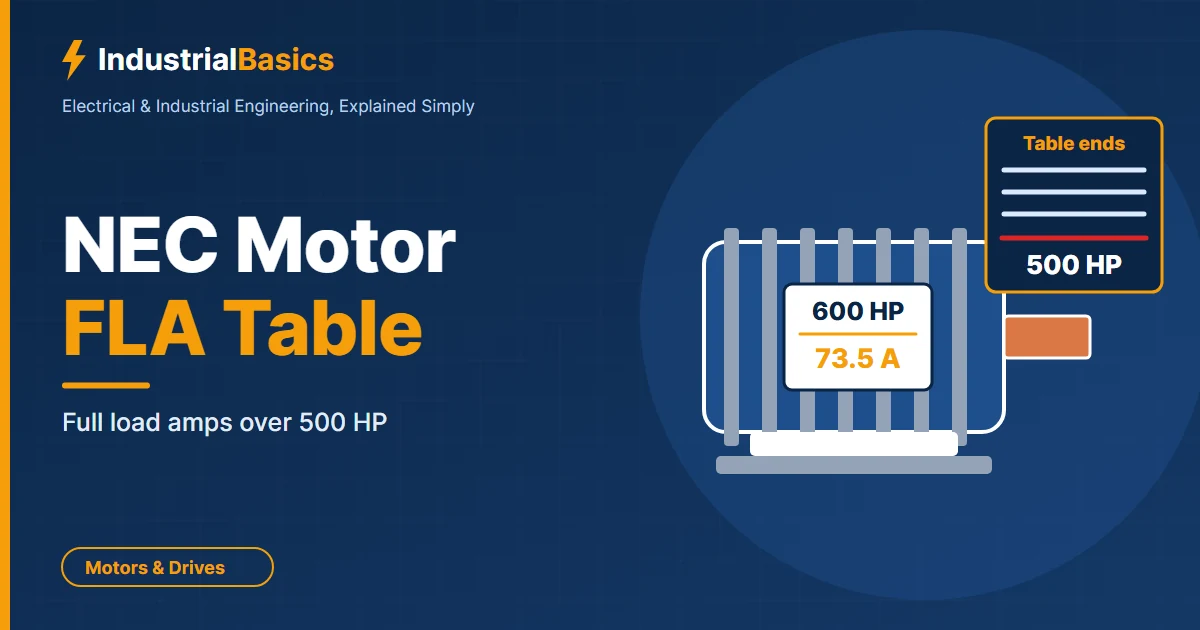
NEC Table 430.250 gives three-phase motor full-load current up to 500 HP. For example, a 500 HP induction motor at 460 V is listed at 590 A. Over 500 HP the table has no value, so use the motor maker’s rated current. For an early estimate, use I = HP × 745.7 ÷ (√3 × V × efficiency × power factor). A 600 HP, 4160 V motor at 96% efficiency and 0.88 power factor draws about 73.5 A.
NEC Motor FLA Table: Three-Phase Induction Motors
| HP | 230 V | 460 V | 575 V | 2300 V |
|---|---|---|---|---|
| 25 | 68 | 34 | 27 | — |
| 30 | 80 | 40 | 32 | — |
| 40 | 104 | 52 | 41 | — |
| 50 | 130 | 65 | 52 | — |
| 60 | 154 | 77 | 62 | 16 |
| 75 | 192 | 96 | 77 | 20 |
| 100 | 248 | 124 | 99 | 26 |
| 125 | 312 | 156 | 125 | 31 |
| 150 | 360 | 180 | 144 | 37 |
| 200 | 480 | 240 | 192 | 49 |
| 250 | — | 302 | 242 | 60 |
| 300 | — | 361 | 289 | 72 |
| 350 | — | 414 | 336 | 83 |
| 400 | — | 477 | 382 | 95 |
| 450 | — | 515 | 412 | 103 |
| 500 | — | 590 | 472 | 118 |
The table states that these are typical values for motors running at speeds usual for belted motors with normal torque characteristics. Its listed currents are also permitted for system voltage ranges of 220 to 240, 440 to 480 and 550 to 600 V. For smaller motors and the difference between FLC and nameplate FLA, read our full load amps guide.
Which Current Should You Use?
| Value | Source | Use it for |
|---|---|---|
| Table FLC | NEC Table 430.250 | Code-based sizing for motors in the table |
| Nameplate FLA | The motor | Current the motor is designed to draw at rated load and voltage |
| Maker’s data sheet | Motor manufacturer | Large or medium-voltage motors outside the table |
| Calculated estimate | Formula | Early planning before a motor is selected |
Motor Current Calculator for Over 500 HP
Enter the motor size and voltage. If you have the data sheet, use its full-load efficiency and power factor.
The Formula
| Symbol | Meaning | Unit |
|---|---|---|
| HP | Rated motor output | Horsepower |
| 745.7 | Watts per horsepower | W/HP |
| V | Line-to-line voltage | Volts |
| η | Full-load efficiency, as a decimal | — |
| PF | Full-load power factor, as a decimal | — |
| I | Line current | Amps |
Worked Example: 600 HP at 4160 V
- Input power: 600 × 0.7457 ÷ 0.96 = 466.1 kW
- Apparent power: 466.1 ÷ 0.88 = 529.6 kVA
- Current: 529,600 ÷ (1.732 × 4160) ≈ 73.5 A
| Motor | Voltage | Estimated FLA |
|---|---|---|
| 600 HP | 2300 V | 132.9 A |
| 600 HP | 4160 V | 73.5 A |
| 1000 HP | 4160 V | 122.5 A |
Why the formula and the table differ
At 500 HP and 460 V, assuming 95% efficiency and 0.88 power factor, the formula gives 560 A. The table lists 590 A. That gap is normal, because the table is a set of typical values and the formula depends on the efficiency and power factor you assume. Do not substitute one for the other in a code calculation.
What the Current Affects
Full-load current feeds into several design decisions. These include the conductor size, the protective device, the overload setting, the starting method and the CT ratio for metering and protection. Large motors also draw high starting current, so check voltage dip and consider a VFD or soft starter.
To check the physical size and mounting of a replacement motor, see our motor frame size chart.
Frequently Asked Questions
What is the NEC motor FLA table?
For three-phase AC motors, it is NEC Table 430.250. It lists typical full-load currents by horsepower and voltage, up to 500 HP in the 2011 edition we reviewed.
What is the full load current of a 500 HP motor at 460 V?
Table 430.250 lists 590 A for an induction motor at 460 V in the 2011 NEC.
How do I find FLA for a motor over 500 HP?
The table has no row for it, so use the rated current from the motor maker’s data sheet or nameplate. Use the formula only as an early estimate.
What is the formula for three-phase motor current?
I = HP × 745.7 ÷ (√3 × V × efficiency × power factor), with efficiency and power factor written as decimals.
What is the current of a 600 HP motor at 4160 V?
At an assumed 96% efficiency and 0.88 power factor, it is about 73.5 A. The real value depends on the motor design.
Why is the table value higher than my nameplate?
The table lists typical values for sizing, while the nameplate gives the rated current of that specific motor. They are used for different purposes.
Does the table include 4160 V motors?
The 2011 table we reviewed has columns up to 2300 V. For 4160 V or 4000 V motors, use manufacturer data.
Can I use this table for synchronous motors?
The table has separate unity power factor columns for synchronous motors, with multipliers for 90% and 80% power factor. The values on this page are for induction motors.
Sources and Further Reading
- NECA-IBEW: NEC 2011 Table 430.250: three-phase full-load currents.
- US Department of Energy: Determining Electric Motor Load and Efficiency: three-phase power and efficiency relationships.
- ABB: How to Read a NEMA Motor Nameplate: full-load amps and power factor.