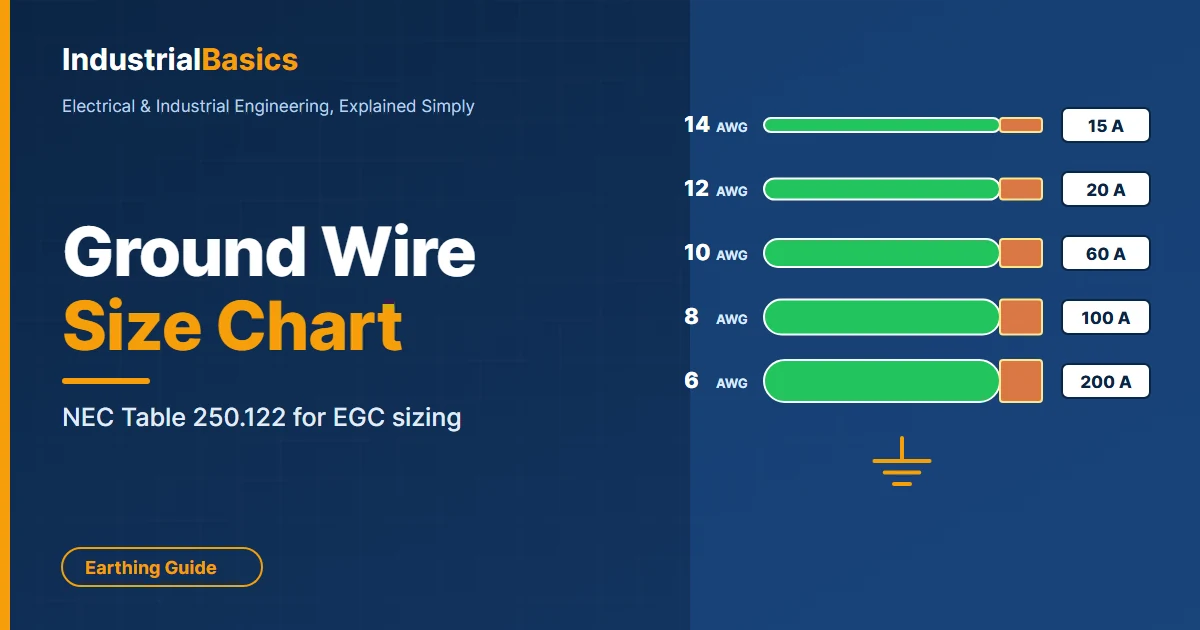
Under NEC Table 250.122, the ground wire is sized from the breaker or fuse rating, not the wire ampacity. Common copper sizes are 14 AWG for 15 A, 12 AWG for 20 A, 10 AWG for 30 to 60 A, 8 AWG for 100 A and 6 AWG for 200 A. If a rating falls between two rows, use the next higher row. This chart covers equipment grounding conductors (EGCs), the ground wires run with a circuit.
| Breaker or fuse (not exceeding) | Copper EGC | Aluminum or copper-clad aluminum EGC |
|---|---|---|
| 15 A | 14 AWG | 12 AWG |
| 20 A | 12 AWG | 10 AWG |
| 60 A | 10 AWG | 8 AWG |
| 100 A | 8 AWG | 6 AWG |
| 200 A | 6 AWG | 4 AWG |
| 300 A | 4 AWG | 2 AWG |
| 400 A | 3 AWG | 1 AWG |
| 500 A | 2 AWG | 1/0 AWG |
| 600 A | 1 AWG | 2/0 AWG |
| 800 A | 1/0 AWG | 3/0 AWG |
| 1000 A | 2/0 AWG | 4/0 AWG |
| 1200 A | 3/0 AWG | 250 kcmil |
| 1600 A | 4/0 AWG | 350 kcmil |
| 2000 A | 250 kcmil | 400 kcmil |
How to Read the Ground Wire Size Chart
- Find the overcurrent device rating protecting the circuit.
- Go to the first row that equals or exceeds that rating.
- Read the size in the column for your conductor material.
- Check whether the hots were upsized for voltage drop.
- Check parallel runs, because each raceway or cable needs its own EGC.
- Confirm the EGC need not exceed the size of the circuit conductors.
The EGC’s main job is to carry fault current back to the source so the breaker or fuse opens quickly. That is why its size follows the protective device. To choose the circuit conductors themselves, use our AWG wire ampacity chart.
EGC vs GEC: Use the Right Table
“Ground wire” can mean two different conductors. Confusing them is one of the most common sizing mistakes.
| Point | EGC | GEC |
|---|---|---|
| Full name | Equipment grounding conductor | Grounding electrode conductor |
| Connects | Equipment to the panel | System to the grounding electrode |
| NEC table | Table 250.122 | Table 250.66 |
| Sized from | Overcurrent device rating | Largest ungrounded service conductor |
| 200 A example | 6 AWG copper | 4 AWG copper with 2/0 or 3/0 copper service conductors |
Table 250.66 for grounding electrode conductors
| Largest copper service conductor | Copper GEC | Aluminum GEC |
|---|---|---|
| 2 AWG or smaller | 8 AWG | 6 AWG |
| 1 or 1/0 AWG | 6 AWG | 4 AWG |
| 2/0 or 3/0 AWG | 4 AWG | 2 AWG |
| Over 3/0 through 350 kcmil | 2 AWG | 1/0 AWG |
| Over 350 through 600 kcmil | 1/0 AWG | 3/0 AWG |
| Over 600 through 1100 kcmil | 2/0 AWG | 4/0 AWG |
| Over 1100 kcmil | 3/0 AWG | 250 kcmil |
The GEC can be smaller for some electrodes. A sole connection to a rod, pipe or plate electrode is not required to be larger than 6 AWG copper or 4 AWG aluminum, and a sole connection to a concrete-encased electrode is not required to be larger than 4 AWG copper. For how these conductors fit into a complete system, see our guides to earthing systems and earthing vs grounding.
When the Ground Wire Must Be Upsized
If you increase the ungrounded conductors beyond the size needed for ampacity, usually to reduce voltage drop, NEC 250.122(B) requires a wire-type EGC to increase by the same circular-mil ratio.
Worked example: 200 A feeder
A 200 A feeder would normally use 3/0 copper with a 6 AWG copper EGC. It is upsized to 250 kcmil for voltage drop.
| Step | Calculation | Result |
|---|---|---|
| Original conductor | 3/0 AWG copper | 167,800 cmil |
| Larger conductor | 250 kcmil copper | 250,000 cmil |
| Ratio | 250,000 / 167,800 | 1.49 |
| Table EGC | 6 AWG copper | 26,240 cmil |
| Required EGC area | 26,240 × 1.49 | About 39,100 cmil |
| Next standard size | 4 AWG = 41,740 cmil | 4 AWG copper |
Sizing the Ground in Multiconductor Cable and Parallel Runs
In a parallel installation, the EGC is not divided between the runs. Under NEC 250.122(F), each raceway or cable gets its own EGC, sized from the full rating of the overcurrent device.
| Overcurrent device | Parallel sets | EGC in each raceway or cable (copper) |
|---|---|---|
| 400 A | 2 | 3 AWG |
| 800 A | 2 | 1/0 AWG |
| 1200 A | 3 | 3/0 AWG |
| 1600 A | 3 | 4/0 AWG |
This matters most with factory-made multiconductor cable. The built-in ground is sized for the cable’s use as a single run, so it may be too small when several cables are paralleled on one large breaker. Compare the cable’s actual ground size with the table before you buy it, and check the multiconductor cable provisions in 250.122(F) for your code edition. Our guide to types of electrical cables covers common constructions.
Motor circuits
For motor circuits, NEC 250.122(D) bases the EGC on the rating of the motor’s short-circuit and ground-fault protective device. If you need the motor current first, see our guide to full load amps.
Common Ground Wire Sizing Mistakes
| Mistake | Why it is wrong | Correct approach |
|---|---|---|
| Sizing from the load current | The table uses the device rating | Use the breaker or fuse rating |
| Using Table 250.66 for a feeder EGC | That table is for GECs | Use Table 250.122 |
| Rounding a 50 A circuit down | There is no 50 A row | Use the 60 A row |
| Not upsizing with the hots | The fault path stays too weak | Apply the circular-mil ratio |
| Dividing the EGC across parallel runs | Each run needs a full EGC | Size each from the full device rating |
| Assuming cable grounds are adequate | Paralleling can change the need | Check against the table |
To see where Table 250.122 sits among the other grounding rules, read our NEC Article 250 guide.
Frequently Asked Questions
What size ground wire do I need for a 200 amp circuit?
NEC Table 250.122 requires 6 AWG copper or 4 AWG aluminum for an equipment grounding conductor on a 200 A device. A service grounding electrode conductor is sized differently, from Table 250.66.
What size ground wire for a 100 amp circuit?
Use 8 AWG copper or 6 AWG aluminum as the equipment grounding conductor.
What size ground wire for a 50 amp circuit?
Table 250.122 has no 50 A row, so use the 60 A row: 10 AWG copper or 8 AWG aluminum.
What size ground wire for a 30 amp circuit?
A 30 A circuit also uses the 60 A row, which is 10 AWG copper or 8 AWG aluminum.
Does the ground wire have to be the same size as the hot wire?
No. It is usually smaller. It must meet Table 250.122 but generally does not have to be larger than the circuit conductors.
Do I have to upsize the ground wire for voltage drop?
Generally yes. If the ungrounded conductors are made larger than needed for ampacity, NEC 250.122(B) requires a wire-type EGC to increase in proportion by circular mil area.
How do I size the ground in parallel conduits?
Each raceway or cable gets its own EGC, sized from the full rating of the overcurrent device, as described in NEC 250.122(F).
What is the difference between Table 250.122 and Table 250.66?
Table 250.122 sizes equipment grounding conductors from the overcurrent device rating. Table 250.66 sizes grounding electrode conductors from the service conductor size.
Sources and Further Reading
- WireSizing: NEC Table 250.122: equipment grounding conductor sizes.
- WireSizing: NEC Table 250.66: grounding electrode conductor sizes.
- JCR Productions: Equipment Grounding Conductor Size: upsizing, parallel and motor rules.
- JCR Productions: Grounding Electrode Conductor Size: electrode-specific limits.
- IAEI Magazine: Sizing of Conductors Related to Grounding and Bonding: how the Code sections fit together.
- PDH Online: Voltage Drop Tables: circular mil areas.
- NFPA 70, National Electrical Code: the official code page.