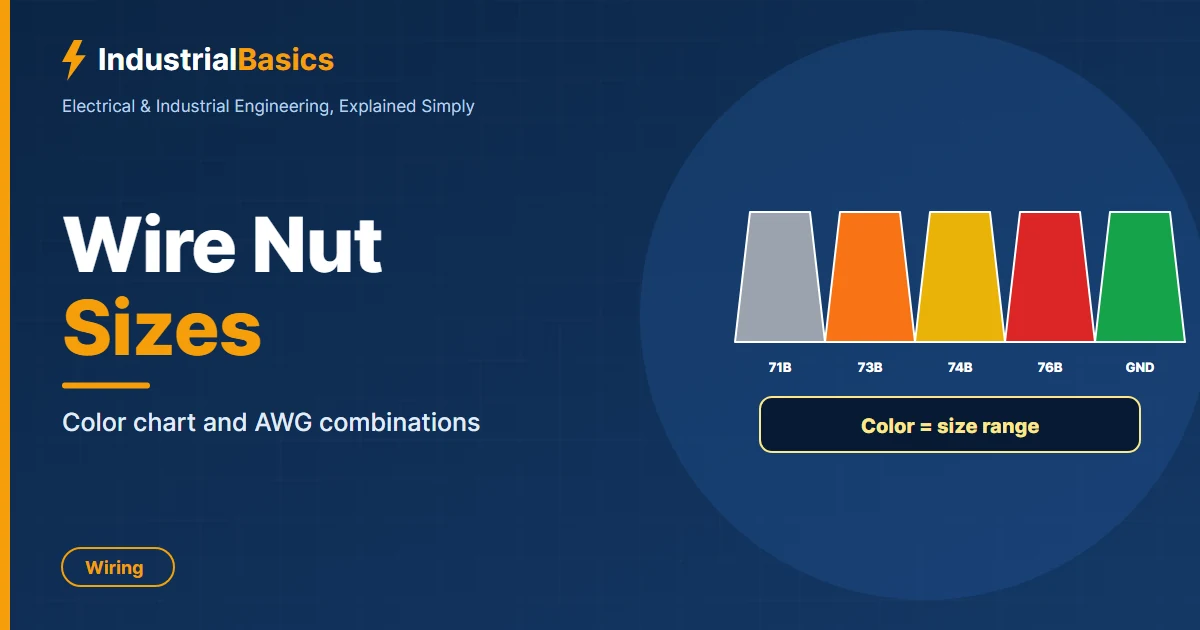
Wire nut sizes are identified by color, but colors are set by each manufacturer. On IDEAL connectors: gray 71B is 22–16 AWG, blue 72B and orange 73B are 22–14, yellow 74B is 18–12 and red 76B is 18–6. Larger Wing-Nuts run up to 6 AWG, and green connectors are for grounding. Every connector lists a minimum and maximum wire combination. A splice must match a combination printed on that package, and ordinary wire nuts are not for aluminum, wet or vibrating locations.
Wire Nut Size Chart
| Color / model | Line | Wire range | Minimum | Maximum | Voltage |
|---|---|---|---|---|---|
| Gray 71B | Wire-Nut | #22 – #16 | 2 #22 | 2 #16 | 300 V |
| Blue 72B | Wire-Nut | #22 – #14 | 2 #22 | 3 #16 | 300 V |
| Orange 73B | Wire-Nut | #22 – #14 | 1 #18 + 1 #20 | 2 #14 | 600 V |
| Yellow 74B | Wire-Nut | #18 – #12 | 2 #18 | 4 #14 + 1 #18 | 600 V |
| Red 76B | Wire-Nut | #18 – #6 | 2 #14 | 4 #12 | 600 V |
| Yellow 451 | Wing-Nut | #18 – #10 | 2 #18 | 3 #12 | 600 V |
| Red 452 | Wing-Nut | #18 – #8 | 2 #18 | 4 #10 | 600 V |
| Blue 454 | Wing-Nut | #14 – #6 | 3 #12 | 1 #6 + 2 #8 | 600 V |
| Green 92 | Greenie (ground) | #14 – #10 | 2 #14 | 4 #12 | – |
Wire Nut Finder
How Twist-On Connectors Work
A twist-on wire connector has an insulating plastic shell around a tapered, coiled metal spring. Twisting it onto stripped conductors draws the wires into the spring and squeezes them together. Continuity comes from both wire-to-wire contact and contact with the insert (Wikipedia). IDEAL describes its square-wire spring as cutting its own threads, with no pre-twisting needed. Its deep skirt protects against flash-over, and the shell is rated 105 °C (UL 94V-2).
- Strip to the length shown on the package.
- Hold the wires parallel with the ends even (pre-twisting optional on many models).
- Twist the connector on clockwise until tight and the wires twist together beyond the skirt.
- Tug each wire: none should pull out, and no bare copper should show below the skirt.
Where Wire Nuts Should Not Be Used
- Aluminum wire: not generally recommended in the US; the CPSC disapproves wire nuts for aluminum. Use connectors listed for aluminum.
- Wet or buried locations: ordinary connectors are not rated; use gel-filled connectors.
- Vibration: not used in automotive or trailer wiring.
- Large stiff wire: rarely used above 10 AWG solid; use set-screw, crimp or mechanical lugs.
- High temperature: use high-temperature versions (IDEAL lists black 150 °C models) or ceramic connectors in fixtures and heating appliances.
Grounding Connectors
Green connectors join equipment grounding conductors. IDEAL lists its Greenie 92 for 14–10 AWG, from 2 #14 up to 4 #12. It is listed to UL 467 and helps meet NEC 250.146 and 250.148, which require all grounding conductors in a box to be connected together and to a metal box (see NEC Article 250). Feed-through versions let one bare conductor pass out of the top as a pigtail to the box or device screw.
For conductor ampacity, see the AWG wire ampacity chart.
Frequently Asked Questions
What size wire nut do I need for two 12-gauge wires?
Several IDEAL models include #12 in their range: yellow 74B (18–12), red 76B (18–6) and yellow Wing-Nut 451 (18–10). Whether 2 #12 is a listed combination for a given model must be confirmed on its package.
What do wire nut colors mean?
Color indicates size and capacity, but there is no universal code: each manufacturer sets its own. On IDEAL connectors, gray and blue are smallest, then orange, yellow and red; Wing-Nut blue is the largest.
What is the capacity of a blue wire nut?
It depends on the line. IDEAL’s blue Wire-Nut 72B is small (22–14 AWG, max 3 #16, 300 V), while the blue Wing-Nut 454 is large (14–6 AWG, up to 1 #6 + 2 #8).
What size is an orange wire nut?
IDEAL 73B orange covers 22–14 AWG: minimum 1 #18 with 1 #20, maximum 2 #14, 600 V.
What size is a yellow wire nut?
IDEAL 74B yellow covers 18–12 AWG: minimum 2 #18, maximum 4 #14 + 1 #18. The yellow Wing-Nut 451 covers 18–10 AWG, maximum 3 #12.
What size is a red wire nut?
IDEAL 76B red covers 18–6 AWG: minimum 2 #14, maximum 4 #12. The red Wing-Nut 452 covers 18–8 AWG, up to 4 #10.
What is a green wire nut for?
Grounding. IDEAL’s Greenie connectors join equipment grounding conductors; feed-through versions let a bare ground pass through the top as a pigtail to the box screw (Wikipedia).
Can wire nuts be used on aluminum wire?
Ordinary twist-on connectors are not generally recommended for aluminum in the US; the CPSC disapproves of wire nuts for aluminum wiring. Use connectors specifically listed for aluminum (Wikipedia).
Can wire nuts be used outdoors or underground?
Not ordinary ones. Wet or buried locations need gel-filled connectors rated for wet use. Wire nuts are also not used in vibration-prone places such as vehicles (Wikipedia).
What is the largest wire for a wire nut?
Twist-on connectors are rarely used above 10 AWG solid, which is too stiff to twist reliably (Wikipedia), though some models such as IDEAL’s red 76B and blue Wing-Nut 454 are listed to 6 AWG.
Sources and Further Reading
- IDEAL Industries: Wire-Nut wire connectors catalog page (via Galco): models, colors, ranges, combinations, ratings.
- IDEAL Industries: Wing-Nut and Greenie connectors catalog page (via Galco).
- Wikipedia: Twist-on wire connector: construction, limits, aluminum, wet locations, grounding pigtails.