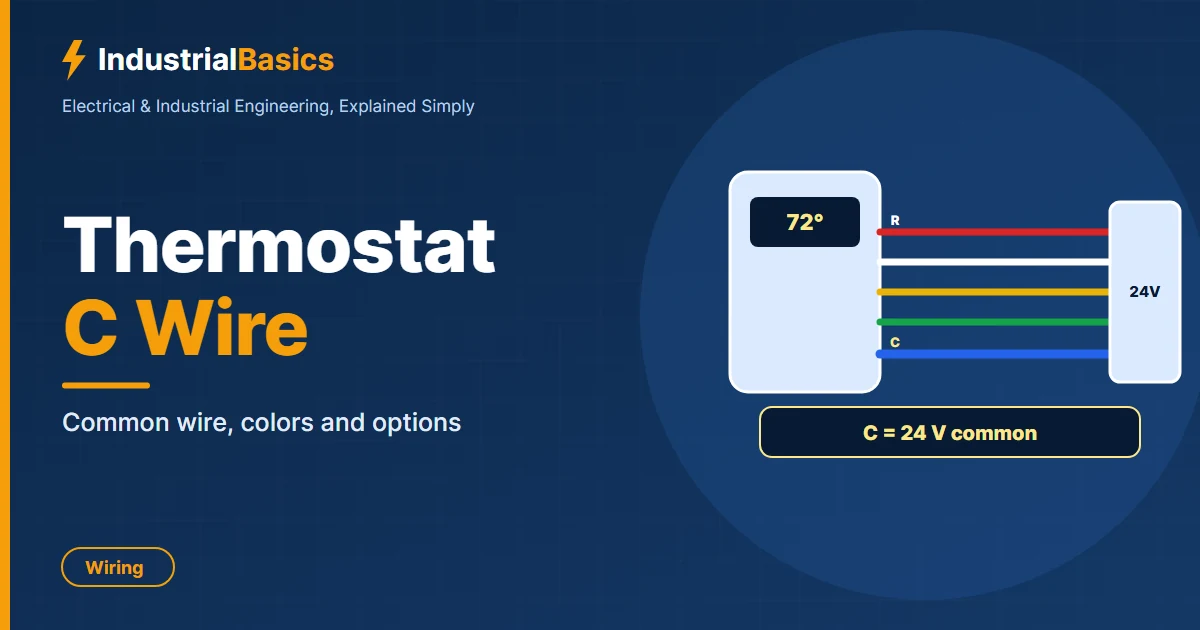
The C wire (common wire) is the 24-volt return conductor that runs from the thermostat back to the furnace or air handler transformer. Together with the R (24 V hot) wire, it gives the thermostat continuous power, which smart and Wi-Fi thermostats need. It is often blue, but there is no color standard, so go by the terminal letter C. If you have no C wire, use a spare conductor in the bundle, an add-a-wire kit or new cable, or a thermostat designed to work without one.
What the C Wire Does
Most US heating and cooling thermostats work on a low-voltage control circuit, typically 24 VAC, supplied by a control transformer in the furnace or air handler (Wikipedia). With four wires, red brings 24 V to the thermostat, and the thermostat connects it to white for heat, yellow for cooling or green for the fan. A relay at the equipment then starts that function.
Those call wires only carry current when the thermostat closes them. A smart thermostat needs power all the time. The C wire is the return leg that lets it draw power from R to C without closing a call (The Smart Cave). Older mechanical or battery thermostats needed almost no standing power, so many homes were never wired with C.
Thermostat Wire Colors and Terminals
| Terminal | Usual color | Function |
|---|---|---|
| R | Red | 24 V hot; often jumpered to Rh and Rc |
| Rh / Rc | Red | 24 V for heat / cool when there are two transformers |
| C | Blue, black, brown or cyan | 24 V common (return) to the transformer |
| W / W1 | White | Heat |
| W2 | Varies | 2nd-stage or backup heat |
| Y / Y1 | Yellow | Cool (compressor) |
| Y2 | Varies | 2nd-stage cool |
| G | Green | Fan |
| O | Orange (varies) | Heat pump reversing valve, energize to cool |
| B | Varies | Reversing valve energize to heat, or common on some brands |
| E | Varies | Emergency heat (heat pump) |
How to Tell If You Have a C Wire
- Turn off power to the furnace or air handler at the breaker or service switch.
- Remove the thermostat face and photograph the wiring.
- Look for a wire on a terminal marked C. If there is one, you have a C wire.
- If C is empty, gently pull the bundle and look for an unused conductor folded back into the wall.
- At the furnace or air handler board, check what is on the C terminal and match its color at the thermostat.
Finding the wire is not the whole job. Modern Air notes that the common tap must land on the correct point at the equipment, and the low-voltage transformer must have enough capacity to power a thermostat continuously. Low-voltage wiring can still be live when the thermostat looks dead, and shorting two terminals can damage the control board.
No C Wire? Your Options
- Use a spare conductor already in the cable as C, connected at both ends.
- Add-a-wire / power extender kit at the furnace board, which works for most single-stage systems.
- Run new thermostat cable, the best long-term fix but it may mean fishing through walls.
- 24 VAC plug-in adapter at the thermostat location (The Smart Cave lists this option).
- Choose a thermostat that works without C (power stealing), accepting possible Wi-Fi and battery trade-offs.
Heat Pumps and Other Systems
Heat pumps use a reversing valve: most residential thermostats energize O in cooling, while some brands energize B in heating. E brings on emergency electric heat when the compressor cannot run (Wikipedia). Multi-stage systems add W2 and Y2. Zoned and dual-fuel systems may have several transformers. HVAC Optimizer advises stopping and calling a professional when there are multiple transformers, zoning panels or dual-fuel controls, or brittle or scorched wiring.
Line-voltage thermostats for baseboard heaters switch 120 or 240 V directly and have no C wire. Never fit a 24 V thermostat to a line-voltage circuit (Wikipedia). For the relays these control circuits drive, see contactor vs relay. For HVAC fan and pump speed control, see VFDs in HVAC.
Frequently Asked Questions
What is a C wire on a thermostat?
The common wire: the 24 VAC return leg back to the furnace or air handler transformer. With R (24 V hot) it gives the thermostat a continuous power circuit, so a smart thermostat’s screen and Wi-Fi can run all the time.
What color is the C wire?
Often blue, but there is no standard. Wikipedia lists cyan, black, blue or brown for C. Always go by the terminal letter at both the thermostat and the furnace board, not the color.
Does the C wire power the thermostat?
Not on its own. R supplies the 24 V; C is the return path that completes the circuit without using the heat, cool or fan call wires (The Smart Cave).
How do I know if I have a C wire?
Switch off power, remove the thermostat face and look for a wire on a terminal marked C. If none, look for an unused wire folded into the wall, then check the C terminal on the furnace control board and match the color.
Why do smart thermostats need a C wire?
Their Wi-Fi radio and color screen need constant power. Older thermostats used batteries or tiny amounts of borrowed power and never needed C.
What is power stealing?
Drawing a little current through the call wires when no C wire is present. It can work, but may cause Wi-Fi drops, a dead display when the system is idle, or humming and odd cycling on some equipment (HVAC Optimizer).
Can I use the G wire as a C wire?
Some do, but you give up independent fan control, since G then becomes the common path and can no longer run the blower on its own. It only works if your thermostat does not need G for its own features (Modern Air).
What is an add-a-wire kit?
An adapter installed at the furnace board that creates a common path over the existing wires. It suits most single-stage systems; on multi-stage, zoned or dual-fuel systems it can cost you a stage.
Is the C wire high voltage?
No. It is part of the 24 VAC control circuit. Shut off power anyway: a slip that shorts two terminals can damage the control board (Modern Air).
Can a miswired C wire damage anything?
Yes. Miswiring a single terminal can damage a control board, the transformer or the thermostat (Modern Air). Switch off power before working and photograph the wiring first.
Sources and Further Reading
- Wikipedia: Thermostat: 24 VAC control circuits, terminal codes and colors, heat pump terminals.
- The Smart Cave: What is a C wire?: return path, checking for C, fixes.
- HVAC Optimizer: The C-wire explained: power stealing symptoms, when to call a pro.
- Modern Air Conditioning and Heating: What a thermostat C-wire is: low-voltage circuit and terminals.