
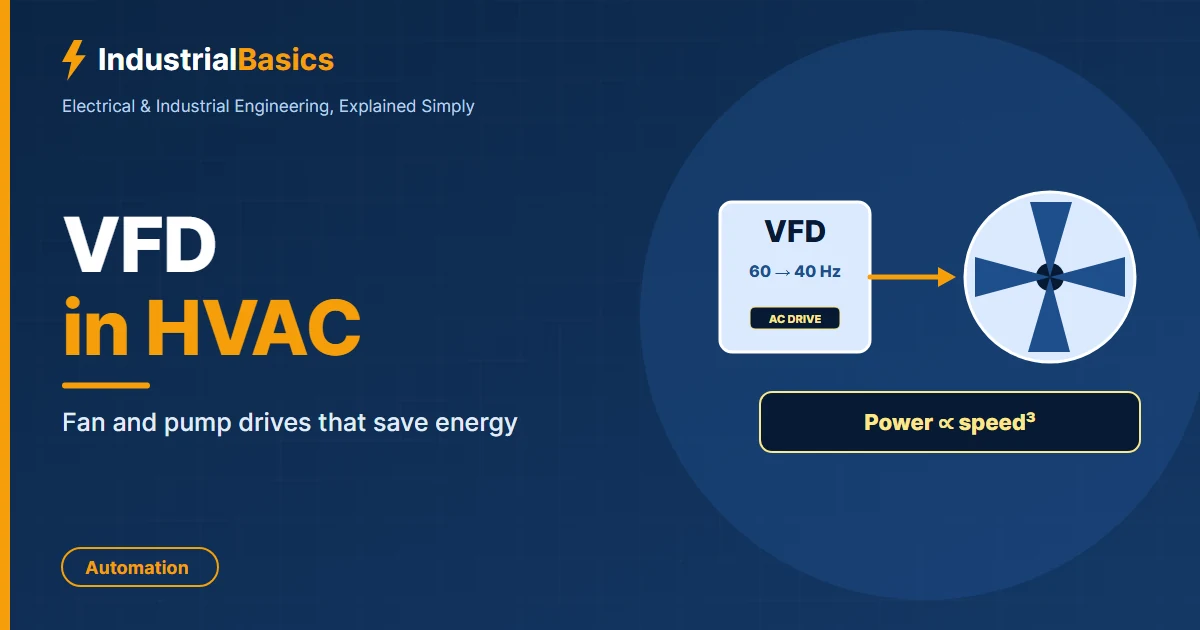
A VFD in HVAC changes the speed of fan, pump and compressor motors to match the actual load, instead of running at full speed and throttling with dampers or valves. For centrifugal fans and pumps, power falls with the cube of speed, so a 20% speed cut can save about 50% of input power (DOE). Typical HVAC savings are 30–50% for fans and pumps and up to 35% for compressors (IntechOpen). The drive also gives a soft start and reports speed and power to the building automation system.
How a VFD Saves Energy: the Affinity Laws
The affinity laws (fan laws) relate speed to flow, pressure and power for geometrically similar fans and pumps. They assume efficiency stays constant, which is rarely exact but close over a sensible speed range (Wikipedia). DOE notes the cube law applies to centrifugal fans or pumps with no static lift. A pump lifting water to a fixed height, or a system with a high fixed pressure, saves less. For converting drive frequency to speed, see Hz and RPM.
Constant-torque loads behave differently: power falls only in proportion to speed. DOE lists cranes, hoists, conveyors, extruders, mixers, positive displacement pumps and reciprocating and rotary screw air compressors.
VFD Energy Savings Calculator
DOE’s worked example is a 20 hp exhaust fan drawing 16.4 kW at full speed. At half speed it needs 1/8 of full shaft power. Even with motor efficiency down to 77.8% and drive efficiency 86%, input falls to 2.8 kW, an 82.9% reduction. Real savings need the duty cycle, meaning the share of hours at each speed, plus part-load drive and motor efficiencies from the manufacturer.
Where VFDs Are Used in HVAC Systems
| Equipment | What the VFD controls to |
|---|---|
| Supply fan, single-duct VAV AHU | Duct static pressure (set point can be reset as load falls) |
| Return fan, VAV AHU | Airflow difference to the supply fan (volume tracking); return or building pressure is less reliable |
| Supply fans, dual-duct VAV | Cold-deck static pressure (single fan) or each deck’s own static pressure (dual fan) |
| Single-zone AHU or fan coil | Zone load; two-speed or VFD control required by ASHRAE 90.1 (2010 on) above set sizes |
| Exhaust fans (labs, hospitals) | Suction pressure, or supply/exhaust airflow difference for building pressure |
| Secondary chilled water pumps | Loop differential pressure or supply/return temperature difference |
| Primary chilled water pumps | Track the secondary pumps, but stay above the chiller minimum flow |
| Condenser water pumps | Loop differential pressure or temperature difference |
| Cooling tower fans | Leaving condenser water temperature |
| Compressors (RTU, chiller, CRAC) | Capacity; minimum speed set by oil return and resonance |
In a single-duct VAV system, the supply fan VFD holds duct static pressure. As zone boxes close at part load, the drive slows the fan, and resetting the static-pressure set point downward saves more. For the airflow side of ventilation design, see air changes per hour.
VFD vs Dampers, Valves and Two-Speed Motors
| Method | How flow is reduced | Energy effect |
|---|---|---|
| Outlet damper or throttling valve | Adds resistance; fan or pump stays at full speed | Smaller saving: fan or pump keeps running at full speed |
| Two-speed motor | Switches between two fixed speeds | Saves at low speed, but steps rather than tracking the load |
| VFD | Slows the motor to the needed speed | Largest saving on variable-torque loads; soft start; adds drive losses and harmonics |
For how a VFD differs from a reduced-voltage starter, see VFD vs soft starter and types of motor starters.
Setup and Installation Considerations
- Minimum speed: about 30% (18 Hz) is a common drive-maker recommendation to protect motor cooling; about 20% (12 Hz) with inverter-duty motors. Fans are often limited near 20 Hz to keep fresh air and air throw (IntechOpen).
- Maximum speed: normally 60 Hz in the US; running above base speed is uncommon and not recommended.
- Skip frequencies: program the drive to step over speeds where the fan, pump or compressor resonates.
- Chiller flow: primary chilled water pumps must stay above the chiller’s minimum flow or the low-flow alarm trips the chiller.
- Interference: keep motor leads short (a 200 ft guideline), use the lowest workable carrier frequency, shielded or armored cable and separate conduits for power, control and communications, and inverter-rated motors.
- Harmonics: the rectifier distorts supply current; with many drives, add line reactors, filters or multi-pulse drives (Wikipedia). See power quality problems.
For the 24 VAC thermostat wiring that starts these fans and compressors, see our guide to the thermostat C wire.
Frequently Asked Questions
What is a VFD in HVAC?
A variable frequency drive is a solid-state motor controller that changes the frequency and voltage supplied to an AC motor, so fans, pumps and compressors run only as fast as the load requires. It is also called an adjustable speed drive (ASD), AC drive or inverter (DOE; IntechOpen).
How much energy does a VFD save on an HVAC fan?
Fan power falls roughly with the cube of speed. DOE says a 20% speed reduction can cut input power by about 50%. IntechOpen reports typical savings of 30–50% for fans and pumps and up to 35% for compressors.
Why does power fall with the cube of speed?
For a centrifugal fan or pump, flow is proportional to speed, pressure to speed squared, and power (flow × pressure) to speed cubed. These are the affinity laws, which assume constant efficiency.
What controls the VFD speed in an air handler?
Usually duct static pressure for the supply fan, measured partway down the main duct. The return fan often tracks the supply airflow to hold the building pressure.
What is the minimum speed for an HVAC VFD?
Drive makers often recommend about 30% (18 Hz) to avoid motor overheating, or about 20% (12 Hz) for inverter-duty motors. Fan minimums are often near 20 Hz for air distribution and fresh air. Pumps must keep chiller minimum flow (IntechOpen).
Does a VFD work on constant-torque loads?
Yes, but savings are smaller because power falls only in proportion to speed. Positive displacement pumps, conveyors and reciprocating or screw air compressors are constant-torque loads (DOE).
Do VFDs cause harmonics?
Yes. The input diode rectifier draws non-sinusoidal current, which distorts the supply voltage when VFD load is a large share of the system. Line reactors, filters or multi-pulse drives reduce it (Wikipedia).
How long can the motor cable be?
IntechOpen notes a general guideline of no more than 200 ft, a lower carrier frequency for longer runs, shielded cable and separate conduits. The drive manufacturer’s limit governs.
Is a VFD required by energy code?
ASHRAE 90.1 (2010 and later) requires two-speed or VFD control of supply fans on single-zone chilled-water units above 5 hp, and on DX units of 110,000 Btu/h or more serving single zones (IntechOpen). Check the edition adopted locally.
What is the payback of an HVAC VFD?
IntechOpen reports paybacks usually under three years, but it depends on run hours, the speed profile and electricity cost. Use the calculator above with your duty cycle.
Sources and Further Reading
- U.S. DOE Advanced Manufacturing Office: Adjustable Speed Drive Part-Load Efficiency (Motor Systems Tip Sheet #11): cube law, constant-torque loads, 20 hp worked example.
- IntechOpen: Variable Frequency Drive Applications in HVAC Systems: HVAC applications, control variables, savings, minimum speed, interference.
- Wikipedia: Affinity laws: fan and pump laws and their assumptions.
- Wikipedia: Variable-frequency drive: operation and AC line harmonics.



