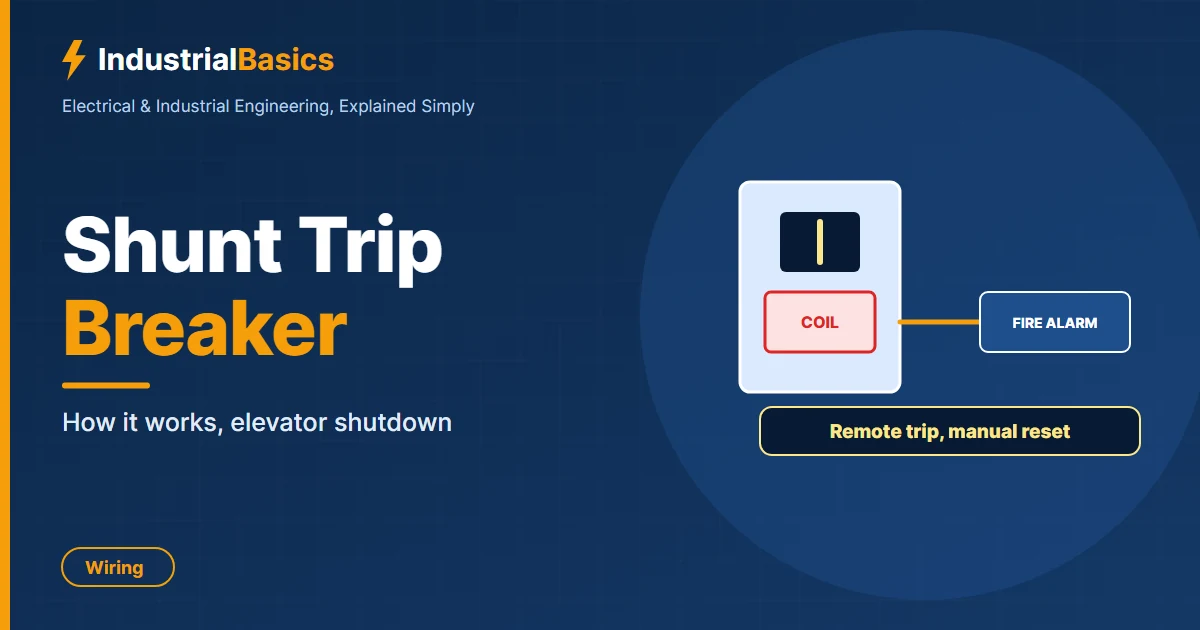
A shunt trip is a solenoid accessory that opens a circuit breaker when an external control voltage is applied, letting a remote signal trip the breaker instead of overcurrent. A fire alarm relay, emergency power-off button or other contact energizes the coil, typically 120 VAC or 24 VDC, and the breaker trips and must be reset by hand. The most common use is cutting elevator power before sprinklers discharge in a hoistway or machine room. Codes require that control circuit to be supervised for loss of voltage.
How a Shunt Trip Works
Wikipedia describes the shunt-trip unit as looking like a normal breaker, with actuators ganged to the breaker mechanism. The shunt trip is a solenoid operated by an external constant-voltage signal, commonly local mains voltage or DC, rather than by current. It is often used to cut power when a high-risk event occurs, such as a fire or flood alarm, or another electrical condition such as over-voltage. Shunt trips can be user-fitted accessories or integral to the breaker.
- A remote device (fire alarm relay, emergency power-off button, process interlock) closes a contact.
- Control voltage energizes the shunt trip coil.
- The solenoid releases the trip mechanism and the breaker opens all poles.
- Power stays off until someone resets the breaker by hand.
Elevator Shunt Trip and Sprinklers
Fire Alarms Online defines elevator shunt trip as removing elevator power before water discharges onto energized equipment where sprinklers are present. Life Safety Wiki explains the risk: water on elevator equipment could cause a short circuit and trap passengers, so codes may require a shunt trip that disconnects power before the sprinklers activate.
| Element | Typical requirement |
|---|---|
| Initiating device | Smoke or heat detector at the top of a sprinklered hoistway, and the machine room detector (NFPA 72 §21.3.5, §21.3.6 via Life Safety Wiki) |
| Sequence | Detector starts Phase I recall; shunt trip removes power after the car can reach the recall level (Life Safety Wiki cites NFPA 72 §21.3.12) |
| Supervision | Control circuit monitored for operating voltage; loss causes a supervisory signal (NFPA 72, quoted by Mersen) |
| Disconnect | Shunt-trip breaker or fusible shunt trip switch in the elevator main line |
| Emergency/standby power | Interface contacts per NEC 620.91 where the elevator has emergency or standby power (Mersen) |
Other Uses of Shunt Trip Breakers
- Emergency power-off (EPO) circuits that de-energize a room or equipment from a remote button
- Fire or flood alarm interlocks that remove power from at-risk equipment (Wikipedia)
- Protective relay or over-voltage detection outputs tripping a breaker (Wikipedia)
- Process interlocks where a PLC or safety device must open a feeder
For breaker types and accessories, see types of circuit breakers and MCB vs MCCB vs ACB. For machine emergency stopping, see the e-stop guide.
Frequently Asked Questions
What is a shunt trip breaker?
A circuit breaker fitted with a shunt trip: a solenoid that trips the breaker when an external constant-voltage signal is applied, rather than by overcurrent. It can be an accessory added to a standard breaker or built in (Wikipedia).
How does a shunt trip work?
A remote contact, such as a fire alarm relay or emergency stop, applies control voltage to the shunt trip coil. The solenoid releases the breaker mechanism and the contacts open; the breaker is then reset by hand.
What is a shunt trip used for?
Cutting power when a high-risk event occurs, such as a fire or flood alarm, or another electrical condition like over-voltage detection (Wikipedia). The best-known use is shutting down elevator power before sprinklers discharge in a hoistway or machine room.
Why do elevators need a shunt trip?
Where sprinklers protect the hoistway or machine room, water on energized elevator equipment could short it and trap passengers, so codes may require power to be removed before sprinkler discharge (Life Safety Wiki; Fire Alarms Online).
What triggers an elevator shunt trip?
A smoke or heat detector at the top of a sprinklered hoistway, or in the machine room, through the fire alarm system; it must act before sprinkler water reaches energized equipment (Life Safety Wiki, citing NFPA 72 §21.3.5 and §21.3.6). Detector type and placement follow the adopted code.
Does the shunt trip circuit need supervision?
Yes. NFPA 72 requires control circuits that shut down elevator power to be monitored for operating voltage; loss of voltage must cause a supervisory signal at the control unit (quoted by Mersen).
What voltage is a shunt trip coil?
It depends on the breaker; common ratings are 120 VAC and 24 VDC, and the coil must match the control power source. Check the breaker accessory rating.
Can a shunt trip breaker be reset remotely?
Generally no: a shunt trip only trips the breaker. It is reset by hand at the breaker unless a separate motor operator is fitted.
Is a shunt trip the same as an emergency stop?
No. An e-stop is a machine safety function with its own requirements; a shunt trip is a way to open a breaker remotely and can be the output of an emergency power-off system.
What is a fusible shunt trip switch?
A fused disconnect switch with a shunt trip mechanism, used for elevator shutdown; Mersen’s version includes a fire monitoring relay for supervision and contacts for NEC 620.91 emergency or standby power interface.
Sources and Further Reading
- Wikipedia: Circuit breaker: shunt-trip units.
- Life Safety Wiki: Elevator recall: shunt trip and sprinkler interaction, sequence, testing.
- Fire Alarms Online: Elevator recall and shunt trip fundamentals.
- Mersen: Fusible shunt trip switch application guidelines (PDF): NFPA 72 supervision and NEC 620.91.