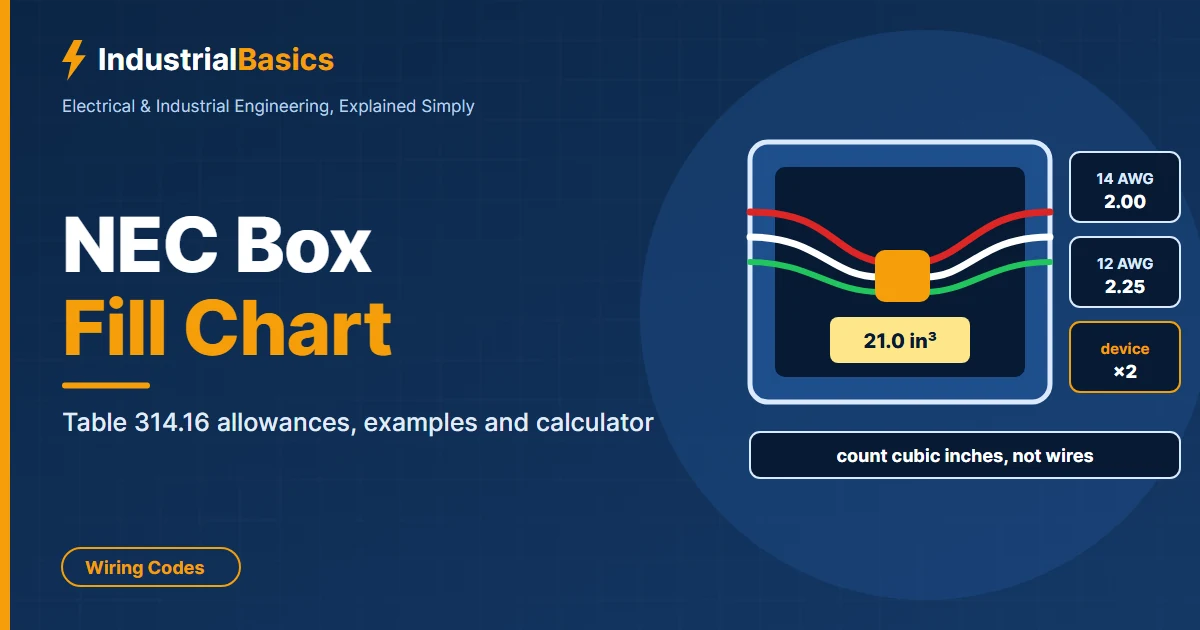
Box fill is the NEC rule (Section 314.16) that limits how much can go in an electrical box. Each conductor counts as 2.00 in³ for 14 AWG, 2.25 in³ for 12 AWG or 2.50 in³ for 10 AWG; each switch or receptacle counts as two conductors; all internal clamps count as one; and up to four ground wires count as one. Add up these allowances and the total must not exceed the box volume. A 4 x 1-1/2 in square box holds 21.0 in³, and a typical plastic single-gang box is marked around 18 in³.
NEC Box Fill Chart: Table 314.16(A)
Table 314.16(A) lists the volume of standard metal boxes and the maximum number of same-size conductors each can hold. The counts apply only when the box holds nothing but conductors of one size. With a device, clamp, stud or ground wire in the box, you must calculate (next section).
| Metal box (in) | Volume (in³) | 18 AWG | 16 AWG | 14 AWG | 12 AWG | 10 AWG | 8 AWG | 6 AWG |
|---|---|---|---|---|---|---|---|---|
| 4 x 1-1/4 round/octagonal | 12.5 | 8 | 7 | 6 | 5 | 5 | 4 | 2 |
| 4 x 1-1/2 round/octagonal | 15.5 | 10 | 8 | 7 | 6 | 6 | 5 | 3 |
| 4 x 2-1/8 round/octagonal | 21.5 | 14 | 12 | 10 | 9 | 8 | 7 | 4 |
| 4 x 1-1/4 square | 18.0 | 12 | 10 | 9 | 8 | 7 | 6 | 3 |
| 4 x 1-1/2 square | 21.0 | 14 | 12 | 10 | 9 | 8 | 7 | 4 |
| 4 x 2-1/8 square | 30.3 | 20 | 17 | 15 | 13 | 12 | 10 | 6 |
| 4-11/16 x 1-1/4 square | 25.5 | 17 | 14 | 12 | 11 | 10 | 8 | 5 |
| 4-11/16 x 1-1/2 square | 29.5 | 19 | 16 | 14 | 13 | 11 | 9 | 5 |
| 4-11/16 x 2-1/8 square | 42.0 | 28 | 24 | 21 | 18 | 16 | 14 | 8 |
| 3 x 2 x 1-1/2 device | 7.5 | 5 | 4 | 3 | 3 | 3 | 2 | 1 |
| 3 x 2 x 2 device | 10.0 | 6 | 5 | 5 | 4 | 4 | 3 | 2 |
| 3 x 2 x 2-1/4 device | 10.5 | 7 | 6 | 5 | 4 | 4 | 3 | 2 |
| 3 x 2 x 2-1/2 device | 12.5 | 8 | 7 | 6 | 5 | 5 | 4 | 2 |
| 3 x 2 x 2-3/4 device | 14.0 | 9 | 8 | 7 | 6 | 5 | 4 | 2 |
| 3 x 2 x 3-1/2 device | 18.0 | 12 | 10 | 9 | 8 | 7 | 6 | 3 |
| 4 x 2-1/8 x 1-1/2 handy (utility) | 10.3 | 6 | 5 | 5 | 4 | 4 | 3 | 2 |
| 4 x 2-1/8 x 1-7/8 handy (utility) | 13.0 | 8 | 7 | 6 | 5 | 5 | 4 | 2 |
| 4 x 2-1/8 x 2-1/8 handy (utility) | 14.5 | 9 | 8 | 7 | 6 | 5 | 4 | 2 |
Nonmetallic (plastic) boxes and nonstandard metal boxes are not in the table. They must be marked with their volume by the manufacturer, and you use that marked number. Some plastic boxes also carry counts such as “9-14, 8-12, 7-10”. Like the table, those counts assume no device is installed.
Volume Allowance per Conductor: Table 314.16(B)
| Conductor size | Volume allowance (in³) | Device yoke (×2) | Quarter (each ground beyond 4) |
|---|---|---|---|
| 18 AWG | 1.50 | 3.00 | 0.375 |
| 16 AWG | 1.75 | 3.50 | 0.4375 |
| 14 AWG | 2.00 | 4.00 | 0.5 |
| 12 AWG | 2.25 | 4.50 | 0.5625 |
| 10 AWG | 2.50 | 5.00 | 0.625 |
| 8 AWG | 3.00 | 6.00 | 0.75 |
| 6 AWG | 5.00 | 10.00 | 1.25 |
Insulation type does not change the allowance. Conductors 4 AWG and larger fall under the pull and junction box sizing rules of 314.28 instead of volume-based fill.
What Counts in a Box Fill Calculation
- Conductors (314.16(B)(1)): each conductor that comes from outside the box and is spliced or terminated counts once. A conductor passing through without a splice counts once. An unbroken loop 12 in or longer (twice the 6 in free length required by 300.14) counts twice.
- Clamps (B)(2): one or more internal cable clamps count as a single allowance, based on the largest conductor in the box.
- Support fittings (B)(3): fixture studs and hickeys count one allowance per type, based on the largest conductor.
- Devices (B)(4): each yoke or strap counts as two, based on the largest conductor connected to that device. A device wider than a single 2 in device box counts two per gang it needs.
- Grounds (B)(5): up to four equipment grounding conductors or bonding jumpers entering the box count as one allowance, based on the largest. Each additional one adds a quarter allowance (2020 NEC). An isolated-ground set counts separately.
- Barriers: each space is calculated separately. An unmarked barrier takes 0.5 in³ if metal or 1.0 in³ if nonmetallic.
Box Fill Calculator
The calculator also suggests the smallest standard metal box from Table 314.16(A) that holds your total. For a plastic box, enter the volume molded inside it. Wire sizing itself comes from ampacity; see the AWG wire ampacity chart and the ground wire size chart.
Worked Examples
Example 1: Is a 4 x 4 box with a raised cover big enough?
NEC Mastery works this example. All conductors are 12 AWG. The box is a 4 x 1-1/2 in square metal box (21.0 in³) with a raised cover marked 6.5 in³, for 27.5 in³ available.
| Item | Count | Volume (in³) |
|---|---|---|
| Conductors entering from outside | 7 | 7 × 2.25 = 15.75 |
| Conductors passing through (loop under 12 in) | 2 | 2 × 2.25 = 4.50 |
| 3 grounding conductors (4 or fewer) | 1 | 2.25 |
| Duplex receptacle on 12 AWG | 2 | 4.50 |
| Total | 12 | 27.00 (OK, 0.5 spare) |
Pigtails, wire nuts and the bonding jumper are not counted. Adding a second receptacle would add 4.5 in³ and fail the box, so you would need a deeper raised cover or an extension ring.
Example 2: Sizing a box for a switch and a receptacle
EC&M’s example: one 14/3 NM cable to a 3-way switch and one 12/2 NM cable to a receptacle, in a box with internal clamps.
| Item | 14 AWG | 12 AWG |
|---|---|---|
| Cable conductors | 3 | 2 |
| Switch yoke (14 AWG) | 2 | |
| Receptacle yoke (12 AWG) | 2 | |
| Internal clamps (largest = 12) | 1 | |
| Grounds (largest = 12) | 1 | |
| Volume | 5 × 2.00 = 10.00 | 6 × 2.25 = 13.50 |
The total is 23.5 in³. A 4 x 1-1/2 in square box (21.0 in³) is too small. EC&M selects a 4 x 2-1/8 in square box (30.3 in³); the smallest standard box in the table that fits is the 4-11/16 x 1-1/4 in square (25.5 in³).
Example 3: Two 12/2 cables to a receptacle in a plastic box
This is a common pass-through receptacle in a single-gang plastic box with no clamp deduction. It has four 12 AWG insulated conductors (9.00), one receptacle (4.50) and two grounds counted as one (2.25), for 15.75 in³. An 18 in³ box passes with 2.25 in³ to spare; a 15 in³ box would not.
How to Fix an Overfilled Box
- Add volume: install a marked extension ring or a deeper raised cover (mud ring). This is usually the quickest retrofit.
- Swap the box: replace it with a deeper or 4-11/16 in square box.
- Split the circuits: move pass-through or extra cables to a separate junction box (it must stay accessible).
- Watch bulky devices: GFCI, AFCI and smart switches take far more physical room than their two-conductor allowance suggests. Size up even when the math passes. See GFCI vs AFCI.
Box fill is separate from conduit fill. Conduit fill limits how many wires fit inside a raceway and is set by the tables in NEC Chapter 9, not by Article 314.
Sizing the raceway that feeds the box is a separate check: see the NEC conduit fill chart for EMT and PVC pipe fill limits.
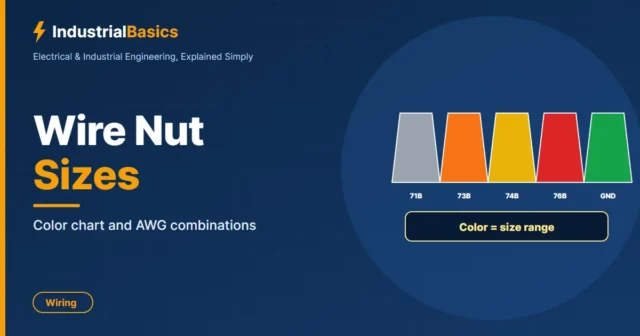
To choose the right connector for each splice, see our wire nut sizes color chart.
Frequently Asked Questions
What is box fill?
Box fill is the total volume that the conductors, devices, clamps and fittings in an electrical box are counted as taking up under NEC 314.16(B). The box’s volume must equal or exceed that total, so the wires have room to shed heat and the box is not overcrowded.
How do you calculate box fill?
Count each item that counts (conductors entering, devices at two per yoke, one for all internal clamps, one for up to four grounds), multiply each by the Table 314.16(B) allowance for its wire size (2.00 in³ for 14 AWG, 2.25 in³ for 12 AWG), add them up and compare the total with the box volume plus any marked ring.
Do ground wires count in box fill?
Yes. Under the 2020 NEC, up to four equipment grounding conductors entering the box count together as one allowance based on the largest one, and each additional ground adds a quarter allowance. Six 14 AWG grounds count 2.00 + 2 × 0.50 = 3.00 in³.
Do wire nuts count toward box fill?
No. Wire connectors are not counted, and neither are locknuts, bushings or pigtails that start and end inside the box.
Does a switch or receptacle count as two wires?
Yes. Each yoke or strap counts as two conductors, sized by the largest conductor connected to it: 4.0 in³ on 14 AWG, 4.5 in³ on 12 AWG. A device too wide for a single 2 in gang, such as a range receptacle, counts two for each gang it needs.
How many 12 AWG wires can go in a 4 x 4 box?
Table 314.16(A) allows nine 12 AWG conductors in a 4 x 1-1/2 in square box (21.0 in³), but only if there is nothing else in it. Add a receptacle (4.5 in³) and grounds (2.25 in³) and only six 12 AWG conductors fit.
How many wires can go in a single-gang box?
It depends on the marked volume. A common 18 in³ plastic box holds nine 14 AWG or eight 12 AWG conductors with nothing else; with one device and its grounds, six 14 AWG or five 12 AWG insulated conductors.
Can I add an extension ring to get more volume?
Yes. A plaster ring, raised cover or extension ring marked with its volume adds to the box volume. An unmarked metal extension ring matching a Table 314.16(A) size counts at that table volume. Rings are listed to go on a box, not stacked on other rings.
Do cable clamps count in box fill?
Internal clamps count once in total, based on the largest conductor in the box, however many there are. Connectors with the clamping part outside the box do not count, and single-gang plastic boxes have no clamp deduction.
Why does Table 314.16(A) give fewer wires than I expected?
Its counts assume all conductors are one size and the box holds no devices, clamps, studs or grounds. Most real boxes hold at least one of those, so calculate in cubic inches with Table 314.16(B) instead.
Sources and Further Reading
- IAEI Magazine: Box Fill Calculations (Keith Lofland): box volume, rings, barriers, conductor, clamp, fitting, device and grounding fill.
- NEC Mastery: NEC 314.16 Box Fill Calculation with a Worked Example: allowance table, loop rule, 2020 grounding rule and Example 1.
- EC&M: Box Fill Calculations: Table 314.16(A) limits and Example 2.
- ElectricalLicenseRenewal: 314.16(B)(5) Equipment Grounding Conductor Fill: 2017 vs 2020 code language.
- zing2: NEC 2020 Table 314.16(A) Box Fill Chart: standard metal box volumes and conductor counts.
- JADE Learning: Understanding Box Fill Calculations: 4 x 1-1/2 in box example.