
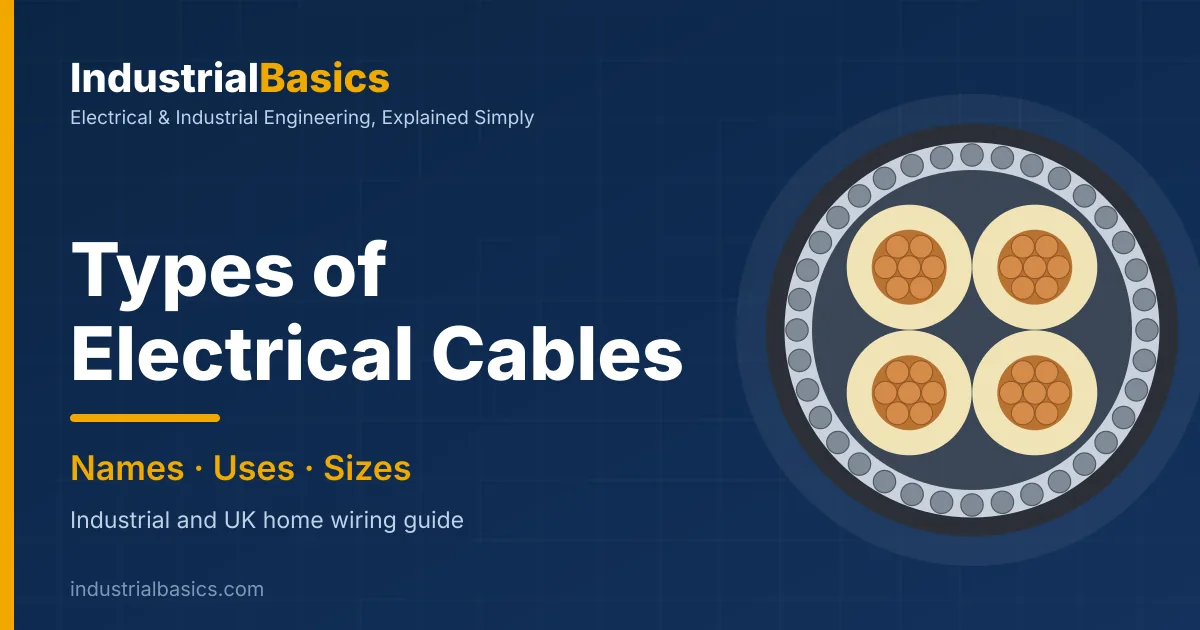
The main types of electrical cables are power, control, instrumentation, communication (data) and flexible cables. Each is built for a different job. Power cables carry energy, control cables carry on/off commands, instrumentation cables carry small measurement signals, data cables carry information and flexible cables move with machinery.
There is no single official number of cable types. A cable can be sorted by what it does, its voltage, how it is built, what insulates it and where it is installed, so one cable can be several things at once. For example, a cable can be a low-voltage, XLPE-insulated, steel wire armoured, multicore power cable. This guide keeps those labels apart so you can name, compare and choose cables without confusion. It focuses on industrial and commercial cables, with a shorter section on home wiring, and uses UK terms and standards first.
- 3 common industrial types: power, control and instrumentation (a common grouping, not an official one).
- Other types: communication and data, flexible and trailing, VFD, fire-resistant, and special-purpose cables such as solar and marine.
- Construction labels: single-core or multicore, armoured or unarmoured, shielded or unshielded.
- Insulation labels: PVC, XLPE, EPR, PE and LSZH.
- Size: mm² in the UK and IEC countries, AWG or kcmil in the US. They are not interchangeable.
| Cable type | What it does | Typical core size | Typical use |
|---|---|---|---|
| Power | Carries energy to equipment | 1.5 mm² up to 240 mm² and above | Motors, panels, feeders |
| Control | Carries on/off and command signals | Usually 1.5 or 2.5 mm² per core | PLC panels, contactors, relays |
| Instrumentation | Carries small measurement signals | Often 0.5 to 1.5 mm² per core | Sensors and transmitters |
What Is an Electrical Cable?
An electrical cable is one or more insulated conductors held together inside a protective outer sheath. It carries electrical power or signals from one point to another, such as from a transformer to a distribution board or from a sensor to a controller. Cables are used in homes, offices, factories, substations and power networks.
Wire, cable, conductor and cord
| Term | Meaning | Example |
|---|---|---|
| Conductor | The metal part that carries current, usually copper or aluminium, solid or stranded | The copper strands inside any cable |
| Wire | A single conductor, bare or insulated | A single insulated wire in conduit |
| Cable | One or more insulated conductors under an overall sheath, sometimes with bedding, armour or a screen | Twin and Earth, SWA cable |
| Cord or flex | A flexible cable for portable or moving connections | An appliance lead |
Demand for cable is large and still growing. One market estimate puts power and control cable at USD 156.3 billion in 2025, rising to a forecast USD 296.2 billion by 2035. Other analysts give different totals because they define the market differently, so treat these as a guide to scale, not an exact figure.
How Are Electrical Cables Classified?
Cables are classified in several independent ways. Mixing them in one list is the most common mistake in online guides. Armoured, XLPE, single-core and power cable are not four types of the same thing. They are labels from different axes.
| Classification axis | Question it answers | Examples |
|---|---|---|
| Function | What does the cable do? | Power, control, instrumentation, data, flexible |
| Voltage class | How much voltage is it built for? | ELV, LV, MV, HV |
| Construction | How is it built? | Single-core, multicore, armoured, screened |
| Insulation and sheath | What covers the conductor? | PVC, XLPE, EPR, PE, LSZH |
| Fire performance | How does it behave in a fire? | Flame-retardant, LSZH, fire-resistant |
| Installation | Where and how is it used? | Fixed, buried, on tray, moving, hazardous area |
Classification by function
The six functional groups are power, control, instrumentation, communication and data, flexible and trailing, and special-purpose cables. The next section explains each one.
Classification by voltage
Cables are rated as extra-low voltage (ELV), low voltage (LV), medium voltage (MV) or high voltage (HV). The limits vary by region and standard, so the voltage section below shows each range with its source.
Classification by construction
Construction labels come in pairs: single-core or multicore, armoured or unarmoured, shielded or unshielded. Each pair has its own comparison later in this guide.
Different Types of Electrical Cables and Their Uses
This is the main list. Each type below is a functional or special-purpose family. Construction labels such as armoured and shielded are covered after this section. The diagram shows where each type sits in a typical plant.
Power cables
A power cable carries electrical energy from a source to equipment. It is the most common industrial cable. Low-voltage (LV) power cables feed motors, panels and machines. Medium-voltage (MV) power cables connect substations, transformers and large motors.
- Construction: copper or aluminium conductors, PVC or XLPE insulation, and often bedding, armour and an outer sheath. MV cables add conductor and insulation screens to control the electric field inside the cable.
- Typical uses: motor feeders, distribution boards, transformer connections, plant feeders, and outdoor or buried runs.
- Watch out for: sizing for current, voltage drop and short-circuit withstand, and protection by the right circuit breakers. Faults on large feeders can cause an arc flash, so isolate before any work.
Control cables
A control cable carries commands, interlocks and low-power control signals between panels and equipment. It tells things to start, stop, open or close. It does not carry the main load current.
- Construction: multicore, commonly from 2 up to 48 cores of 1.5 mm² or 2.5 mm², with PVC insulation and sheath, and a copper braid screen or armour when needed. UK catalogues often list YY (unscreened), CY (copper braid screen) and SY (steel wire braid) types.
- Typical uses: PLC panels, the coils of a contactor or relay, motor starter circuits, limit switches and interlocks.
- Watch out for: using it for bulk power, and running it next to power or VFD cables without a screen.
Instrumentation cables
An instrumentation cable carries small, sensitive signals from field devices. A typical signal is a 4 to 20 mA loop from a pressure or temperature transmitter. These signals are easily disturbed by electrical noise, so the cable is built to block it.
- Construction: twisted pairs or triads (the twist cancels noise), an individual foil screen on each pair, an overall screen, a drain wire for the screen connection and a tough sheath. Cores are often 0.5 to 1.5 mm².
- Typical uses: sensors and transmitters, thermocouple and RTD signals, and links to PLC, DCS and SCADA systems. Thermocouples need extension or compensating cable that matches the thermocouple type.
- Watch out for: screen earthing (usually at one end only, as the project specification says), routing away from power cables, and lightning surges on long outdoor runs, which is where surge protection devices help.
Power, control and instrumentation cable compared
| Power cable | Control cable | Instrumentation cable | |
|---|---|---|---|
| Carries | Load current | Commands and interlocks | Measurement signals |
| Cores | Usually 1 to 5 | Many, often 4 to 48 | Pairs or triads |
| Conductor size | Large, up to 240 mm² and above | Small, 1.5 to 2.5 mm² | Small, often 0.5 to 1.5 mm² |
| Screen | Not usually (MV and VFD cables excepted) | Sometimes | Almost always |
| Signal level | Highest energy | Medium | Lowest, most sensitive |
| Example circuit | Motor feeder | Start/stop circuit | 4 to 20 mA pressure loop |
Communication and data cables
Communication and data cables carry information, not power. In industry they link PLCs, drives, HMIs, cameras and plant networks.
- Construction: twisted-pair copper (Ethernet), coaxial, fibre optic, and industrial Ethernet or fieldbus cables (such as Profibus, Modbus RS-485 or CAN) with tougher jackets and screening.
- Typical uses: industrial networks, CCTV (coaxial), long links between buildings (fibre), and device networks on machines.
- Watch out for: matching the cable to the protocol, data rate and distance, and keeping copper data cable away from power and VFD cable. Fibre is not affected by electrical noise.
Flexible and trailing cables
A flexible cable has very fine strands so it bends easily and can move. Trailing cables are flexible cables built to be dragged, reeled or flexed again and again.
- Construction: Class 5 or Class 6 conductors (IEC 60228) with rubber or special sheaths. A common example is H07RN-F, a heavy-duty rubber cable rated 450/750 V that resists oil and suits medium mechanical stress.
- Typical uses: cranes, robots, portable tools, site equipment, mobile plant and drag chains.
- Watch out for: flexing life, bend radius, twisting and tension limits. These differ by cable, so check the datasheet for the movement you need.
VFD and inverter cables
A VFD cable connects a variable frequency drive (VFD) to a motor. Drives switch voltage on and off very fast, which creates electrical noise and voltage spikes in the motor cable.
- Construction: a symmetrical layout (often three phase cores plus three earth conductors laid evenly) and a copper tape or braid screen that contains the noise.
- Typical uses: any motor fed by a drive, especially on long runs or near noise-sensitive equipment.
- Watch out for: ordinary unscreened cable, which can radiate noise onto nearby control and data cables and is linked to motor bearing currents. Bearing damage is one of the many motor failure causes worth designing out. Screens need 360° termination, and there is no single universal VFD cable standard, so follow the drive maker’s manual. If you are still deciding between a drive and a soft starter, read VFD vs soft starter first.
Fire-resistant cables
A fire-resistant cable is designed to keep a circuit working during a fire for a stated time. It is also called a circuit-integrity cable.
- Construction: a mica-glass tape barrier around the conductors, then insulation and usually an LSZH sheath.
- Typical uses: emergency lighting, fire alarms, fire pumps, smoke extraction and other life-safety circuits.
- Watch out for: confusing it with flame-retardant or LSZH cable. They are different properties, compared in the insulation section. Check the required test (IEC 60331) and survival time.
Special-purpose industrial cables
- Solar (PV) cables: single-core, flexible tinned copper with cross-linked, UV-resistant, halogen-free insulation and sheath. A common type is H1Z2Z2-K to EN 50618, used for DC up to 1,500 V.
- Welding cables: very flexible, fine-strand cables with a tough rubber-type sheath for welding machines.
- Mining cables: heavy-duty flexible rubber-sheathed cables for mobile mining machines.
- Marine cables: built for ships and offshore units, often LSZH and resistant to oil and sea water.
- Hazardous-area cables: used where explosive gas or dust may be present. The cable, gland and installation must all meet the hazardous-area rules, which are based on IEC 60079.
- Oil and chemical-resistant cables: special sheath compounds, such as PUR, for workshops and process plants.
Electrical Cable Types Chart
Use this chart to compare cable families at a glance. It is a reference chart, not a current-rating table, so it carries no ampacity figures. Armoured cable is a construction category, not a function like power or control cable.
| Cable type | Axis | Main purpose | Typical applications | Watch out for |
|---|---|---|---|---|
| LV power cable | Function and voltage | Carries power up to about 1 kV | Motors, panels, distribution boards, machines | Size and install to the wiring rules; PVC has the lower temperature rating |
| MV power cable | Function and voltage | Carries power from about 1 kV to 35 kV | Substations, transformers, large motors | Needs MV design, terminations and testing skills |
| Control cable | Function | Carries commands and interlock signals | PLC panels, contactors, relays, starters | Not for bulk power; screen it near noisy cables |
| Instrumentation cable | Function and signal quality | Carries small measurement signals | Sensors, transmitters, PLC, DCS, SCADA | Screen earthing and routing decide performance |
| Communication and data cable | Function and protocol | Carries data | Ethernet, fieldbus, CCTV, plant networks | Must match protocol and distance; keep copper away from power |
| Flexible and trailing cable | Mechanical duty | Moves with equipment | Cranes, robots, portable tools, site equipment | Flexing life varies by design; check bend radius |
| VFD (motor) cable | Application-specific | Connects a drive to a motor | Motors fed by variable frequency drives | Needs 360° screen termination at both ends |
| Fire-resistant cable | Fire performance | Keeps a circuit working in a fire | Emergency lighting, fire alarms, fire pumps | Must meet the specified test and survival time |
| LSZH / LSOH cable | Fire emissions | Gives low smoke and no halogen acid gas | Tunnels, public buildings, offshore | Not automatically fire-resistant |
| Armoured cable | Mechanical protection (construction) | Resists impact and crushing | Buried, outdoor and exposed plant routes | Needs the right glands and earthing |
| Solar (PV) cable | Application-specific | Carries DC from solar modules | Solar strings and inverter links | Use PV-rated cable only (DC up to 1,500 V) |
| Twin and Earth cable | Function and construction | Fixed wiring in buildings | Lighting and socket circuits in homes | Not for unprotected outdoor or damage-prone routes |
The PDF adds construction and standard columns. It is a classification chart only. It is not a sizing or ampacity chart.
Cable Construction: Main Parts Explained
Most industrial cables are built in layers. The diagram shows a four-core armoured power cable from the centre outwards.
Conductor
The conductor carries the current. Copper is the usual choice because it conducts well and is easy to terminate. Aluminium is lighter and cheaper for large cables but needs suitable lugs and connectors. IEC 60228 groups conductors into classes. Class 1 (solid) and Class 2 (stranded) are for fixed installations. Class 5 (flexible) and Class 6 (extra-flexible) are for cables that move, and Class 6 uses finer wires than Class 5 for the same size.
Conductor insulation
Insulation surrounds each conductor. It stops current leaking to earth and stops short circuits between conductors. The common materials are PVC, XLPE and EPR, compared in the next section.
Bedding or inner sheath
Bedding is a plastic layer over the cores. It cushions them and gives the armour a smooth, round base. Armoured cables have it. Many simple cables do not.
Armour layer
Armour is a metal layer for mechanical protection. Steel wire armour (SWA) is used on multicore cables. Steel tape armour (STA) also protects against impact and crushing. Aluminium wire armour (AWA) is used on single-core AC cables because non-magnetic armour avoids induced heating.
Shield or screen
A screen wraps the cores or pairs to block electromagnetic interference (EMI). It can be copper tape, copper braid or aluminium foil, often with a drain wire. Screens are used on instrumentation, data and VFD cables, and on MV cables to control the electric field.
Outer sheath
The outer sheath is the final layer. PVC is the common general-purpose choice. PE (polyethylene) is tough and moisture resistant and is used outdoors. LSZH is used where low smoke and no halogen acid gas matter. The sheath protects against moisture, chemicals, abrasion and weather. Not every cable has every layer.
Types of Electrical Cables Based on Insulation Materials
The insulation and sheath material decides how hot a cable can run, how it behaves in a fire and where it can be used. Whatever the material, insulation ages, and an insulation resistance test shows whether it is still healthy.
| Property | PVC | XLPE | EPR | LSZH compound |
|---|---|---|---|---|
| Material type | Thermoplastic | Thermoset (cross-linked) | Thermoset rubber | Low-smoke, halogen-free compound |
| Continuous conductor temperature | 70 °C | 90 °C | 90 °C (typical) | Depends on the compound |
| Short-circuit temperature | 160 °C | 250 °C | 250 °C (typical) | Depends on the compound |
| Moisture resistance | Moderate | Excellent | Excellent | Good |
| Flexibility | Good | Stiffer | Very flexible | Good |
| In a fire | Dense smoke and hydrogen chloride gas | Needs an LSZH sheath for low smoke | Needs flame-retardant compounding | Low smoke, no halogen acid gas |
| Typical use | Building wiring, general power and control | Industrial power, buried and high-load cables | Trailing, mining, marine, portable cables | Tunnels, public buildings, offshore |
PVC cable
PVC (polyvinyl chloride) is a thermoplastic, so it softens when hot. It is cheap, flexible and widely used in building wiring and general power and control cables. Its limit is 70 °C at the conductor. In a fire it gives off dense smoke and hydrogen chloride gas.
XLPE cable
XLPE (cross-linked polyethylene) is a thermoset. Its molecules are chemically linked, so it holds its shape when hot. It runs at 90 °C continuously and withstands 250 °C in a short circuit. It resists moisture well, which suits buried and outdoor cables. For the same conductor size and installation, an XLPE cable can usually carry more current than a PVC cable because of its higher temperature rating. In UK practice, XLPE cores often sit inside a PVC or LSZH sheath, so an XLPE cable may still have a PVC outer.
EPR cable
EPR (ethylene propylene rubber) is a flexible thermoset rubber. It is used for trailing, mining, marine and portable cables because it stays flexible. It needs flame-retardant compounding where fire performance matters. Exact temperature and chemical limits depend on the compound, so check the datasheet.
LSZH cable
LSZH stands for low smoke zero halogen. It is also written LSOH or LSHF. The compound gives off little smoke and no halogen acid gases when it burns. It is used in tunnels, public buildings, data centres and offshore platforms, where people may be slow to escape. BS 6724 is the UK standard for LSZH armoured cable. LSZH describes smoke and gas, not how long a circuit survives, so it is not the same as fire-resistant cable.
PE cable
PE (polyethylene) is a tough, moisture-resistant plastic. It is used as the outer sheath on outdoor and buried cables and as insulation in some data and coaxial cables. PE is not flame-retardant unless it is specially compounded, so it needs care indoors.
Armoured vs Unarmoured Electrical Cables
An armoured cable has a metal layer, usually steel wire, between the bedding and the outer sheath. An unarmoured cable does not, so it relies on its sheath and on containment such as tray, conduit, trunking or duct.
| Armoured cable | Unarmoured cable | |
|---|---|---|
| Extra layer | Steel wire, steel tape or aluminium wire armour | None |
| Mechanical protection | High: resists impact, crushing and digging | Low: needs containment |
| Typical places | Buried, outdoors, exposed plant routes | Indoors, in tray, conduit or trunking |
| Weight and handling | Heavier and stiffer | Lighter and easier to install |
| Termination | Needs armoured cable glands | Standard glands or clips |
| Earth path | Armour can act as the earth conductor if design checks are met | Needs a separate earth conductor |
| UK examples | XLPE/SWA/PVC to BS 5467; LSZH version to BS 6724 | Twin and Earth to BS 6004; PVC power cable in trunking |
Choose armoured cable where it could be hit, crushed or dug up, and for buried or outdoor runs with no other protection. Choose unarmoured cable where tray, conduit or trunking already protects it. Always terminate armour with the right glands. Whether the armour can serve as the earth conductor depends on the design and the earthing system in use.
Single-Core vs Multicore Electrical Cables
| Single-core cable | Multicore cable | |
|---|---|---|
| What it is | One insulated conductor in one sheath | Two or more insulated conductors under one sheath |
| Typical use | Large power feeders and transformer connections | LV power circuits, control and instrumentation cables |
| Installation | Easier to pull in large sizes. Each phase is a separate cable, so more cleats and care | One pull for the whole circuit |
| Armour | Non-magnetic aluminium wire armour on AC circuits, or unarmoured | Steel wire armour is fine |
| Magnetic effects | Needs care: induced currents and heating if laid wrongly | Fields cancel out inside the cable |
| Limits | Cores of one circuit must be grouped together | Large sizes become heavy and stiff |
Use single-core cable when the current is large and a multicore cable would be too heavy to handle. Use multicore cable for most other circuits, and for all control and instrumentation work.
Shielded vs Unshielded Electrical Cables
A shielded (screened) cable has a conductive layer around the cores or pairs that blocks electromagnetic interference. An unshielded cable does not. Shielding works both ways: it keeps outside noise out of a signal, and it keeps a noisy cable from disturbing its neighbours.
| Shielded cable | Unshielded cable | |
|---|---|---|
| Extra layer | Foil, braid or tape screen, often with a drain wire | None |
| Best for | Instrumentation, data, VFD and control cables near noise | Simple power circuits in a clean environment |
| Cost and size | Higher cost, slightly larger | Lower cost, smaller |
| Needs | Correct screen earthing and termination | Separation from noisy cables |
Types of cable shielding
- Aluminium foil with drain wire: full coverage, thin and cheap. Best for fixed runs because foil can crack if flexed.
- Copper braid: tougher and more flexible. Good where the cable moves and for lower-frequency noise.
- Copper tape: a wrapped copper layer, common on VFD cables and MV cables.
- Foil plus braid: combines full coverage with strength. Used where noise is severe.
Use shielded cable for instrumentation, data and VFD circuits, for long runs, and near high-power equipment or radio sources. A screen that is earthed wrongly can make noise worse, so follow the project specification for where each screen is connected.
Types of Electrical Cables and Their Sizes
Understanding cable sizes
Cable size means the cross-sectional area of the conductor. In the UK and most other countries it is measured in square millimetres (mm²), for example 2.5 mm². IEC 60228 lists standard sizes from 0.5 mm² to 2,000 mm². In the US and Canada, small conductors use American Wire Gauge (AWG), where a smaller number means a thicker wire. Very large conductors use kcmil (thousand circular mils). Metric and American sizes do not match exactly.
Common electrical cable sizes
These are the metric sizes you will meet most often. The diameter column is calculated from the area as a solid circle, so real stranded conductors are slightly larger.
| Nominal size | Equivalent diameter (calculated) | Where you often see it (general guide only) |
|---|---|---|
| 1.5 mm² | 1.4 mm | UK lighting circuits; control cable cores |
| 2.5 mm² | 1.8 mm | UK socket circuits; control cable cores |
| 4 mm² | 2.3 mm | Larger appliance circuits and small motors |
| 6 mm² | 2.8 mm | Cooker and similar circuits in homes |
| 10 mm² | 3.6 mm | Showers and small sub-mains |
| 16 mm² | 4.5 mm | Sub-mains and small motors |
| 25 mm² | 5.6 mm | Sub-mains and medium motors |
| 35 mm² | 6.7 mm | Larger sub-mains and motors |
| 50 mm² | 8.0 mm | Motor feeders and plant sub-mains |
| 70 mm² | 9.4 mm | Industrial feeders |
| 95 mm² | 11.0 mm | Industrial feeders and larger motors |
| 120 mm² | 12.4 mm | Large feeders |
| 240 mm² | 17.5 mm | Main feeders; often used in parallel |
Factors affecting cable size selection
- Current-carrying capacity: how much current the cable can carry without overheating.
- Operating voltage: sets the insulation rating.
- Cable length and voltage drop: long runs lose voltage and may need a larger conductor.
- Conductor material: copper and aluminium carry different currents at the same size.
- Insulation temperature rating: 90 °C XLPE can run hotter than 70 °C PVC.
- Installation method: buried, in conduit, on tray or clipped direct all change cooling.
- Ambient temperature: hot surroundings reduce capacity.
- Grouping and derating: cables bundled together run hotter, so capacity falls.
- Short-circuit withstand: the cable must survive the fault current until its protective device trips.
The cable must also be protected from overload and short circuit by a fuse or circuit breaker (see fuse vs circuit breaker). For motor circuits, a thermal overload relay guards against overload.
Voltage Classification of Electrical Cables
Voltage class decides how much insulation a cable needs. The figure shows the classes on a log scale. A rating written as 0.6/1 kV means 0.6 kV between a conductor and earth and 1 kV between conductors.
Extra-low voltage cables
Extra-low voltage (ELV) is up to 50 V AC or 120 V ripple-free DC in UK and IEC practice. It is used for 24 V control circuits, alarms, instrument loops and low-voltage lighting. These cables need less insulation but often need screening to protect the signal.
Low-voltage cables
Low voltage (LV) is 50 V to 1,000 V AC, or 120 V to 1,500 V DC, under IEC 60038. This covers most building and plant wiring, such as 230 V single-phase and 400 V three-phase supplies in the UK. Typical ratings are 300/500 V or 450/750 V for building wiring and flexible cables, and 0.6/1 kV for power cables. IEC 60502-1 covers extruded power cables rated 0.6/1 kV and 1.8/3 kV. In North America, 600 V is a common LV ceiling.
Medium-voltage cables
Medium voltage (MV) is above 1 kV and up to about 35 kV under European practice (EN 50160). IEC 60502-2 covers extruded solid-insulated cables from 6 kV to 30 kV. In the UK, 11 kV and 33 kV are common distribution voltages. MV cables use XLPE or EPR insulation with conductor, insulation and metallic screens to control the electric field. Terminations and joints need MV-trained staff.
High-voltage cables
High voltage (HV) is above about 35 kV and runs to hundreds of kV. It is used for transmission and large grid connections. HV cables follow other standards, for example IEC 60840 for higher voltage ranges, and are specialist designs with metallic sheaths and special accessories. Most readers will never specify one.
How to Choose the Right Electrical Cable
- Identify the cable’s purpose. Is it for power, control, a measurement signal, data, a drive output or a moving machine?
- Check voltage and current requirements. Note the supply voltage, load current and fault level.
- Calculate the required conductor size. Allow for current, voltage drop, short circuit and installation method.
- Consider environmental and mechanical conditions. Think about heat, moisture, oil, UV, impact, burial and movement.
- Check insulation, fire performance and applicable standards. Choose PVC, XLPE or LSZH, armour or screen, and any fire-resistant rating the building needs.
Extra checks that catch people out
- Indoor or outdoor: outdoor cable needs a UV-resistant sheath and protection from damage.
- Direct burial: use armoured cable or run cable in duct, and follow the burial depth and marking rules in BS 7671.
- Industrial or residential: plant work often needs armour, screens and higher fault ratings. Homes usually use Twin and Earth in protected routes.
- Hazardous areas: the cable, gland and installation must all meet the hazardous-area rules.
- Termination and compatibility: glands, lugs and terminals must match the cable size, metal and armour, including at switchgear connections.
- Fault level: check the cable survives the fault current until its protective device trips. This is part of protection coordination.
Electrical Cable Standards and Regulations
Standards set how cables are built, tested and installed. Requirements depend on the country, the cable application and the installation conditions, and the standards below are not interchangeable.
| Standard | Region | Main purpose |
|---|---|---|
| IEC 60228 | International | Conductors for insulated cables, including classes and sizes |
| IEC 60502 | International | Power cable construction and testing (Part 1 to 3 kV, Part 2 for 6 to 30 kV) |
| IEC 60332 | International | Fire tests for flame propagation |
| IEC 60331 | International | Circuit-integrity tests under fire conditions |
| IEC 60038 | International | Standard voltage values |
| BS 7671 | UK | IET Wiring Regulations: installation, sizing, protection and earthing |
| BS 5467 | UK | Armoured power cables with thermosetting insulation (PVC sheath) |
| BS 6724 | UK | Low-smoke, halogen-free armoured cables |
| BS 6004 | UK | PVC insulated and sheathed cables for fixed wiring, including Twin and Earth |
| EN 50618 | Europe and UK trade | Solar (PV) cables such as H1Z2Z2-K |
| NEC / NFPA 70 | United States | Electrical installation requirements |
| UL | United States | Cable product safety and listing standards |
The current UK edition is BS 7671:2018+A4:2026. It was published on 15 April 2026, and the previous version was withdrawn six months later, on 15 October 2026. US documents use the word grounding where UK documents use earthing. The two systems are explained in earthing vs grounding.
Residential and Commercial Electrical Cable Types
Home and office wiring uses a short list of cables. This section is brief because the industrial types above cover most of the detail.
| Cable | Where it is used | Notes |
|---|---|---|
| Twin and Earth (6242Y) | Lighting and socket circuits | Flat PVC cable with two insulated cores and a bare earth, to BS 6004. Rated 300/500 V |
| Single-core building wire | Inside conduit or trunking | Individual insulated wires for fixed wiring |
| SWA cable | Outbuildings, garages, outdoor and underground feeders | Armoured. Often XLPE/SWA/PVC to BS 5467 |
| Flexible cord (flex) | Appliances and portable equipment | Fine-strand conductors for moving connections |
| Fire-resistant cable | Fire alarms and emergency lighting | Keeps working in a fire |
| US only: NM-B, UF-B, MC, THHN/THWN | US homes and buildings | Names come from the NEC and apply to US installations only |
In buildings, these cables feed lighting circuits, socket circuits, air conditioning, distribution boards and outdoor installations. In every case the size, protection and route must be designed to BS 7671 or the local code.
Frequently Asked Questions About Types of Electrical Cables
What are the different types of electrical cables?
By function: power, control, instrumentation, communication and data, and flexible cables. Special types include VFD, fire-resistant and solar cables. Construction labels such as armoured or shielded sit on top of these.
What are the 3 main types of electrical cables?
The common industrial three are power, control and instrumentation cables. This is a widely used grouping, not an official standard.
How many types of electrical cables are there?
There is no fixed number. The count depends on whether you classify by function, voltage, construction, insulation, fire performance or installation. One cable can fit several categories.
What are the most commonly used electrical cables?
In UK homes, Twin and Earth is the most common. In industry, XLPE/SWA/PVC power cable and multicore control cable are widely used.
What is the difference between a wire and a cable?
A wire is a single conductor. A cable is one or more insulated conductors inside an overall sheath.
What is the difference between power and control cables?
Power cables carry the load current and use few, large cores. Control cables carry commands and use many small cores, often 1.5 or 2.5 mm².
What is the difference between armoured and unarmoured cables?
Armoured cable has a metal layer, usually steel wire, for protection against impact and crushing. Unarmoured cable relies on tray, conduit or trunking.
What is an XLPE cable?
An XLPE cable uses cross-linked polyethylene insulation. It runs at 90 °C continuously and resists moisture well. The outer sheath may still be PVC or LSZH.
What is the difference between PVC and XLPE cables?
PVC is a thermoplastic rated at 70 °C. XLPE is a thermoset rated at 90 °C, so it can usually carry more current for the same size and installation.
What is an instrumentation cable used for?
It carries small measurement signals, such as 4 to 20 mA loops, from sensors and transmitters to PLC, DCS and SCADA systems. Twisted pairs and screens protect the signal from noise.
What is a VFD cable?
A VFD cable connects a variable frequency drive to a motor. It has a symmetrical layout and a screen to contain noise and reduce bearing currents.
What does LSZH mean in electrical cables?
LSZH means low smoke zero halogen. The cable gives off little smoke and no halogen acid gas when it burns.
What are single-core and multicore cables?
A single-core cable has one insulated conductor. A multicore cable has two or more insulated conductors in one sheath.
How do I choose the correct electrical cable size?
Size depends on current, voltage drop, short-circuit withstand, insulation rating, installation method, ambient temperature and grouping. Use BS 7671 or your local code, and have a competent person check it.
Can mm² and AWG cable sizes be interchanged?
No. They are different systems with different step sizes. Use the cable datasheet and the code table, not a rounded conversion.
Which cable is best for underground installation?
Armoured cable, such as XLPE/SWA/PVC to BS 5467, is the usual choice. Cable in a duct is another option. The route, depth and marking must follow BS 7671.
What is the difference between fire-resistant and flame-retardant cables?
Flame-retardant cable resists the spread of flame along it. Fire-resistant cable keeps a circuit working during a fire for a stated time. They are different properties.
What are the common electrical cable standards?
Common ones are IEC 60228 and IEC 60502 (international), BS 5467, BS 6724 and BS 7671 (UK), and NEC/NFPA 70 and UL (US).
Conclusion
The main types of electrical cables are power, control, instrumentation, communication and flexible cables, with special types for drives, fire safety and solar systems. Voltage, construction, insulation and environment then decide the exact cable for each job.
- Name the cable on each axis: function, voltage, construction, insulation, fire performance and installation.
- Size the cable from current, voltage drop, short-circuit withstand and installation conditions, never from cable type alone.
- Follow BS 7671 or your local code, and ask a qualified electrical professional to select and install the cable.
Sources
- IEC 60228: Conductors of insulated cables (IEC webstore)
- IEC 60502-2: Power cables, 6 kV to 30 kV (IEC webstore preview)
- IEC 60332 series: Tests on electric and optical fibre cables under fire conditions (IEC webstore)
- IEC 60331-1: Circuit integrity under fire with shock (IEC webstore preview)
- BS 6724: Armoured cables with thermosetting insulation and low emission of smoke and corrosive gases (BSI)
- IET and BSI publish Amendment 4 (2026) to BS 7671:2018, 15 April 2026
- IET Wiring Matters, issue 93: PVC and XLPE insulation (IET)
- BS 6724 cable construction (Prysmian, construction reference only)
- Power and Control Cable Market, 2026 to 2035 (GM Insights, February 2026)
- H1Z2Z2-K solar cable to EN 50618 and H07RN-F rubber cable (Lapp product data, examples only)
Facts and figures last checked 15 November 2026. Temperature values, sizes and examples are typical. Always confirm against the current edition of the standard and the cable datasheet.
Keep Reading
- MCB vs MCCB vs ACB: choose the protective device that guards your cable.
- What is a busbar?: how power is shared inside a panel.
- Types of protection relays: how faults on cable circuits are detected.
- Substation equipment list: where MV cables connect.
- Types of switchgear panels: where most cables end.
Related articles
BS 7671 Explained
The UK wiring rules that govern cable selection and sizing.
Types of Circuit Breakers
Devices that protect cables from overload and short circuit.
Insulation Resistance Test (Megger)
How to check that cable insulation is healthy.



