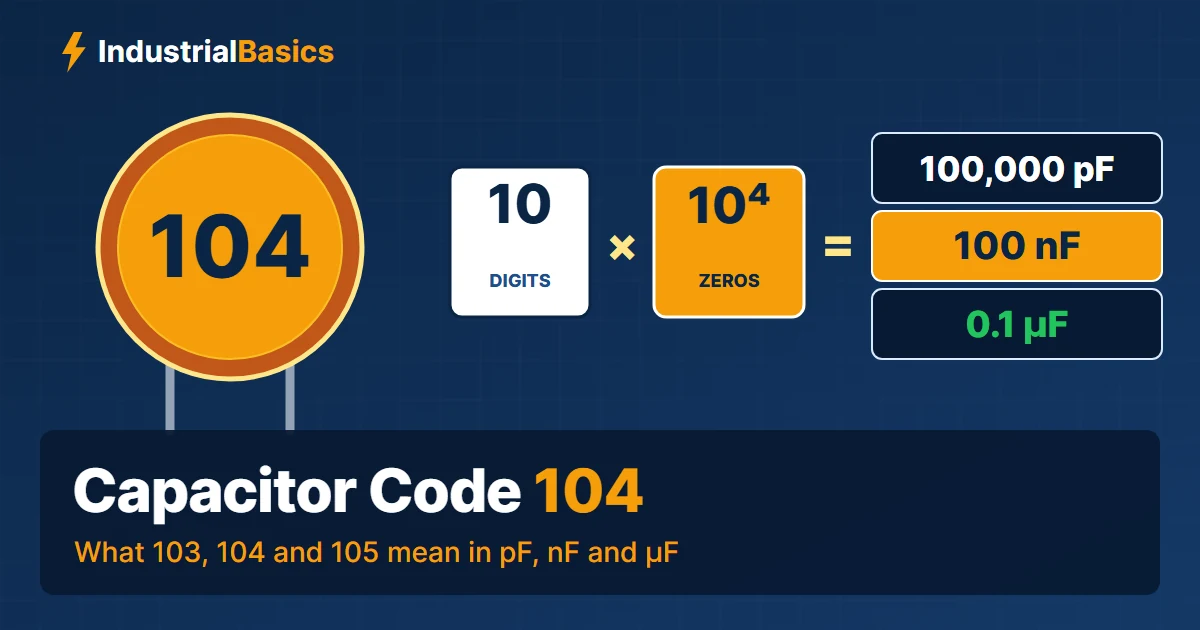
A capacitor marked 104 has a value of 100,000 pF, which equals 100 nF or 0.1 µF. The first two digits are the value (10), and the third digit is the number of zeros to add (4). The result is in picofarads. The same rule makes 103 = 10 nF and 105 = 1 µF.
| Code | Picofarads | Nanofarads | Microfarads |
|---|---|---|---|
| 100 | 10 pF | 0.01 nF | 0 µF |
| 101 | 100 pF | 0.1 nF | 0 µF |
| 102 | 1,000 pF | 1 nF | 0.001 µF |
| 103 | 10,000 pF | 10 nF | 0.01 µF |
| 104 | 100,000 pF | 100 nF | 0.1 µF |
| 105 | 1,000,000 pF | 1,000 nF | 1 µF |
| 106 | 10,000,000 pF | 10,000 nF | 10 µF |
Capacitor Code Decoder
Type the code printed on the capacitor. Add a tolerance letter if it has one.
How to Read a Three-Digit Capacitor Code
- Take the first two digits as a number.
- Use the third digit as the number of zeros to add.
- Read the answer in picofarads (pF).
- Divide by 1,000 for nF, or by 1,000,000 for µF.
| Code | Calculation | Result |
|---|---|---|
| 104 | 10 × 10⁴ | 100,000 pF = 100 nF = 0.1 µF |
| 223 | 22 × 10³ | 22,000 pF = 22 nF = 0.022 µF |
| 474 | 47 × 10⁴ | 470,000 pF = 470 nF = 0.47 µF |
| 225 | 22 × 10⁵ | 2,200,000 pF = 2.2 µF |
Very small values can use 9 or 8 as the third digit. JLCPCB’s guide gives 479 as 47 × 0.1 = 4.7 pF and 228 as 22 × 0.01 = 0.22 pF. These are less common, so confirm them from the datasheet.
Common Capacitor Code Chart
| Code | Picofarads | Nanofarads | Microfarads |
|---|---|---|---|
| 221 | 220 pF | 0.22 nF | 0 µF |
| 471 | 470 pF | 0.47 nF | 0 µF |
| 222 | 2,200 pF | 2.2 nF | 0.002 µF |
| 472 | 4,700 pF | 4.7 nF | 0.005 µF |
| 223 | 22,000 pF | 22 nF | 0.022 µF |
| 473 | 47,000 pF | 47 nF | 0.047 µF |
| 224 | 220,000 pF | 220 nF | 0.22 µF |
| 474 | 470,000 pF | 470 nF | 0.47 µF |
| 225 | 2,200,000 pF | 2,200 nF | 2.2 µF |
| 475 | 4,700,000 pF | 4,700 nF | 4.7 µF |
Tolerance Letters
A letter after the digits usually shows the tolerance, which is how far the actual value may differ from the marked value.
| Letter | Tolerance | Note |
|---|---|---|
| B | ±0.1 pF | Absolute, for small values |
| C | ±0.25 pF | Absolute, for small values |
| D | ±0.5 pF | Absolute, for small values |
| F | ±1% | |
| G | ±2% | |
| J | ±5% | |
| K | ±10% | |
| M | ±20% | |
| Z | +80% / −20% | Asymmetric |
For example, a 104K capacitor has a nominal value of 100 nF with ±10% tolerance, so its allowed range is 90 nF to 110 nF.
Voltage Codes and Full Markings
Many capacitors print the voltage directly, such as 50V. Others use a digit and letter. These codes are common but not universal, so they apply only when the maker’s datasheet uses that scheme.
| Code | Voltage | Code | Voltage |
|---|---|---|---|
| 0J | 6.3 V | 1H | 50 V |
| 1A | 10 V | 2A | 100 V |
| 1C | 16 V | 2E | 250 V |
| 1E | 25 V | 2G | 400 V |
| 1V | 35 V | 2J | 630 V |
Letter Codes Such as 4n7 and μ1
Some capacitors, especially film types, use a letter as both the unit and the decimal point. This style follows IEC 60062, and TDK uses it on film capacitors.
| Marking | Meaning | Value |
|---|---|---|
| 4R7 | R is the decimal point, in pF | 4.7 pF |
| 2p2 | p is the decimal point, in pF | 2.2 pF |
| n1 | Short code in nF | 100 pF |
| 1n0 | n is the decimal point, in nF | 1.0 nF |
| 4n7 | n is the decimal point, in nF | 4.7 nF |
| 100n | Value in nF | 100 nF |
| μ1 | Short code in µF | 100 nF |
| 1μ0 | μ is the decimal point, in µF | 1.0 µF |
So a film capacitor marked 100n or μ1 has the same value as a ceramic capacitor marked 104.
What the Code Does Not Tell You
| Marking or property | What to know |
|---|---|
| Voltage | Not part of the three-digit code |
| Dielectric | Codes such as C0G, X7R and Y5V are separate from the value |
| X7R | ±15% capacitance change from −55 °C to +125 °C |
| Y5V | +22% / −82% capacitance change from −30 °C to +85 °C |
| X1, X2, Y1, Y2 | Safety classes, not value codes |
| 0402, 0603 | Package sizes, not capacitance |
Class 2 ceramics, such as X7R and Y5V, can also lose capacitance under DC bias. In a timing, filter or drive circuit, that can matter as much as the marked value. Capacitors appear throughout control electronics, including the boards inside variable frequency drives and devices that use analog speed control. Single-phase motors have their own needs, and our guide to the shaded pole motor shows one type that avoids a capacitor altogether.
Frequently Asked Questions
What is the value of capacitor 104?
A capacitor marked 104 is 100,000 pF, which equals 100 nF or 0.1 µF.
What is the value of a 103 capacitor?
A 103 capacitor is 10,000 pF, which equals 10 nF or 0.01 µF.
What is the value of a 105 capacitor?
A 105 capacitor is 1,000,000 pF, which equals 1,000 nF or 1 µF.
What does 104K mean on a capacitor?
It means 100 nF with a K tolerance of ±10%.
What does 104J mean?
It means 100 nF with a J tolerance of ±5%. Do not confuse a trailing J with a 2J voltage code, which is commonly 630 V.
Does 104 tell me the capacitor voltage?
No. The three-digit code gives capacitance only. Voltage may be printed separately or found in the datasheet.
Is a capacitor marked 100 equal to 100 pF?
No. In the three-digit system, 100 means 10 followed by no zeros, so it is 10 pF.
Can I replace an X2 capacitor with a normal 104 capacitor?
No. X and Y capacitors are safety-rated parts. Replace them only with a part of the correct safety class, voltage and capacitance.
Sources and Further Reading
- JLCPCB: Ceramic Capacitor Code Guide: three-digit values, tolerance, voltage and dielectric codes.
- Specap: Capacitor Code Chart: value, tolerance, voltage and safety capacitor guidance.
- TDK Electronics: Film Capacitors, Marking and Ordering Code System: IEC 60062 capacitance and tolerance codes.