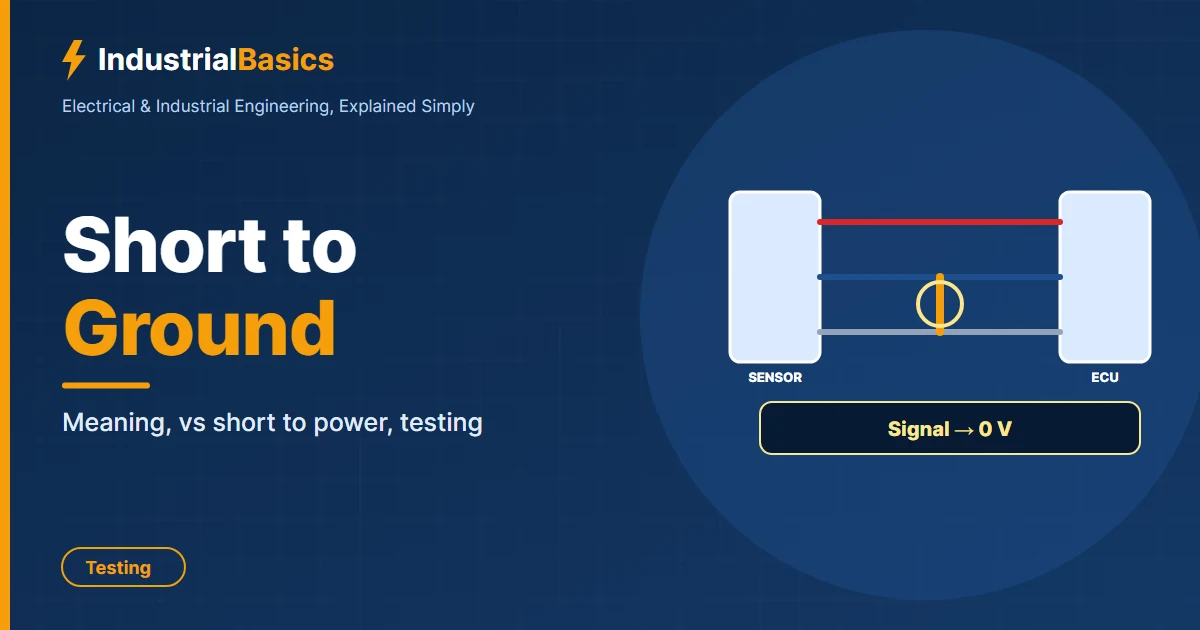
A short to ground is an unintended low-resistance connection between a wire and ground (0 V, chassis or the negative supply). A short to power, also called short to voltage, battery or positive, connects the wire to a supply instead. On a power circuit, a short to ground draws excessive current and blows the fuse. On a 5 V sensor circuit, the signal drops to about 0 V for a “circuit low” code, while a short to power pulls it to about 5 V for a “circuit high” code. An open signal wire can mimic a short to power, so always confirm with tests.
What Is a Short Circuit?
Wikipedia defines a short circuit as an unintended current path with no or very low impedance, an abnormal connection between two points meant to be at different voltages. The current is limited only by the resistance of the rest of the circuit, which can cause damage, overheating, fire or explosion. Its opposite is an open circuit, with infinite or very high resistance. “Short to ground” and “short to power” describe what the faulty wire has shorted to.
| Fault | Wire is connected to | Typical effect |
|---|---|---|
| Short to ground | 0 V, chassis, negative supply | Power circuit: fuse blows. Signal: reads ≈ 0 V, “circuit low”. |
| Short to power / voltage / positive | A supply such as 5 V reference | Signal reads ≈ supply, “circuit high”; load may run continuously. |
| Short to battery | Battery voltage (≈ 12 V vehicle) | Signal reads above the sensor supply; may damage inputs. |
| Open circuit | Nothing: wire broken or unplugged | No current. With a pull-up input, reads ≈ supply (looks like short to positive). |
Short to Ground vs Short to Power in Sensor Circuits
A typical active sensor gets a 5 V reference and a ground from the controller and returns a signal between 0.5 and 4.5 V. It never sends exactly 0 or 5 V, so the controller can spot faults. MVW Automotive explains that below 0.5 V the ECU stores “short circuit to ground”, and above 4.5 V it reports “short to positive”. MVW lists the shorts: signal to power wire (short to positive), signal to ground wire (short to ground), and any of the three wires to the bodywork (short to ground).
The catch is the input’s pull-up resistor. When MVW interrupted the signal wire, the sensor still produced 2.9 V, but the ECU input read 4.98 V. Its internal resistors pulled the floating input up, and it logged a short to positive. An open power or ground wire produced the same 4.98 V reading. AVI OnDemand stresses knowing whether a circuit uses a pull-up or pull-down resistor before interpreting codes.
Signal Fault Interpreter
How to Find a Short to Ground
- Read the fault code and live data, and note whether the signal is stuck low, stuck high or erratic.
- Check the reference supply and ground at the sensor connector before blaming the sensor.
- Compare the voltage at the sensor with the voltage at the controller input (a breakout box helps). They should match; a difference means a wiring problem.
- Unplug the sensor. If the controller side jumps to about the reference voltage and the sensor side reads 0 V, the signal wire is open.
- With power off and both ends disconnected, measure each wire to ground. A healthy isolated wire reads OL; a low reading is a short to ground.
- Measure resistance between wires in the harness to find a short to power, then inspect for chafing at clips, edges and moving parts.
Shorts to Ground in Industrial Control Circuits
The same faults happen on plant-floor wiring. A 24 VDC sourcing output or sensor supply shorted to 0 V or earth blows the I/O fuse or trips the module’s short-circuit protection (see PLC I/O fuse protection). A 4–20 mA loop shorted to ground reads under-range. On power systems, a phase-to-ground short is a ground fault, detected by ground fault relays and GFCIs (see GFCI vs AFCI).
Frequently Asked Questions
What does short to ground mean?
An unintended low-resistance connection between a circuit conductor and ground (0 V, the chassis or the negative supply). Current takes that path instead of the intended load (Wikipedia, short circuit).
What is the difference between a short to ground and a short to power?
A short to ground connects a wire to 0 V, pulling its voltage down; a short to power (to voltage, to battery or to positive) connects it to a supply, pulling its voltage up. On a sensor signal the first gives a “circuit low” reading and the second a “circuit high” reading.
What does short to battery mean?
The wire is connected to battery voltage (about 12 V in a car), usually through chafed insulation touching a powered wire. On a 5 V sensor signal it reads above the sensor supply.
What happens when a power wire shorts to ground?
Current rises sharply, limited only by the rest of the circuit, which can overheat wiring or cause a fire unless a fuse or breaker opens. A blown fuse is a classic sign (AVI OnDemand).
Can an open circuit look like a short to positive?
Yes. Many inputs use a pull-up resistor, so a broken signal wire floats up to about 5 V and the controller reports a short to positive. MVW Automotive measured 4.98 V at the ECU with the signal wire interrupted.
How do you test for a short to ground?
Switch off and disconnect both ends, then measure resistance from the wire to ground: an isolated wire reads OL (open). A low reading means a short to ground. Unplugging sections one at a time narrows down the location.
Does a sensor short code mean the sensor is bad?
Not necessarily. Wiring, connectors and terminals cause many of these codes, so test the circuit before replacing the sensor.
Why do sensor signals stay between 0.5 and 4.5 V?
So the controller can tell a real reading from a fault: a 5 V sensor signal never reaches exactly 0 or 5 V, so readings outside 0.5–4.5 V are flagged as short to ground or short to positive (MVW Automotive).
Is a short to ground the same as a ground fault?
Closely related. In power systems a ground fault is current flowing from a phase conductor to ground; ground fault relays and GFCIs detect it.
How do PLC inputs show a short to ground?
On sourcing 24 V I/O, a field wire shorted to 0 V or earth usually blows the I/O fuse or trips the module’s short-circuit protection; analog inputs show under-range.
Sources and Further Reading
- Wikipedia: Short circuit: definition, open vs short.
- MVW Automotive: Troubleshooting sensor wiring: signal window, short to ground and positive, open-wire pull-up readings.
- AVI OnDemand: Taking the trouble of using diagnostic trouble codes: circuit high/low codes, pull-up and pull-down resistors.