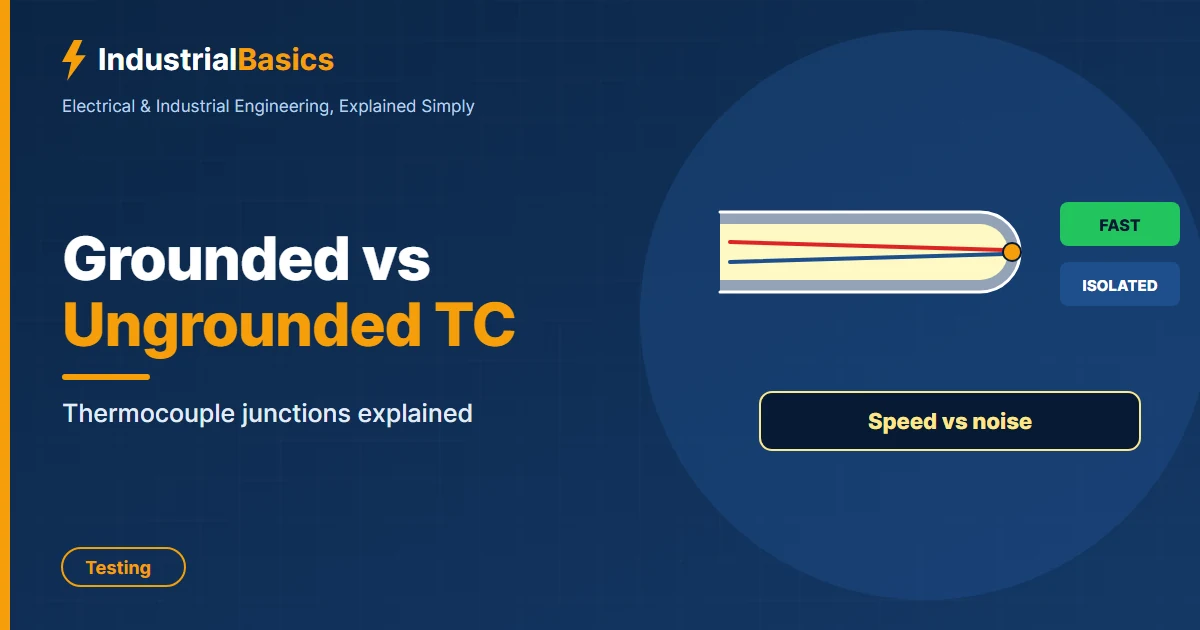
A grounded thermocouple has its junction welded to the probe sheath. It responds faster, but it is electrically connected to the sheath and can pick up ground-loop noise. An ungrounded thermocouple insulates the junction from the sheath with MgO. It responds roughly 1.5 times slower but is electrically isolated and quieter. An exposed junction sticks out of the sheath and is fastest of all, but only suits clean, non-corrosive gas. Choose grounded for speed in high-pressure or corrosive service, and ungrounded where noise or isolation matters.
Grounded vs Ungrounded vs Exposed
| Grounded | Ungrounded | Exposed | |
|---|---|---|---|
| Junction | Welded to inside of sheath tip | Insulated from sheath (MgO) | Protrudes beyond sheath |
| Response | Fast | Slowest (~1.5× grounded) | Fastest |
| Electrical isolation | No: junction at sheath potential | Yes | No sheath protection |
| Noise / ground loops | Most susceptible | Best immunity | Depends on installation |
| Corrosive / high pressure | Yes | Yes (preferred if isolation needed) | No |
| Typical use | Fast response in liquids, gases, pressure | Noisy plants, isolation required | Clean gas, lab, fast transients |
Grounded Junction
Dwyer Omega explains that in a grounded probe the thermocouple wires are physically attached to the inside of the probe wall. That gives good heat transfer through the wall to the junction and faster response than an ungrounded junction. It recommends grounded junctions for static or flowing corrosive gases and liquids and for high pressure. The drawback is noise: because the junction is tied to the sheath, grounded probes are highly susceptible to ground-loop noise, which reduces accuracy.
Ungrounded Junction
In an ungrounded probe, the junction is detached from the probe wall and insulated from the sheath by soft MgO powder. It responds more slowly, but electrical isolation keeps noise out of the signal, which Omega notes gives much better accuracy with very low-level signals. Cleveland Electric Laboratories quotes ungrounded response as typically about 1.5 times longer than grounded. The isolation is ideal where the sensor must float from ground potential or many sensors share one system.
Exposed Junction
The exposed junction protrudes from the sheath tip into the medium. It has the best response time but is limited to non-corrosive, non-pressurized use (Omega). Cleveland Electric Laboratories cites a bare 0.001 in wire junction reaching 63.2% of a step in 0.003 s in moving air.
Response Time Calculator
Ground Loops and Installation
A ground loop forms when the grounded sheath touches equipment at one ground potential while the measuring instrument references another. Current then flows in the thermocouple circuit, adding noise or a steady offset. Remedies include ungrounded probes, isolated input channels, and keeping thermocouple extension wire away from power and VFD motor leads. To check a probe, measure from each lead to the sheath with the probe disconnected: continuity means grounded.
For the choice between sensor types, see RTD vs thermocouple. For control-loop use of the reading, see PID tuning.
Frequently Asked Questions
What is a grounded thermocouple?
A sheathed thermocouple whose measuring junction is welded to the inside of the protective sheath tip. Heat passes straight through the sheath wall, so it responds faster than an ungrounded probe (Dwyer Omega).
What is an ungrounded thermocouple?
One whose junction is insulated from the sheath, typically by compacted MgO powder, so it is electrically isolated from the sheath and from ground. It responds more slowly but rejects electrical noise.
Which responds faster, grounded or ungrounded?
Grounded. Cleveland Electric Laboratories puts ungrounded response at roughly 1.5 times longer; exposed junctions are faster than both.
Why do grounded thermocouples cause ground loops?
The junction is electrically connected to the sheath, which touches grounded equipment. If the instrument input is also referenced to a different ground, current can flow in the thermocouple circuit and add noise or offset (Dwyer Omega).
When should I use an ungrounded thermocouple?
Where electrical isolation matters: noisy plants, VFD-driven equipment, multiple sensors on one non-isolated input card, or corrosive service where the sheath must shield the junction (Dwyer Omega; Cleveland Electric Laboratories).
When should I use an exposed junction?
Only in clean, non-corrosive, low-pressure gas where the fastest response is needed. The junction protrudes from the sheath and is unprotected.
How can I tell if a thermocouple is grounded?
With the probe disconnected, measure resistance from either thermocouple lead to the metal sheath. Near zero ohms means grounded; an open (very high) reading means ungrounded.
What is a thermocouple time constant?
The time to reach 63.2% of a sudden temperature change (Cleveland Electric Laboratories). About five time constants are needed to settle within 1%.
Can I use a grounded thermocouple with a PLC input?
Yes if the input channel is isolated. On non-isolated multi-channel cards, several grounded probes can create ground loops between channels; use ungrounded probes or isolated inputs.
Does junction type affect accuracy?
Not the calibration itself, but noise pickup on grounded junctions can reduce effective accuracy, especially with low-level signals (Dwyer Omega).
Sources and Further Reading
- Dwyer Omega: Thermocouples, grounded, ungrounded and other considerations: junction construction, response, ground loops, applications.
- Cleveland Electric Laboratories: Grounded vs ungrounded thermocouples: time constant definition and relative response.
- Wikipedia: Thermocouple.