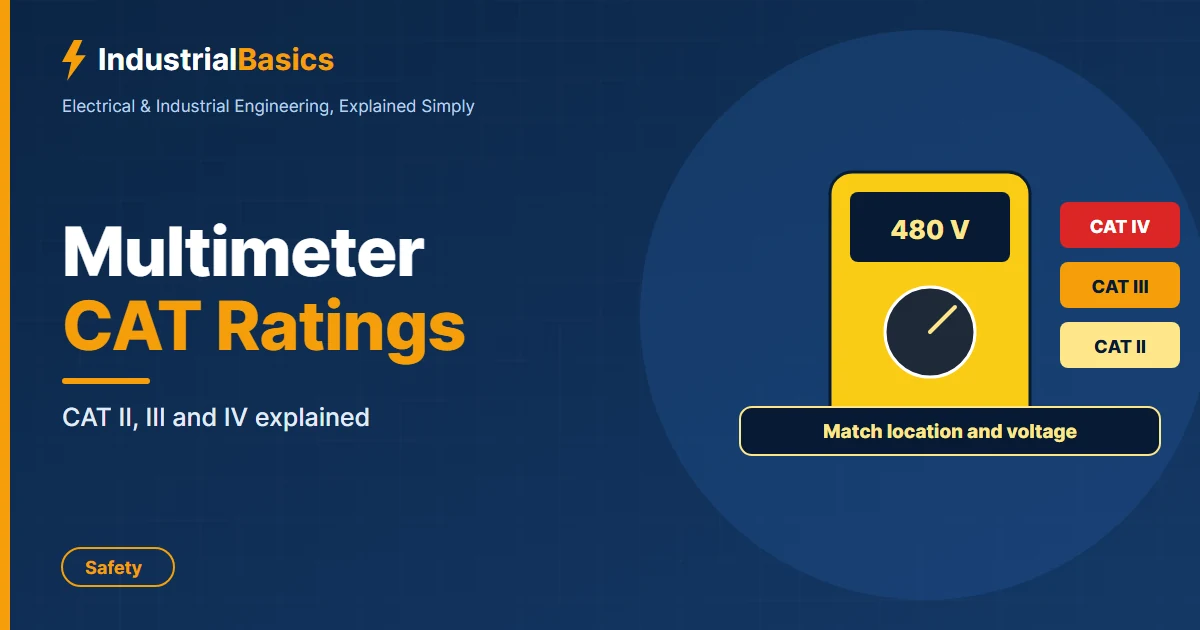
A multimeter CAT rating (measurement category I–IV under IEC 61010-1) tells you where in an electrical system the meter can be used safely, and the voltage beside it tells you how high. CAT IV covers the origin of the installation: service drop, utility meter and main breaker. CAT III covers the building installation: panels, feeders, motors and fixed wiring. CAT II covers plug-in appliances, and CAT I covers circuits not connected to mains. Higher categories must survive bigger transients. A CAT III 600 V meter withstands a 6,000 V impulse, and a CAT IV 600 V meter 8,000 V. Test leads need the same rating.
Measurement Categories CAT I to CAT IV
| Category | Where | Examples |
|---|---|---|
| CAT IV | Source of the low-voltage installation | Electricity meters, primary overcurrent protection, ripple control units, service entrance |
| CAT III | Building installation | Distribution boards, circuit breakers, wiring and cables, bus bars, junction boxes, switches, fixed socket outlets, industrial equipment |
| CAT II | Circuits directly connected to the low-voltage installation | Household appliances, portable tools and similar equipment |
| CAT I | Not directly connected to mains | Battery circuits, specially protected internal mains-derived circuits |
The categories reflect two things: the continuous energy available at that point, limited by breakers and fuses, and the size of impulse voltages expected there (Wikipedia). In general, transients from the utility side are least damped near the service entrance, which is why the same 480 V can demand a CAT IV meter at the main switchboard but only CAT III at a motor disconnect.
Impulse Withstand Voltages
| Working voltage (to ground) | CAT IV | CAT III | CAT II | CAT I |
|---|---|---|---|---|
| 150 V | 4,000 V | 2,500 V | 1,500 V | 800 V |
| 300 V | 6,000 V | 4,000 V | 2,500 V | 1,500 V |
| 600 V | 8,000 V | 6,000 V | 4,000 V | 2,500 V |
| 1000 V | 12,000 V | 8,000 V | 6,000 V | 4,000 V |
| Test source impedance | 2 Ω | 2 Ω | 12 Ω | 30 Ω |
Notice the overlap: CAT III 1000 V and CAT IV 600 V both require 8,000 V, and CAT II 1000 V equals CAT III 600 V at 6,000 V. Higher categories are also tested with a lower source impedance, 2 Ω instead of 12 Ω, which delivers far more energy. A meter is only as good as its rating in the category where you actually use it.
CAT Rating Selector
Choosing and Checking a Meter
- Rate the meter and every accessory for the highest category and voltage you will meet (University of Washington).
- Look for an independent testing lab mark such as UL, CSA or TÜV. A CE mark alone is not proof of independent testing.
- Check for the double-insulation symbol, a square within a square.
- Make sure leads have shrouded connectors, finger guards, CAT ratings at or above the meter, and minimal exposed probe metal.
- Confirm the fuses meet the maker’s specification. Fuse voltage must be at least the meter’s rating, and Wikipedia notes good meters use high-rupture-capacity ceramic fuses.
- Inspect before each use for cracks, worn leads and a faded display, and check that the ohms and continuity circuits are protected to the same level as the voltage circuit.
For PPE and arc-flash context, see electrical safety PPE and arc flash. For insulation testing instruments, see the megger insulation resistance test.
Frequently Asked Questions
What does CAT III mean on a multimeter?
Measurement category III: the meter is designed for measurements in the building installation, such as distribution boards, breakers, wiring, bus bars, junction boxes, switches and fixed outlets, and industrial equipment, and to survive the transients found there (IEC 61010-1, via Wikipedia).
What is the difference between CAT III and CAT IV?
CAT IV is for measurements at the origin of the installation, such as utility meters and primary overcurrent devices, where available fault energy is highest. At 600 V a CAT IV meter must withstand an 8,000 V impulse versus 6,000 V for CAT III.
Is CAT III 1000 V better than CAT IV 600 V?
They are equivalent in impulse withstand (8,000 V), but CAT IV 600 V is rated for the higher-energy location at the service entrance, while CAT III 1000 V allows higher working voltage inside the building.
What CAT rating do I need for a breaker panel?
At least CAT III for the panel voltage, for example CAT III 600 V for a 277/480 V panel. Many electricians carry CAT III 1000 V / CAT IV 600 V meters to cover service equipment too.
What is CAT II used for?
Measurements on circuits directly connected to the low-voltage installation through plugs: household appliances, portable tools and similar equipment.
What is CAT I?
Circuits not directly connected to mains, such as battery-powered or specially protected electronics. The equipment’s transient withstand must be stated by the maker.
Do the test leads need a CAT rating?
Yes. Leads, probes and clamps must be rated for the category and voltage of the work, at or above the meter’s rating; the system is only as safe as its lowest-rated part.
Why does the CAT rating matter if the voltage is the same?
Because transients and available fault energy differ by location. A meter that fails during a transient near the service can start an arc flash in the user’s hands.
What else should I check on a meter?
An independent testing lab mark (UL, CSA, TÜV or other NRTL), double-insulation symbol, high-energy fuses with adequate voltage and interrupting rating, and undamaged case and leads (University of Washington).
What source impedance is used for the transient test?
2 Ω for CAT IV and CAT III, 12 Ω for CAT II and 30 Ω for CAT I, per the IEC table reproduced by Wikipedia; lower impedance means more energy in the test pulse.
Sources and Further Reading
- Wikipedia: Measurement category: CAT I–IV definitions, impulse withstand table, source impedance.
- Wikipedia: Multimeter: IEC 61010-1 categories and fusing.
- University of Washington Facilities: Acquisition and use of electrical test equipment: selection and inspection practice.