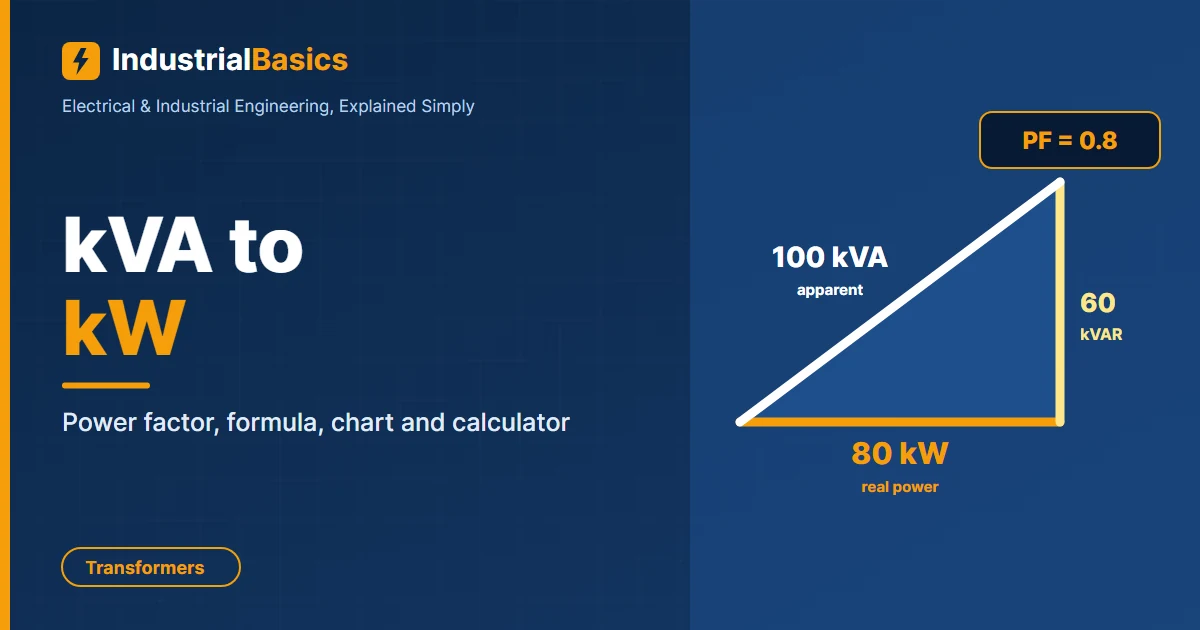
To convert kVA to kW, multiply by the power factor: kW = kVA × PF. To convert kW to kVA, divide by the power factor: kVA = kW ÷ PF. At the 0.8 power factor used for most generator ratings, 100 kVA = 80 kW and 50 kW needs 62.5 kVA. kVA is apparent power (volts × amps), while kW is the real power that does work; the difference is reactive power (kVAR) drawn by motors, transformers and other inductive loads.
kVA vs kW: What Is the Difference?
| kVA (apparent power) | kW (real power) | |
|---|---|---|
| What it measures | Volts × amps: the total the supply must deliver | The power converted to heat, light or motion |
| Includes reactive power? | Yes | No |
| Formula (three-phase) | √3 × V × I ÷ 1,000 | √3 × V × I × PF ÷ 1,000 |
| Equipment rated this way | Transformers, UPS (VA), generators (alternator), switchgear | Motors (output hp/kW), heaters, generator engines, utility energy (kWh) |
| What it limits | Current, heating of conductors and windings | Fuel or energy used, work done |
Wikipedia’s AC power article explains why both matter: the current associated with reactive power “does no work at the load”, but it still must be supplied by the source, so “conductors, transformers and generators must be sized to carry the total current”, not just the current that does useful work. kVA measures that total; kW measures the useful part.
kVA to kW Formula
The power factor (PF) is the ratio of real power to apparent power, PF = kW ÷ kVA, so it is always between 0 and 1. Rearranging gives the two conversions:
- kW = kVA × PF
- kVA = kW ÷ PF
- kVAR = √(kVA² − kW²), the reactive power
Worked examples
- 150 kVA generator to kW: 150 × 0.8 = 120 kW.
- 75 kVA transformer at 0.9 PF: 75 × 0.9 = 67.5 kW.
- 40 kW load to kVA at 0.85 PF: 40 ÷ 0.85 = 47.1 kVA.
- Reactive power of 100 kVA at 0.8 PF: √(100² − 80²) = 60 kVAR.
kVA to kW Calculator
kVA to kW Conversion Chart
| kVA | kW at PF 0.8 | kW at PF 0.9 | kW at PF 1.0 |
|---|---|---|---|
| 1 | 0.8 | 0.9 | 1 |
| 2 | 1.6 | 1.8 | 2 |
| 3 | 2.4 | 2.7 | 3 |
| 5 | 4 | 4.5 | 5 |
| 7.5 | 6 | 6.75 | 7.5 |
| 10 | 8 | 9 | 10 |
| 15 | 12 | 13.5 | 15 |
| 20 | 16 | 18 | 20 |
| 25 | 20 | 22.5 | 25 |
| 30 | 24 | 27 | 30 |
| 37.5 | 30 | 33.75 | 37.5 |
| 45 | 36 | 40.5 | 45 |
| 50 | 40 | 45 | 50 |
| 62.5 | 50 | 56.25 | 62.5 |
| 75 | 60 | 67.5 | 75 |
| 100 | 80 | 90 | 100 |
| 112.5 | 90 | 101.25 | 112.5 |
| 125 | 100 | 112.5 | 125 |
| 150 | 120 | 135 | 150 |
| 200 | 160 | 180 | 200 |
| 225 | 180 | 202.5 | 225 |
| 250 | 200 | 225 | 250 |
| 300 | 240 | 270 | 300 |
| 500 | 400 | 450 | 500 |
| 750 | 600 | 675 | 750 |
| 1000 | 800 | 900 | 1000 |
| 1500 | 1200 | 1350 | 1500 |
| 2000 | 1600 | 1800 | 2000 |
| 2500 | 2000 | 2250 | 2500 |
How Power Factor Changes the Answer
A low power factor means more current for the same useful power. Wikipedia’s power factor article notes that inductive loads such as induction motors consume reactive power, with current lagging voltage, and that a lower power factor gives higher apparent power and higher losses for the same real power. Utilities may charge customers with poor power factor, and EC&M suggests designing systems for about 95% power factor. Our leading vs lagging power factor guide explains correction with capacitors.
| Load | Typical power factor | 100 kVA supplies |
|---|---|---|
| Resistive heaters, incandescent lamps | About 1.0 | About 100 kW |
| Modern UPS output (Schneider Smart-UPS On-Line) | 0.9 to 1.0 | 90 to 100 kW |
| Generator rating convention | 0.8 | 80 kW |
| Induction motors below about half load | Falls steeply (DOE) | Much less than 80 kW |
Generators: Why kVA and kW Are Both on the Nameplate
EC&M’s equipment-ratings guide says a generator “is always rated in kW with a power factor of 80%”, and that all generators are considered to be rated at 80% power factor unless the nameplate states differently. The engine sets the kW limit; the alternator sets the kVA (current) limit. A 100 kVA / 80 kW set can deliver 80 kW of real power, and up to 100 kVA when the load’s power factor is 0.8.
Atlas Copco’s generator guide gives the same relationship, kW = kVA × pf, and notes that generator capacity is typically quoted in kVA. EC&M warns that sizing a generator from a calculated kVA (kW ÷ 0.8) without examining the real load mix often results in an undersized unit. Total the load in kW, then check both ratings, and allow for motor starting.
Transformers: Rated in kVA
A transformer heats up in proportion to the current through its windings, whatever the load’s power factor. EC&M explains that transformers are rated in kVA because apparent power represents the total current and voltage the transformer can supply, and gives the example that a 25 kVA transformer can deliver 104 A to a single-phase 240 V load (25,000 ÷ 240). A 75 kVA transformer is therefore a 75 kVA transformer whether the load is heaters (75 kW) or motors at 0.8 PF (60 kW).
For transformer types and how they are selected, see types of transformers; for full-load current from a kVA rating, use the 3 phase calculations guide.
UPS Systems: VA and Watts
Schneider Electric says that neither the watt nor the VA rating of a UPS may be exceeded by the connected load, and that the VA rating is always equal to or larger than the watt rating; the ratio is the power factor. Its newer Smart-UPS On-Line models of 6 kVA and above have unity power factor (6,000 VA = 6,000 W), while smaller models are rated at 0.9 or higher. Ratings differ from model to model, so always check both numbers on the data sheet.
Common Mistakes
- Treating kVA and kW as equal. They are only equal at power factor 1.0.
- Adding √3 to the kVA to kW step. √3 is only needed when converting from volts and amps.
- Sizing a generator on kVA alone. Check the kW (engine) rating and the motor starting load as well.
- Loading a transformer to its kVA as kW. At 0.8 PF a 75 kVA transformer supports only 60 kW.
- Confusing kW with kWh. kW is a rate of power; kWh is energy used over time.
Cooling equipment is rated in tons, not kVA; our tons to kW guide converts refrigeration tons to cooling kW and estimates electrical input from COP.
Frequently Asked Questions
How do you convert kVA to kW?
Multiply kVA by the power factor: kW = kVA × PF. At a power factor of 0.8, 100 kVA = 80 kW; at 0.9, 100 kVA = 90 kW.
How do you convert kW to kVA?
Divide kW by the power factor: kVA = kW ÷ PF. A 40 kW load at 0.8 PF needs 50 kVA of supply capacity.
What is 1 kVA in kW?
It depends on the power factor: 0.8 kW at PF 0.8, 0.9 kW at PF 0.9 and 1 kW only at PF 1.0 (a purely resistive load).
What is the difference between kVA and kW?
kVA is apparent power, volts × amps, which sets how much current wires, transformers and generators must carry. kW is real power, the part that does useful work. kW = kVA × power factor, so kW is never larger than kVA.
Why are transformers rated in kVA and not kW?
A transformer’s heating depends on the current it carries, not on the load’s power factor. EC&M explains that transformers are rated in kVA because apparent power represents the total current and voltage the transformer can supply.
Why do generators use a 0.8 power factor?
EC&M notes that generators are considered rated at 80% power factor unless the nameplate states otherwise. The engine limits kW while the alternator limits kVA, and 0.8 is the convention that links the two ratings.
Is the kVA to kW formula different for three-phase?
No. kW = kVA × PF for both single- and three-phase. The √3 only appears when you calculate kVA from volts and amps: kVA = √3 × V × I ÷ 1,000 for three-phase.
What power factor should I assume?
Use the nameplate or measured value when you have it. Otherwise 0.8 is the usual assumption for generator sizing and mixed motor loads, 0.9 or higher for modern UPS loads, and 1.0 for heaters and incandescent lighting.
How many kW is a 75 kVA transformer?
At 0.8 PF a 75 kVA transformer supplies 60 kW; at 0.9 PF, 67.5 kW; at unity, 75 kW. Its kVA rating, not kW, is the limit.
What is kVAR?
Reactive power, in kilovolt-amperes reactive. It flows back and forth between source and inductive or capacitive loads without doing work: kVAR = √(kVA² − kW²). Capacitor banks supply kVAR locally to raise power factor.
Sources and Further Reading
- EC&M: The Basics of Electrical Equipment Ratings: VA vs watts, transformer and generator ratings.
- Wikipedia: AC power: real, reactive and apparent power.
- Wikipedia: Power factor: definition, inductive loads and correction.
- Schneider Electric: VA vs watts: UPS ratings and power factor.
- US DOE Motor Challenge: Determining Electric Motor Load and Efficiency (PDF): motor power factor at part load.
- Atlas Copco: What size generator do I need?: kW = kVA × pf for generator sizing.