
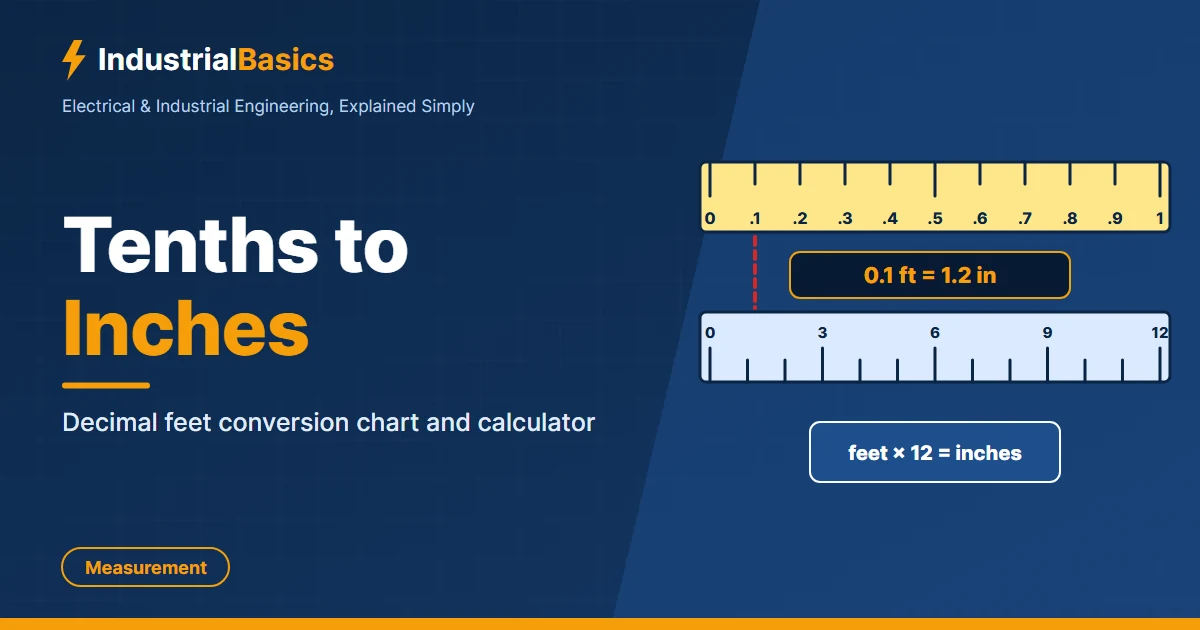
To convert tenths of a foot to inches, multiply by 12: 0.1 ft = 1.2 in, 0.5 ft = 6 in and 0.9 ft = 10.8 in. To convert inches to tenths of a foot, divide by 12: 3 in = 0.25 ft and 6 in = 0.5 ft. For a measurement such as 5.37 ft, keep the whole feet and convert only the decimal: 0.37 × 12 = 4.44 in, which is about 4 7/16 in, so 5.37 ft ≈ 5 ft 4 7/16 in.
Tenths of a Foot to Inches Chart
| Tenths of a foot | Inches (decimal) | Nearest 1/16 in | Nearest 1/8 in |
|---|---|---|---|
| 0.1 ft | 1.2 | 1 3/16″ | 1 1/4″ |
| 0.2 ft | 2.4 | 2 3/8″ | 2 3/8″ |
| 0.3 ft | 3.6 | 3 5/8″ | 3 5/8″ |
| 0.4 ft | 4.8 | 4 13/16″ | 4 3/4″ |
| 0.5 ft | 6.0 | 6″ | 6″ |
| 0.6 ft | 7.2 | 7 3/16″ | 7 1/4″ |
| 0.7 ft | 8.4 | 8 3/8″ | 8 3/8″ |
| 0.8 ft | 9.6 | 9 5/8″ | 9 5/8″ |
| 0.9 ft | 10.8 | 10 13/16″ | 10 3/4″ |
| 1.0 ft | 12.0 | 12″ | 12″ |
Hundredths of a Foot to Inches
| Decimal feet | Inches | Nearest 1/16 in |
|---|---|---|
| 0.01 | 0.12 | 1/8″ |
| 0.02 | 0.24 | 1/4″ |
| 0.03 | 0.36 | 3/8″ |
| 0.04 | 0.48 | 1/2″ |
| 0.05 | 0.60 | 5/8″ |
| 0.06 | 0.72 | 3/4″ |
| 0.07 | 0.84 | 13/16″ |
| 0.08 | 0.96 | 15/16″ |
| 0.09 | 1.08 | 1 1/16″ |
| 0.10 | 1.20 | 1 3/16″ |
| 0.25 | 3.00 | 3″ |
| 0.33 | 3.96 | 3 15/16″ |
| 0.50 | 6.00 | 6″ |
| 0.67 | 8.04 | 8 1/16″ |
| 0.75 | 9.00 | 9″ |
| 0.83 | 9.96 | 9 15/16″ |
Inches to Tenths of a Foot Chart
| Inches | Decimal feet | Inches | Decimal feet |
|---|---|---|---|
| 1″ | 0.083 | 7″ | 0.583 |
| 2″ | 0.167 | 8″ | 0.667 |
| 3″ | 0.250 | 9″ | 0.750 |
| 4″ | 0.333 | 10″ | 0.833 |
| 5″ | 0.417 | 11″ | 0.917 |
| 6″ | 0.500 | 12″ | 1.000 |
| 1/2″ | 0.042 | 1/4″ | 0.021 |
Tenths to Inches Calculator
How to Convert Decimal Feet to Feet and Inches
- Take the whole number as feet. For 12.68 ft, that is 12 ft.
- Multiply the decimal by 12 to get inches: 0.68 × 12 = 8.16 in.
- Multiply the leftover decimal of an inch by 16 (or 8, or 32) to get the fraction: 0.16 × 16 = 2.56, which rounds to 3, so 3/16 in.
- Write the result: 12.68 ft ≈ 12 ft 8 3/16 in.
Going the other way, convert any fraction to a decimal first (3/16 = 0.1875), add it to the inches, divide by 12, and add the feet: 8.1875 ÷ 12 = 0.682, so 12 ft 8 3/16 in = 12.682 ft.
Where Tenths of a Foot Are Used
Surveying and civil work in the US are done in decimal feet because elevations and distances are easier to add and subtract that way. Wikipedia’s level staff article describes imperial rods graduated in feet (large red numbers), tenths of a foot (small black numbers) and hundredths of a foot (the marks between). Grade stakes, site plans and laser-level receivers read the same way, and builders convert to feet and inches for layout.
Plant and industrial work meets decimal feet in tank level readouts, crane and conveyor positions, and encoder scaling. A level transmitter scaled in feet, for example, might show 12.68 ft on the HMI while the maintenance crew measures with a tape in feet and inches. Our psi to feet of head guide covers how a pressure transmitter reports liquid level in feet.
Converting Decimal Feet in a PLC
When an HMI needs to show feet and inches from a REAL value in decimal feet, the math is the same as by hand:
- Feet = truncate(value). Use a truncate function, not round; some controllers round when converting a REAL to an INT, which would show 12.68 ft as 13 ft.
- Inches = (value − feet) × 12.
- Sixteenths = round((inches − truncate(inches)) × 16); if this reaches 16, add 1 to the inches and set it to 0.
- Display feet, whole inches and sixteenths as separate integer tags.
For how scan logic and math instructions work, see what is a PLC.
Do Not Confuse These “Tenths”
| Term | Means | In inches | Where used |
|---|---|---|---|
| Tenth of a foot | 0.1 ft | 1.2 in | Surveying, civil and site work |
| Tenth of an inch | 0.1 in | 0.1 in (≈ 3/32 in) | General measurement, some rulers |
| A “tenth” in machining | 0.0001 in (a tenth of a thou) | 0.0001 in (2.54 µm) | Precision machining and inspection |
Wikipedia notes that in machining, 0.0001 in “is often treated as a basic unit and can be referred to as ‘one tenth’”, meaning one tenth of a thou. So a machinist asking for “two tenths” wants 0.0002 in, while a surveyor’s “two tenths” is 2.4 in. Context decides.
Foot and Inch Definitions
Wikipedia notes that one foot comprises 12 inches and, since the 1959 international agreement, the foot is exactly 0.3048 m. NIST adds that the slightly different US survey foot (1200/3937 m) should not be used after December 31, 2022, except for historic and legacy applications. Neither change affects the 12-inch conversion in this article.
Frequently Asked Questions
How do you convert tenths of a foot to inches?
Multiply by 12. 0.1 ft × 12 = 1.2 in, 0.4 ft × 12 = 4.8 in. For a full measurement such as 5.37 ft, keep the 5 ft and convert only the decimal: 0.37 × 12 = 4.44 in, about 4 7/16 in.
How many inches is a tenth of a foot?
1.2 inches, which is a little over 1 3/16 in (1.1875 in).
How do you convert inches to tenths of a foot?
Divide by 12. 3 in ÷ 12 = 0.25 ft; 7 in ÷ 12 = 0.583 ft (about 0.58 ft).
What is 2 tenths in inches?
0.2 ft = 2.4 inches, about 2 3/8 in.
What is 2 inches in decimal feet?
2 ÷ 12 = 0.167 ft (0.1667).
How many inches is a hundredth of a foot?
0.12 inch, just under 1/8 in (0.125 in). Level rods are marked in hundredths of a foot.
Is a tenth the same as 0.1 inch?
Not in surveying or construction, where “tenths” means tenths of a foot. A tenth of an inch is 0.1 in (about 3/32 in), and machinists use “a tenth” for 0.0001 in. Always check which one is meant.
Why do surveyors use tenths of a foot?
Decimal feet make arithmetic on elevations and distances easy, so survey rods, plans and grade stakes use feet, tenths and hundredths. Builders then convert to feet and inches in the field.
How do I convert decimal feet to feet and inches?
Feet = the whole number; inches = decimal part × 12; fraction = the remaining decimal of an inch × 16 (for sixteenths). 5.37 ft → 5 ft, 0.37 × 12 = 4.44 in, 0.44 × 16 = 7 → 5 ft 4 7/16 in.
Does the US survey foot change the conversion?
Not for this. There are still exactly 12 inches in either foot. NIST deprecated the US survey foot after December 31, 2022, and the international foot (0.3048 m) now applies.
Sources and Further Reading
- Wikipedia: Foot (unit): 12 inches per foot and the 0.3048 m definition.
- NIST: U.S. survey foot: deprecation after December 31, 2022.
- Wikipedia: Level staff: rods graduated in feet, tenths and hundredths.
- Wikipedia: Thousandth of an inch: the machinist’s “tenth”.



