
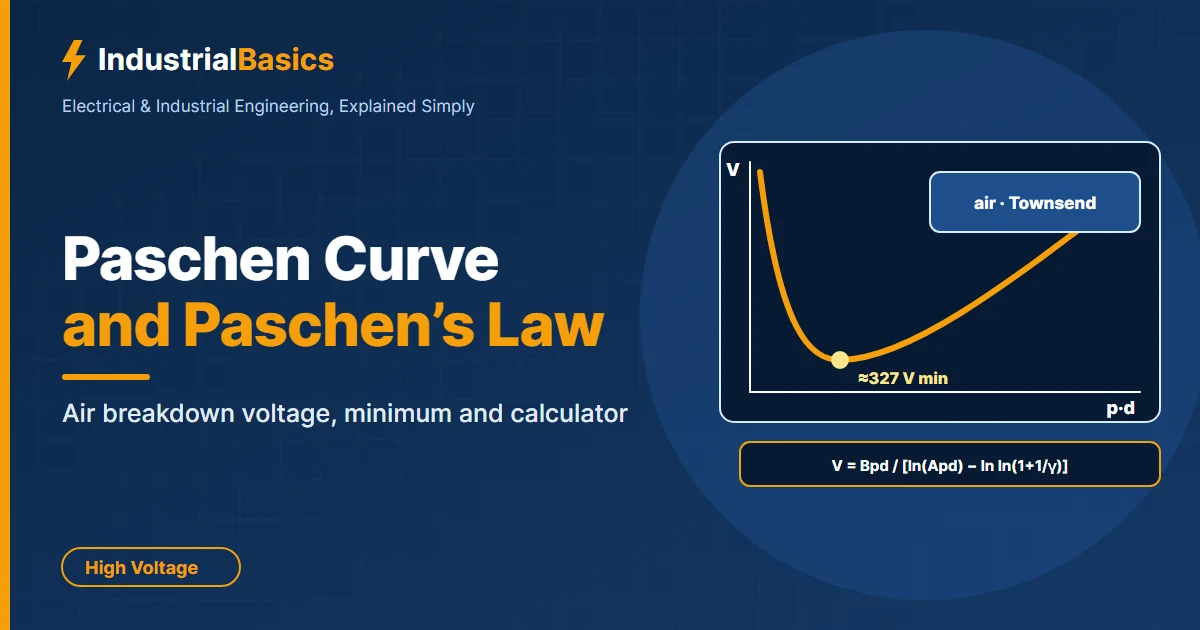
Paschen’s law gives the voltage at which a gas gap breaks down as a function of pressure × gap distance (p·d). The Paschen curve falls to a minimum and then rises. For air the minimum is about 327 V at p·d ≈ 7.5 µm·atm, so below about 327 V air cannot arc by Townsend breakdown at any gap. At ordinary gaps the breakdown voltage rises nearly linearly with p·d: about 5.0 kV for 1 mm at 1 atm. At low pressure (vacuum or altitude) it rises again.
Paschen’s Law Equation
| Symbol | Meaning | Air value |
|---|---|---|
| VB | Breakdown voltage | — |
| p | Gas pressure (absolute) | — |
| d | Gap distance | — |
| A | Saturation ionization constant | 112.50 (kPa·cm)⁻¹ |
| B | Related to excitation and ionization energies | 2737.50 V/(kPa·cm) |
| γ | Secondary-electron-emission coefficient of the cathode | Depends on material and surface (0.01 assumed here) |
The constants come from fitting the first Townsend ionization coefficient, α = A·p·e−B·p/E. A discharge becomes self-sustaining when each electron leaving the cathode creates enough ions that, on hitting the cathode, they release a new electron. That condition is α·d = ln(1 + 1/γ). Wikipedia derives the curve from it.
The Paschen Curve for Air
- Left of the minimum (low p·d): the electron mean free path is long compared with the gap. Electrons gain lots of energy but make few ionizing collisions, so a higher voltage is needed. This is why vacuum is a good insulator.
- At the minimum: the balance is best. In air about 327 V breaks down a 7.5 µm gap at 1 atm (43 MV/m).
- Right of the minimum (high p·d): electrons collide so often they cannot gain enough energy between collisions, and breakdown voltage rises roughly in proportion to p·d.
With Wikipedia’s A and B and γ = 0.01, the formula puts the minimum at about 305 V near p·d ≈ 0.11 kPa·cm, close to but not exactly the measured 327 V at 7.5 µm·atm. The constants are fitted over a limited E/p range and γ depends on the electrodes, so treat formula values as estimates.
Paschen Breakdown Calculator
Where Paschen’s Law Matters
- Altitude and aerospace: lower air pressure moves a fixed gap toward the minimum, so connectors, relays and power supplies that are safe at sea level can arc at altitude. See pressure altitude for how pressure falls with height.
- Vacuum equipment: chambers pass through the Paschen minimum while pumping down, a risky point for energized electrodes.
- Gas discharge devices: neon and fluorescent lamps, gas discharge tubes and surge arresters are designed around their gas’s Paschen curve.
- Insulating gases: pressurized gases raise p·d, which is why gas-insulated equipment uses pressurized gas.
Limits of Paschen’s Law
Wikipedia notes the equation loses accuracy for gaps under about 10 µm in air at one atmosphere. It does not apply when external electron sources such as UV light are present. In long gaps the field becomes non-uniform and streamers form, so a 1.5 m gap breaks down at about 3 MV/m, while the 7.5 µm minimum gap needs 43 MV/m. Electrode surfaces, humidity and temperature also shift γ and the result.
Frequently Asked Questions
What is Paschen’s law?
It describes the voltage needed to start a discharge (breakdown) between two electrodes in a gas as a function of the product of pressure and gap distance, p·d. Breakdown voltage is high at very small and very large p·d, with a minimum in between.
What is the Paschen curve?
The plot of breakdown voltage against p·d for a given gas. For air it has a minimum of about 327 V at roughly 7.5 µm·atm (Wikipedia), rises steeply on the low-pressure (left) side and roughly linearly on the right.
What is the Paschen minimum for air?
About 327 V at a p·d of 7.5×10⁻⁶ m·atm, i.e. a 7.5 µm gap at 1 atmosphere. Below that voltage no Townsend breakdown can occur in air at any gap or pressure.
What is the Paschen equation?
V_B = B·p·d / [ln(A·p·d) − ln(ln(1 + 1/γ))], where A and B are gas constants from the first Townsend coefficient and γ is the secondary-electron-emission coefficient of the cathode.
What are the A and B constants for air?
Wikipedia gives A = 112.50 (kPa·cm)⁻¹ and B = 2737.50 V/(kPa·cm) for air, valid for E/p from about 450 to 7500 V/(kPa·cm).
Why does breakdown voltage rise at low pressure?
Electrons travel so far between collisions that many reach the anode without ionizing anything, so a higher voltage is needed to create enough ionizing collisions (Wikipedia).
What voltage arcs across 1 mm of air?
The Townsend formula gives roughly 5.0 kV for a 1 mm uniform gap at 1 atm (about 5.0 MV/m). Real breakdown depends on electrode shape, humidity and surface condition.
What is the breakdown field of air?
About 3 MV/m for large gaps; Wikipedia gives about 3.4 MV for a 1 m gap at standard conditions. Small gaps break down at much higher fields (43 MV/m at the 7.5 µm Paschen minimum).
Why does Paschen’s law matter at altitude?
Air pressure falls with altitude, reducing p·d for a given gap. Equipment designed for sea level can arc at altitude or in partial vacuum, which is why aerospace and high-altitude electronics need larger clearances.
When does Paschen’s law fail?
For gaps under about 10 µm in air at 1 atm (field emission takes over), with external electron sources such as UV light, and in strongly non-uniform fields or long gaps where streamers form (Wikipedia).
Sources and Further Reading
- Wikipedia: Paschen’s law: equation, air constants, minimum, derivation and limits.
- Wikipedia: Electrical breakdown: breakdown mechanisms in gases.
- Wikipedia: Dielectric strength: breakdown field of air and other insulators.



