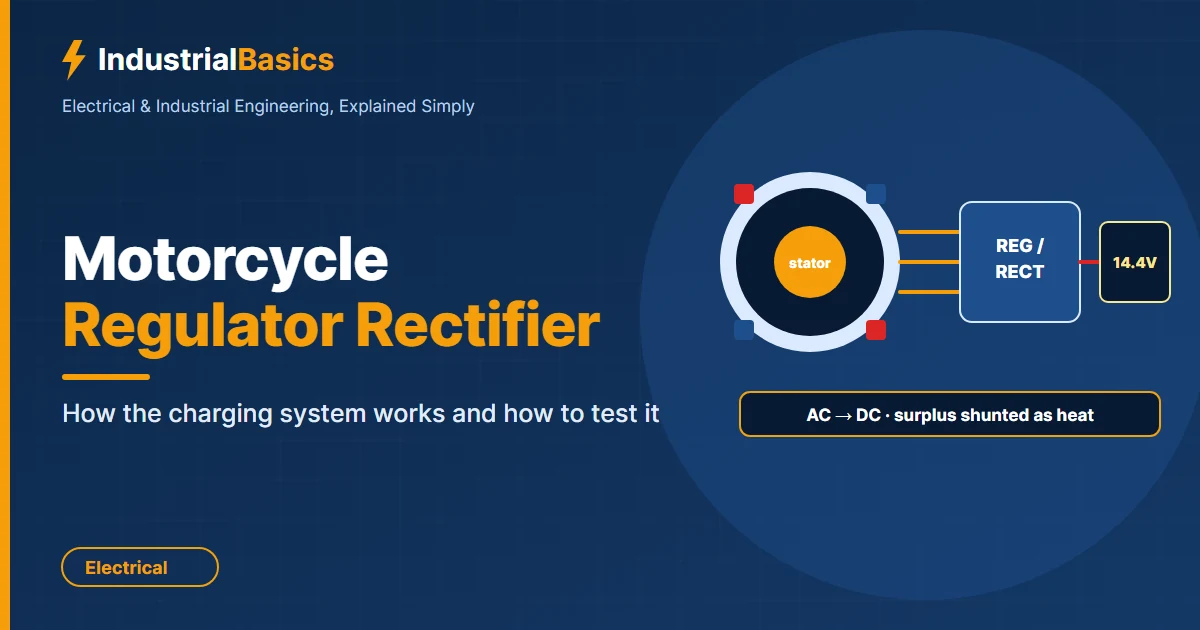
A motorcycle charging system uses an engine-driven alternator, usually permanent magnets on the flywheel spinning around a stator winding, to make AC. The regulator-rectifier turns that AC into DC (the rectifier) and limits the voltage to about 14.4 V (the regulator). Because the magnets cannot be turned down, most motorcycle regulators work by shunting excess stator output to ground as heat. That is why they run hot and why heat is their main cause of failure.
How a Motorcycle Charging System Works
- Generator: magnets in the flywheel spin around the stator, a core with copper windings. The changing magnetic field induces AC, and the output rises with engine speed (ElectroSport).
- Rectifier: diodes let current through in one direction only. A single-phase stator uses a four-diode bridge and a three-phase stator adds another pair for the third phase (Shorai).
- Regulator: a control circuit compares battery voltage with a reference. At the limit (about 14.6 V maximum), it triggers SCRs that short stator output to ground (Shorai).
- Battery: stores energy for starting and buffers the system. A fully charged battery rests at about 13 V and charges at about 14.4 V (ElectroSport).
ElectroSport notes that without regulation the stator output would push the system well above 14.4 V and blow components designed for 12–15 V. It also explains that the permanent-magnet design is not very efficient, because all the surplus is burned off, but it is simple and reliable. That is why it is the most common system on motorcycles. Diode basics are covered in anode vs cathode.
Types of Motorcycle Charging Systems
| System | How voltage is controlled | Notes |
|---|---|---|
| Permanent-magnet, single-phase | Shunt regulator (SCR or MOSFET) shorts surplus to ground | Small bikes; 4-diode rectifier |
| Permanent-magnet, three-phase | Shunt regulator; 6-diode rectifier | Most modern motorcycles |
| Field-controlled rotor (slip rings) | Regulator switches field current on and off | Efficient; many 1970s–80s Japanese bikes |
| Car-type alternator | Built-in rectifier and regulator | Some 1980s street bikes |
Some regulator-rectifiers sense voltage from a stator phase. Others have a separate sense wire, usually through the ignition switch, which lets them compensate for voltage drop in the charging leads (ElectroSport). Shorai describes MOSFET-based regulators as the preferred design for powersports, with longer life and better charging than thyristor (SCR) types.
Charging Test Interpreter
How to Test the Charging System
- Battery first: charge it and confirm it holds about 13 V at rest. A worn battery makes a good charging system look bad.
- Running voltage: with a multimeter on DC volts across the battery, start the engine. Expect roughly 12–13 V at idle, then rev to 4,000–5,000 rpm. It should rise to about 14.4–14.6 V and stop there (Shorai).
- Overcharging: if voltage keeps climbing past 15 V with rpm, the regulation has failed and the unit must be replaced; it is not serviceable (Shorai).
- Not charging: measure stator AC between each pair of the three stator wires (unplugged from the regulator) at the same rpm. ElectroSport stresses testing between phases, not phase to ground, because the AC side floats. Compare with the service manual value.
- Connectors and grounds: heat-browned stator plugs and poor grounds are common causes of low charging.
For current measurements (for example parasitic drain with the bike off), see how to check amps with a multimeter.
Frequently Asked Questions
What does a rectifier do on a motorcycle?
It converts the alternating current (AC) from the stator into direct current (DC) to charge the battery and run the bike. Inside, diodes act as one-way valves: four for a single-phase stator, six for a three-phase stator.
What does a regulator rectifier do?
It combines two jobs: the rectifier turns stator AC into DC, and the regulator holds the system voltage at about 14.4 V (up to ~14.6 V) so the battery and lights are not overcharged.
What charges the battery on a motorcycle?
The engine-driven alternator, usually a permanent-magnet flywheel spinning around a stator winding, feeding the regulator-rectifier, which charges the battery whenever the engine runs.
What voltage should a motorcycle charging system produce?
About 14.4 V at the battery at 4,000–5,000 rpm (Shorai gives ~14.4–14.6 V; ElectroSport 14.4 V). A charged battery rests near 13 V. Over 15 V means the regulator has failed.
How does a shunt regulator work?
When battery voltage reaches the regulation point, the control circuit fires SCR (or MOSFET) switches that short stator output to ground, turning the surplus into heat in the regulator body.
Why do motorcycle regulator rectifiers fail?
Mostly from heat: a shunt regulator dissipates all the surplus power. Poor airflow, mounting near the exhaust and repeatedly charging a flat battery make it worse. Moving it to cooler air can help.
MOSFET or SCR regulator?
Shorai describes MOSFET regulators as the preferred design for powersports, with longer life and better charging performance than thyristor (SCR) types.
How do I test a motorcycle stator?
Measure AC voltage between each pair of stator wires (1–2, 2–3, 1–3) at the same rpm; the readings should be similar and match the service manual. Do not measure phase to ground: the AC side floats from ground (ElectroSport).
What are the symptoms of a bad regulator rectifier?
A battery that keeps going flat (not charging), or overcharging: bulbs blowing, a hot or boiling battery, and voltage that keeps rising with rpm above 15 V.
Do all motorcycles use permanent-magnet alternators?
Most do because the system is simple and reliable, but some older bikes used field-controlled rotors with slip rings, and some 1980s models used car-type alternators with built-in regulators.
Sources and Further Reading
- ElectroSport: How a Motorcycle Charging System Works: permanent-magnet and field systems, 14.4 V, shunt regulation, testing between phases.
- Shorai: Overview of Voltage Regulator Types: single- and three-phase regulators, SCR shunting, MOSFET vs thyristor, test procedure.
- Wikipedia: Alternator: stator, rotor, permanent magnet and field excitation.