
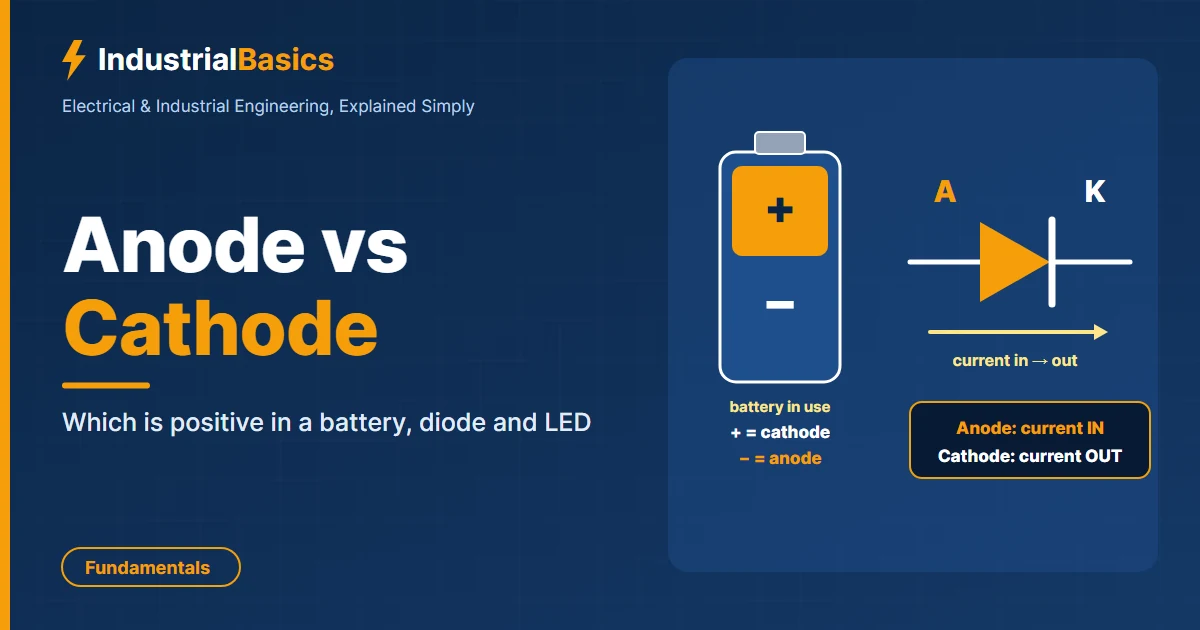
The anode is the electrode where conventional current flows into a device, and where oxidation happens. The cathode is where current flows out, and where reduction happens. Whether the anode is positive or negative depends on the device: in a battery supplying power the anode is the negative (−) terminal, while in a diode, an electroplating bath or a battery being charged the anode is the positive (+) side. On components, the cathode of a diode is marked with a band and the anode of an LED has the longer lead.
Anode vs Cathode at a Glance
| Device or situation | Anode | Cathode | Anode polarity |
|---|---|---|---|
| Battery supplying power (galvanic cell) | Negative terminal, oxidation | Positive terminal, reduction | Negative |
| Battery being charged / electrolytic cell | Positive terminal (external supply) | Negative terminal | Positive |
| Electroplating | Plating metal or inert electrode | Part being plated | Positive |
| Diode or LED (forward biased) | P side, unmarked end, LED long lead | N side, banded end, LED short lead | Positive |
| Vacuum tube / CRT | Plate that collects electrons | Electrode that emits electrons | Positive |
| Cathodic protection | Sacrificial zinc, magnesium or aluminum (or ICCP anode bed) | Protected steel structure | Depends on system |
Wikipedia’s anode article puts the pattern neatly: the anode is negative in a device that provides power, and positive in a device that consumes power. What never changes is the direction of current, which is why the definitions are based on current, not on the + and − signs.
The Definition That Always Works
Wikipedia defines an anode as the electrode “through which conventional current enters the device” and a cathode as the electrode through which conventional current leaves. Its mnemonics are ACID (Anode Current Into Device) and CCD (Cathode Current Departs). Because electrons are negative, they move the opposite way: electrons leave a device at the anode and enter it at the cathode.
In electrochemistry the same electrodes are identified by the reaction. In both galvanic and electrolytic cells the anode is where oxidation (loss of electrons) occurs, and the cathode is where reduction (gain of electrons) occurs. The mnemonics Wikipedia lists include An Ox, Red Cat (anode oxidation, reduction cathode) and OIL RIG (oxidation is loss, reduction is gain).
Is the Anode Positive or Negative?
In a battery or galvanic cell
A discharging battery pushes current out of its positive terminal, so the positive terminal is the cathode and the negative terminal is the anode. LibreTexts’ copper–silver galvanic cell shows this: copper is oxidized, so the copper electrode is the anode; silver ions are reduced at the silver electrode, the cathode; and the cell reads +0.46 V. LibreTexts also notes that the anode is named for the anions that move toward it through the salt bridge, and the cathode for the cations.
In a battery being charged, and in electrolysis
When a charger forces current back into a battery, current now enters at the positive terminal, so the positive terminal becomes the anode. The same applies to electroplating and other electrolytic cells: the external supply makes the anode positive, and the part connected to negative becomes the cathode, where metal is deposited.
The battery-industry convention
Because the roles swap between charge and discharge, Wikipedia notes that battery makers often call the negative electrode the anode and the positive electrode the cathode all the time, based on the discharge roles. That is why lithium-ion data sheets call the negative electrode the “anode” whether the cell is charging or not. When reading battery literature, anode usually just means negative.
Anode and Cathode on Diodes and LEDs
In a semiconductor diode, Wikipedia identifies the anode as the P-doped layer and the cathode as the N side. The diode conducts when its anode is made more positive than its cathode (forward bias) and blocks when the polarity is reversed. Wikipedia’s cathode article notes that diode terminals are always named by the forward-current direction, even for Zener diodes and solar cells where the useful current flows the other way.
- Schematic symbol: the anode connects to the flat side of the triangle; the arrow points toward the cathode bar. SparkFun says current flows in the direction the triangle points.
- Rectifier and signal diodes: a painted band (white, gray or black) marks the cathode. SparkFun shows a 1N4001 with a gray cathode band.
- LEDs: SparkFun says the anode is the positive side, “marked by having a longer lead”; the shorter lead is the cathode. A reversed LED simply does not light.
- Multimeter check: on diode test, a reading of roughly 0.6–0.7 V (Wikipedia’s typical threshold for a silicon p–n diode) means the red lead is on the anode; reversed, the meter shows open.
The same rule decides which pins of a multi-LED display share a connection; see our 7 segment display pinout guide for common anode and common cathode displays.
Cathodic Protection: Anodes That Corrode on Purpose
Corrosion is oxidation, and oxidation happens at the anode. Cathodic protection uses that fact: Wikipedia describes it as controlling corrosion “by making it the cathode of an electrochemical cell”. A more active metal, with a more negative electrode potential, is connected to the steel and corrodes in its place. Galvanic anodes are made from alloys of zinc, magnesium and aluminum, and ASTM International publishes standards for them.
Typical uses include steel water and fuel pipelines, storage tanks and home water heaters, pier piles, ship hulls and offshore platforms. For long pipelines, where sacrificial anodes cannot supply enough current, an external DC source drives the protection current: this is impressed current cathodic protection (ICCP). Galvanized steel works the same way, with its zinc coating acting as the sacrificial anode. Wikipedia notes that cathodic protection was applied to US steel gas pipelines from 1928.
Cathodic protection systems interact with electrical grounding: bonding a protected pipeline to a facility ground grid can drain the protection current. For the difference between protective earthing and system grounding, see earthing vs grounding.
Anode and Cathode in Vacuum Tubes and X-Ray Tubes
In vacuum devices the cathode is heated and emits electrons, and the anode (or plate) is held positive to attract and collect them. Wikipedia describes the anode of a cathode ray tube as “the positively charged electron collector”. Current therefore flows into the tube at the anode, consistent with the ACID rule.
Common Mistakes
- Assuming the anode is always positive. It is negative in a battery that is supplying power.
- Assuming the anode is always negative. It is positive in diodes, plating baths and charging batteries.
- Mixing electron flow with conventional current. ACID and CCD refer to conventional current; electrons go the other way.
- Fitting an LED backwards. Long lead to the positive side, through a resistor.
- Isolating a sacrificial anode. Painting or disconnecting the anode, or breaking its bond wire, stops the protection.
Frequently Asked Questions
What is the difference between an anode and a cathode?
Conventional current flows into a device through the anode and out through the cathode. In chemistry terms, oxidation (loss of electrons) happens at the anode and reduction (gain of electrons) at the cathode.
Is the anode positive or negative?
It depends on the device. In a battery that is supplying power the anode is the negative terminal. In a battery being charged, an electroplating bath or a diode in forward bias, the anode is positive.
Is the positive end of a battery the anode or cathode?
While the battery is discharging, the + end is the cathode. Wikipedia’s anode and cathode articles both use this example. Battery makers, however, usually call the negative electrode the anode at all times.
Which is the anode on a diode?
The anode is the unmarked end, shown as the flat side of the triangle in the symbol. The cathode is marked with a painted band on the body and is the bar the arrow points to in the symbol.
Which leg of an LED is the anode?
The longer lead. SparkFun describes the anode as the positive side, marked by a longer lead; the shorter lead is the cathode.
Does oxidation happen at the anode or cathode?
Oxidation always happens at the anode, and reduction at the cathode, in both galvanic and electrolytic cells. Mnemonic: “An Ox, Red Cat”.
Which way do electrons flow?
Electrons flow opposite to conventional current: they leave a device at the anode and enter it at the cathode. In a battery’s external circuit, electrons flow from the negative terminal to the positive terminal.
What is a sacrificial anode?
A piece of a more active metal such as zinc, magnesium or aluminum connected to steel so that it corrodes instead of the steel. It is used on pipelines, tanks, water heaters and boat hulls, and must be replaced when it is used up.
Why are they called anode and cathode?
LibreTexts explains that the anode is named for the anions that move toward it through the salt bridge, and the cathode for the cations that move toward it.
What are the anode and cathode in a lithium-ion battery?
By battery-industry convention the anode is the negative electrode and the cathode is the positive electrode, named for their roles during discharge, even though the electrochemical roles swap while the cell is charging.
Sources and Further Reading
- Wikipedia: Anode: definition, polarity by device, mnemonics and battery conventions.
- Wikipedia: Cathode: cathode definition, diode naming and vacuum tubes.
- LibreTexts (OpenStax Chemistry): Galvanic cells: oxidation at the anode, salt bridge and naming.
- Wikipedia: Diode: cathode band marking and P–N junction.
- SparkFun: Light-emitting diodes: LED anode on the longer lead.
- SparkFun: Diodes: diode symbol and cathode band.
- Wikipedia: Cathodic protection: sacrificial and impressed current systems.



