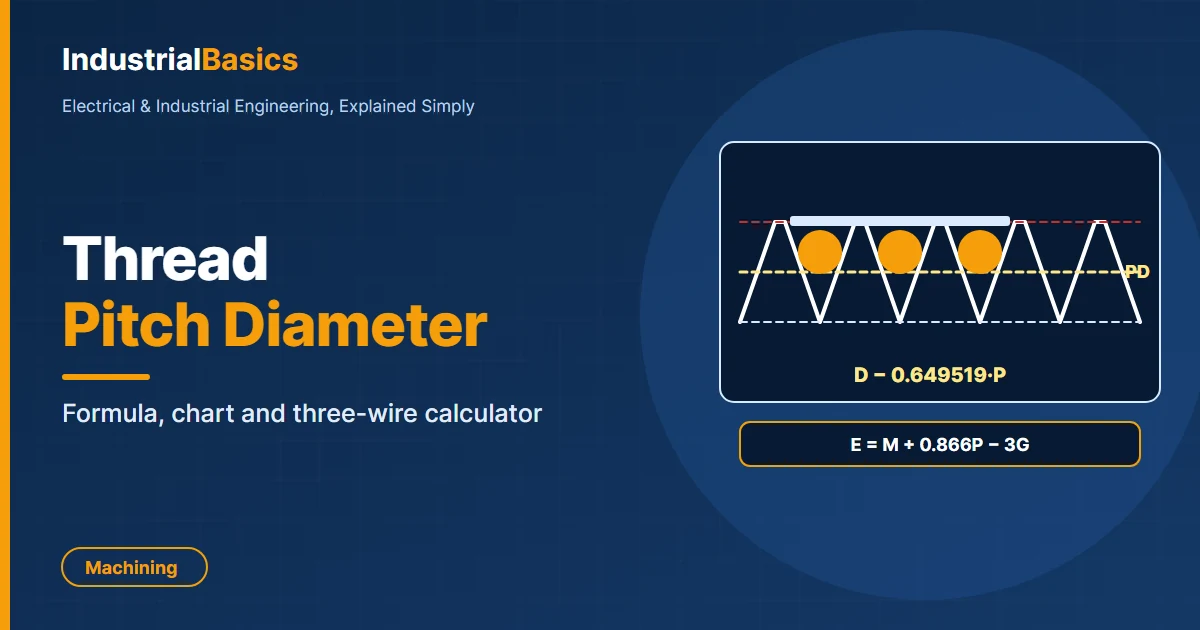
Pitch diameter is the diameter at which the thread and the groove between threads are equal in width, each half the pitch. For 60° UTS and metric threads, basic pitch diameter = major diameter − 0.649519 × pitch. A 1/4-20 thread has a basic pitch diameter of 0.2175 in; M10 × 1.5 has 9.026 mm. It is measured with the three-wire method: E = M + 0.86603·P − 3G, using wires of the best size, 0.57735 × pitch.
What Pitch Diameter Means
Wikipedia defines the pitch diameter (PD, or D₂) as the diameter of a cylinder concentric with the thread that intersects the flanks at equidistant points. On that cylinder the thread and the space are each exactly half the pitch. If a screw and nut have exactly matching pitch diameters, with root and crest clearance, there is no play between them. That is why thread fit classes are defined by pitch diameter rather than by major diameter.
Pitch Diameter Formula
These follow from the basic 60° profile. The fundamental triangle height is H = (√3/2)·P. Pitch diameter is 3/8·H below the major diameter on each side, and the minor diameter is 5/8·H below (Wikipedia, ISO metric screw thread and Unified Thread Standard). For inch threads, P = 1 / threads per inch.
| Thread | Major dia (in) | TPI | Pitch (in) | Basic PD (in) | Minor dia (in) | Best wire (in) |
|---|---|---|---|---|---|---|
| #6-32 | 0.1380 | 32 | 0.03125 | 0.1177 | 0.1042 | 0.01804 |
| #8-32 | 0.1640 | 32 | 0.03125 | 0.1437 | 0.1302 | 0.01804 |
| #10-24 | 0.1900 | 24 | 0.04167 | 0.1629 | 0.1449 | 0.02406 |
| #10-32 | 0.1900 | 32 | 0.03125 | 0.1697 | 0.1562 | 0.01804 |
| 1/4-20 | 0.2500 | 20 | 0.05000 | 0.2175 | 0.1959 | 0.02887 |
| 1/4-28 | 0.2500 | 28 | 0.03571 | 0.2268 | 0.2113 | 0.02062 |
| 5/16-18 | 0.3125 | 18 | 0.05556 | 0.2764 | 0.2524 | 0.03207 |
| 3/8-16 | 0.3750 | 16 | 0.06250 | 0.3344 | 0.3073 | 0.03608 |
| 1/2-13 | 0.5000 | 13 | 0.07692 | 0.4500 | 0.4167 | 0.04441 |
| Thread | Major dia (mm) | Pitch (mm) | Basic PD (mm) | Minor dia (mm) | Best wire (mm) |
|---|---|---|---|---|---|
| M4 × 0.7 | 4 | 0.7 | 3.545 | 3.242 | 0.4041 |
| M5 × 0.8 | 5 | 0.8 | 4.480 | 4.134 | 0.4619 |
| M6 × 1 | 6 | 1 | 5.350 | 4.917 | 0.5774 |
| M8 × 1.25 | 8 | 1.25 | 7.188 | 6.647 | 0.7217 |
| M10 × 1.5 | 10 | 1.5 | 9.026 | 8.376 | 0.8660 |
| M12 × 1.75 | 12 | 1.75 | 10.863 | 10.106 | 1.0104 |
Pitch Diameter and Three-Wire Calculator
The Three-Wire Method
- Choose wires close to the best size, 0.57735 × P for 60° threads. Letter Circular 23 notes the minimum usable size must still project above the crest, and the maximum must not ride on the crest.
- Place the wires: two in adjacent grooves on one side and one in the groove opposite. Grease helps hold them (Wikipedia).
- Measure over the wires with a flat-anvil micrometer to get M.
- Calculate: E = M + 0.86603·P − 3G for 60° threads with helix angles under 5°, the formula the Bureau of Standards gage section used for ordinary fastening screws.
Example: a 1/4-20 thread (P = 0.050 in) with best-size wires of 0.02887 in should read M = 0.2608 in at basic pitch diameter. If the reading is 0.0010 in lower, the pitch diameter is 0.0010 in under basic. LC 23 gives a more general formula for other thread angles, unsymmetrical threads and tapered pipe threads. For taper threads see NPTF vs NPT.
Other Ways to Check Pitch Diameter
- Thread micrometer: a V-anvil and conical spindle tip contact the flanks for a direct pitch diameter reading.
- Optical comparator: determines pitch diameter graphically from a magnified profile.
- Go/no-go thread gauges: the most common production method, confirming the thread is within its class limits.
Tap drill size depends on the minor diameter rather than the pitch diameter; see the 4-40 tap drill size guide. On CNC machines, threaded holes are usually drilled with a G83 peck drilling cycle before tapping.
For a worked size, see 10-24 screw dimensions, which compares 10-24, 10-32 and M5.
Thread classes such as 2A and 3A are limits on pitch diameter: see what 2A means.
Frequently Asked Questions
What is pitch diameter?
The diameter of an imaginary cylinder, concentric with the thread, that cuts the thread flanks where the thread width equals the groove width, i.e. half the pitch (Wikipedia). It is the diameter that controls how a screw and nut fit.
What is the pitch diameter formula?
For UTS and ISO metric 60° threads, basic pitch diameter Dp = D − 0.649519 × P, where D is the major (nominal) diameter and P the pitch (for inch threads, P = 1/TPI).
What is the pitch diameter of 1/4-20?
Basic PD = 0.250 − 0.649519 × 0.05 = 0.2175 in. Class 2A bolts are slightly below this because of the allowance and tolerance.
What is the pitch diameter of M10 × 1.5?
Basic PD = 10 − 0.649519 × 1.5 = 9.026 mm.
How do you calculate thread pitch?
Pitch is the distance between adjacent threads. For inch threads, pitch = 1 ÷ threads per inch (20 TPI = 0.050 in). Metric threads state the pitch directly, e.g. M8 × 1.25.
What is the three-wire method?
Three precision wires (gauge pins) are placed in the thread grooves, a micrometer measures over them (M), and pitch diameter is calculated: E = M + 0.86603·P − 3G for 60° threads, where G is the wire diameter.
What is the best wire size?
For 60° threads, 0.57735 × pitch: the wire that touches the flanks exactly at the pitch diameter, which makes the result least sensitive to thread-angle errors.
What is the difference between the two-wire and three-wire methods?
Three wires (two on one side, one on the other) keep the micrometer square to the thread axis. Two-wire setups are used mainly for special cases such as measuring thread angle with two wire sizes, as described in LC 23.
How else is pitch diameter measured?
With a thread (pitch) micrometer with V-anvil and cone tips for a direct reading, with an optical comparator, or functionally with go/no-go thread gauges, the most common production method (Wikipedia).
Why are thread classes specified by pitch diameter?
Because fit depends on pitch diameter. Classes 1A/1B, 2A/2B and 3A/3B (loose to tight) set the allowed pitch diameter range for external (A) and internal (B) threads.
Sources and Further Reading
- Wikipedia: Screw thread: pitch diameter definition, measuring methods, classes of fit.
- Wikipedia: Unified Thread Standard: basic profile formulas, UTS sizes and TPI.
- Wikipedia: ISO metric screw thread: basic profile and pitch diameter.
- U.S. Bureau of Standards, Letter Circular 23: Measurement of Pitch Diameter of Screw Thread Gages (PDF): three-wire method, wire sizes and formulas.