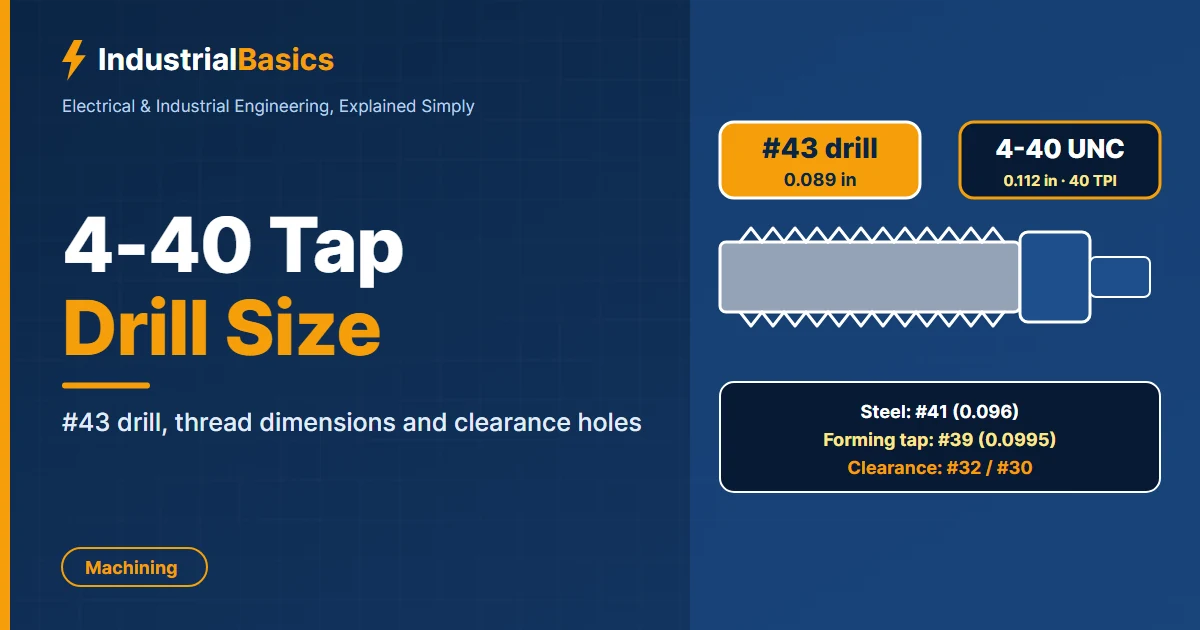
The tap drill size for a 4-40 thread is a #43 drill (0.089 in) with a standard cutting tap, which gives about 75% thread. For harder materials such as steel and stainless, a #41 drill (0.096 in) gives about 50% thread and makes tapping easier. For a forming (roll) tap, use a #39 drill (0.0995 in). A 4-40 screw has a 0.112 in (2.845 mm) major diameter and 40 threads per inch; its clearance hole is a #32 (0.116 in) for a close fit or #30 (0.1285 in) for a free fit.
4-40 Thread Dimensions
| Specification | #4-40 UNC | Source |
|---|---|---|
| Major diameter | 0.1120 in (2.845 mm) | Wikipedia (Unified Thread Standard) |
| Threads per inch | 40 (coarse, UNC) | Wikipedia |
| Pitch | 0.025 in (0.635 mm) | Wikipedia |
| Internal minor diameter | 0.0813 in | Little Machine Shop |
| Fine-thread version | #4-48 UNF | Wikipedia |
| Preferred cutting tap drill | #43 (0.089 in) | Wikipedia, Little Machine Shop |
The “4” is the machine screw number and the “40” is threads per inch. Wikipedia gives the rule for numbered screws: major diameter = screw number × 0.013 in + 0.060 in, so a #4 is 4 × 0.013 + 0.060 = 0.112 in. The Unified Thread Standard lists 40 TPI as the coarse (UNC) thread and 48 TPI as the fine (UNF) thread for this size, and gives #43 as the preferred cutting tap drill for 4-40.
4-40 Tap Drill and Clearance Drill Sizes
| Purpose | Drill | Decimal (in) | mm | Notes |
|---|---|---|---|---|
| Cutting tap, 75% thread | #43 | 0.0890 | 2.261 | Aluminum, brass, plastics (Little Machine Shop) |
| Cutting tap, 50% thread | #41 | 0.0960 | 2.438 | Steel, stainless, iron (Little Machine Shop) |
| Forming (roll) tap | #39 | 0.0995 | 2.527 | About 73.5% thread (Haas) |
| Clearance, close fit | #32 | 0.1160 | 2.946 | Little Machine Shop |
| Clearance, free fit | #30 | 0.1285 | 3.264 | Little Machine Shop |
Why two cutting-tap sizes? A deeper thread (75%) is stronger in soft materials, where the screw is more likely to strip the hole than break. In steel and stainless, the 50% hole takes far less torque to tap, which matters with a tap as small as 4-40, and the thread is still usually stronger than the screw. Little Machine Shop’s chart is built on exactly that split.
Cutting Tap vs Forming Tap for 4-40
| Cutting tap | Forming (roll) tap | |
|---|---|---|
| How it makes the thread | Cuts and removes metal as chips | Displaces metal, no chips |
| 4-40 drill size | #43 (75%) or #41 (50%) | #39 (Haas) |
| Hole preparation | Drilled hole | Drill and ream recommended (Haas) |
| Materials | Almost all | Only malleable materials such as mild steel or aluminum (Wikipedia) |
| Thread strength | Standard | Typically stronger than cut threads (Wikipedia) |
| Lubricant | Cutting oil | Lubricating oil (Wikipedia) |
| Chips in blind holes | Must be cleared | None |
Haas notes that with roll taps “the thread dimensions are formed by a combination of the tap and tap drill size”, so its chart is a starting point and the hole may need adjusting for tolerance, material and hardness. Using a cutting-tap drill (#43) with a forming tap leaves too little room for the displaced metal and is a common way to break small forming taps.
Tap Drill Sizes for Nearby Machine Screw Threads
| Thread | Major dia (in) | TPI | Minor dia (in) | Tap drill 75% | Tap drill 50% | Close clearance | Free clearance |
|---|---|---|---|---|---|---|---|
| #2-56 | 0.0860 | 56 | 0.0641 | #50 (0.0700) | #49 (0.0730) | #43 (0.0890) | #41 (0.0960) |
| #3-48 | 0.0990 | 48 | 0.0734 | #47 (0.0785) | #44 (0.0860) | #37 (0.1040) | #35 (0.1100) |
| #4-40 | 0.1120 | 40 | 0.0813 | #43 (0.0890) | #41 (0.0960) | #32 (0.1160) | #30 (0.1285) |
| #4-48 | 0.1120 | 48 | 0.0864 | #42 (0.0935) | #40 (0.0980) | #32 (0.1160) | #30 (0.1285) |
| #5-40 | 0.1250 | 40 | 0.0943 | #38 (0.1015) | 7/64 (0.1094) | #30 (0.1285) | #29 (0.1360) |
| #6-32 | 0.1380 | 32 | 0.0997 | #36 (0.1065) | #32 (0.1160) | #27 (0.1440) | #25 (0.1495) |
| #8-32 | 0.1640 | 32 | 0.1257 | #29 (0.1360) | #27 (0.1440) | #18 (0.1695) | #16 (0.1770) |
| #10-24 | 0.1900 | 24 | 0.1389 | #25 (0.1495) | #20 (0.1610) | #9 (0.1960) | #7 (0.2010) |
If you are working with sensors, terminal blocks or small brackets in a control panel, #4-40 and #6-32 are the usual small screws in US hardware; metric equipment uses M3 and M4. Do not mix them: a 4-40 screw will start in an M3 hole and then bind, damaging both threads.
4-40 vs Metric Screws
| Thread | Major diameter | Pitch | Interchangeable with 4-40? |
|---|---|---|---|
| #4-40 UNC | 2.845 mm (0.112 in) | 0.635 mm (40 TPI) | — |
| #4-48 UNF | 2.845 mm | 0.529 mm (48 TPI) | No (different pitch) |
| M3 × 0.5 | 3.0 mm | 0.5 mm | No |
| M2.5 × 0.45 | 2.5 mm | 0.45 mm | No |
How to Drill and Tap a 4-40 Hole
- Center punch or spot drill the location so the small drill does not wander.
- Drill with a #43 (or #41 in steel) at a suitable speed (see rpm to fpm and how to compute rpm); for a blind hole, drill at least two or three threads deeper than the screw will go.
- Chamfer the hole lightly so the tap starts straight and the first thread does not burr.
- Tap square to the surface with cutting fluid, reversing regularly to break chips (cutting tap) or in one steady motion (forming tap).
- Check with a 4-40 screw or a go/no-go thread gauge.
Working from an imported drawing? Check its projection first: our guide to first angle vs third angle projection shows how to tell them apart.
Working with pipe rather than machine screws? Our BSPT vs NPT guide compares pipe thread angles, TPI and sealing.
On a CNC machine, deep tap-drill holes are usually drilled with the G83 peck drilling cycle so chips clear before tapping.
Thread fit is controlled by pitch diameter; see thread pitch diameter for the formula and the three-wire check.
Frequently Asked Questions
What size drill do I use for a 4-40 tap?
A #43 drill (0.089 in) for a cutting tap, giving about 75% thread, which Little Machine Shop recommends for aluminum, brass and plastics. For steel, stainless and iron it lists a #41 (0.096 in) for about 50% thread.
What is the tap drill size for a 4-40 forming (roll) tap?
Haas lists a #39 drill (0.0995 in) for a 4-40 roll tap, giving about 73.5% thread. Forming taps need a larger hole than cutting taps because they push material into the thread instead of cutting it out.
What is the major diameter of a 4-40 screw?
0.112 in (2.845 mm). Wikipedia gives the formula for numbered screws: 0.060 in + 0.013 in × the screw number, so #4 = 0.060 + 0.052 = 0.112 in.
What does 4-40 mean?
#4 machine screw size with 40 threads per inch. It is the Unified coarse (UNC) thread for a #4 screw; the fine (UNF) version is 4-48.
What is the clearance hole for a 4-40 screw?
Little Machine Shop gives a #32 drill (0.116 in) for a close fit and a #30 (0.1285 in) for a free fit.
What is the pitch of a 4-40 thread?
1/40 in = 0.025 in (0.635 mm).
What is the minor diameter of a 4-40 thread?
Little Machine Shop lists 0.0813 in for the internal thread minor diameter.
Is a 4-40 the same as M3?
No. A 4-40 is 2.845 mm in diameter with a 0.635 mm pitch; an M3 is 3.0 mm with a 0.5 mm pitch. They are close in size but not interchangeable, and M2.5 is smaller still.
Can I use a 3/32 drill for a 4-40 tap?
A 3/32 in drill is 0.0938 in, between the #42 and #41 sizes, so it gives a thread percentage between the 75% and 50% recommendations. It works for many materials, but the number drills give more predictable results.
What is the difference between a cutting tap and a forming tap?
A cutting tap removes metal as chips. A forming tap displaces material without chips; Wikipedia notes it only works in malleable materials such as mild steel or aluminum and that formed threads are typically stronger. It needs a larger, accurately sized hole, and Haas recommends drilling and reaming for roll taps.
Sources and Further Reading
- Little Machine Shop: Tap and clearance drill sizes: 75% and 50% tap drills and clearance drills.
- Wikipedia: Unified Thread Standard: numbered screw diameter formula, UNC/UNF table and preferred tap drills.
- Wikipedia: Drill bit sizes: number drill decimal and metric equivalents.
- Wikipedia: Tap and die: cutting vs forming taps.
- Haas: Roll tap drill size chart (PDF): forming tap drills and hole practice.