
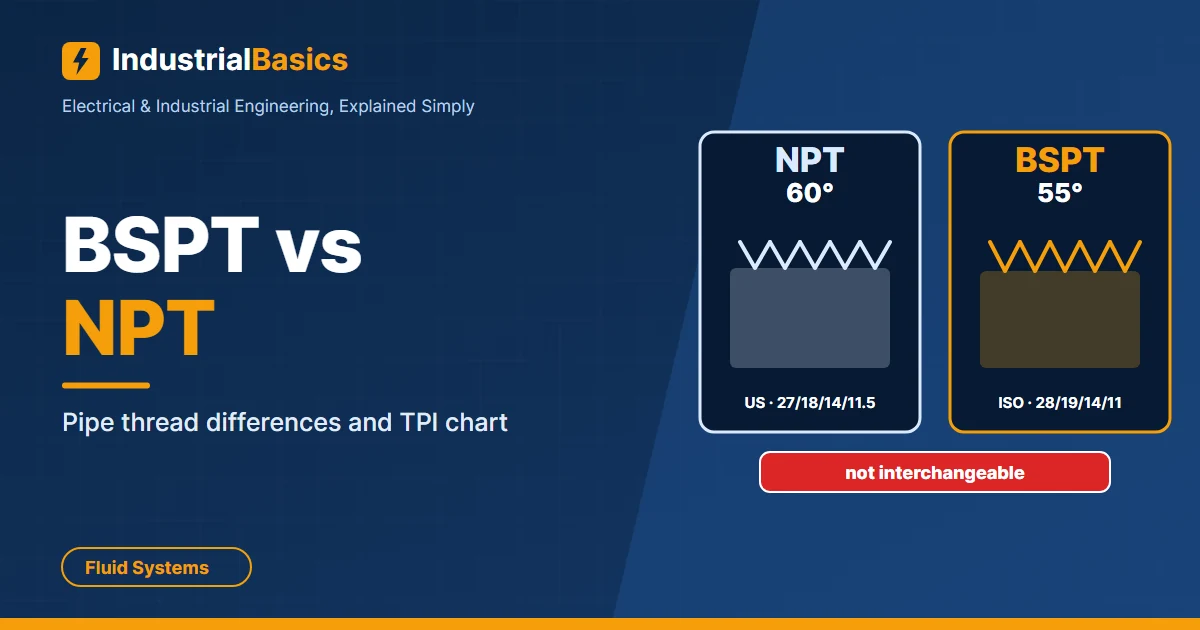
NPT (National Pipe Taper) is the US tapered pipe thread with a 60° thread angle; BSPT (British Standard Pipe Taper, ISO 7, designated R) is the British/international tapered thread with a 55° angle and rounded crests and roots. Both taper 1:16, but the angle and most thread pitches differ, so they are not interchangeable. In 1/2 in and 3/4 in sizes both use 14 threads per inch and can start together, but the 55° and 60° flanks do not seal. Use an NPT-to-BSP adapter instead.
BSPT vs NPT Comparison
| NPT | BSPT (R) | BSPP (G) | |
|---|---|---|---|
| Standard | ASME B1.20.1 (US) | ISO 7 | ISO 228 |
| Thread angle | 60° | 55° | 55° |
| Crest and root | Flattened | Rounded | Rounded |
| Taper | 1:16 | 1:16 | None (parallel) |
| How it seals | Thread flanks + sealant | Thread flanks + sealant | Washer, O-ring or bonded seal on a face |
| Common in | US piping and instruments | UK, Europe, Asia, Australia | Europe and Asia; instruments and hydraulics |
Threads per Inch by Size
| Nominal size | NPT TPI | NPT OD (in) | BSP TPI | BSP major dia (in) | Interchangeable? |
|---|---|---|---|---|---|
| 1/8 | 27 | 0.405 | 28 | 0.383 | No |
| 1/4 | 18 | 0.540 | 19 | 0.518 | No |
| 3/8 | 18 | 0.675 | 19 | 0.656 | No |
| 1/2 | 14 | 0.840 | 14 | 0.825 | No (same TPI, different angle) |
| 3/4 | 14 | 1.050 | 14 | 1.041 | No (same TPI, different angle) |
| 1 | 11.5 | 1.315 | 11 | 1.309 | No |
The safest way to identify an unknown thread is to measure the outside diameter and count threads per inch with a pitch gauge. If the TPI is 27, 18 or 11.5 it is NPT; 28, 19 or 11 points to BSP. In 1/2 and 3/4 in sizes you need a 55°/60° thread gauge or a known fitting to tell them apart.
How Each Thread Seals
Wikipedia explains that the taper on NPT threads lets them form a seal when torqued, as the flanks compress against each other, unlike straight threads that only hold parts together. Because some clearance remains at the crests and roots, NPT normally needs PTFE tape or paste, and fittings should be burr-free and lubricated. NPTF (Dryseal) is designed to seal without sealant. BSP jointing threads always use a taper male thread with either a parallel (Rp) or taper (Rc) female; BSPP (G) longscrew threads seal by compressing a soft washer or O-ring against a face.
Connecting Imported Equipment
- Use an adapter with BSP on one end and NPT on the other rather than forcing threads together.
- Check pressure ratings of adapters and fittings against the system; see psig vs psia and barg pressure for metric ratings.
- Label ports on machines with mixed thread standards to prevent mistakes during maintenance.
- Instrument connections (pressure gauges, transmitters) commonly come in 1/4 or 1/2 NPT in the US and G 1/4 or G 1/2 on European instruments.
Within the US family itself, see NPTF vs NPT for Dryseal threads and what FNPT, MNPT, FPT and FIP mean.
Frequently Asked Questions
What is the difference between BSPT and NPT?
NPT is the US tapered pipe thread with a 60° thread angle; BSPT is the British/ISO tapered pipe thread with a 55° angle and rounded crests. Most sizes also have different threads per inch, so the two are not interchangeable.
Can I connect BSPT to NPT?
Not reliably. In 1/2 and 3/4 in sizes both have 14 TPI and may thread together a few turns, but the 55° and 60° flanks do not seal properly. Use an adapter fitting with the correct thread on each end.
How can I tell NPT from BSP?
Count the threads per inch with a thread gauge and check the angle. 1/8 NPT is 27 TPI vs 28 for BSP; 1/4 and 3/8 NPT are 18 TPI vs 19 for BSP; 1 in NPT is 11.5 TPI vs 11 for BSP.
What is the taper of NPT and BSPT?
Both are 1:16 on diameter. Wikipedia gives NPT’s taper as 1 in of diameter per 16 in of length, or 3/4 in per foot.
What is BSPP or a G thread?
British Standard Pipe Parallel (straight) thread, designated G. It does not seal on the threads; it seals with a washer, O-ring or bonded seal against a face.
What does R or Rc mean?
In BSP, R denotes a taper thread (BSPT). Rc is a taper internal thread and Rp a parallel internal thread used with taper male threads.
Do NPT threads need sealant?
Yes. Wikipedia notes NPT seals by thread flanks compressing under torque and normally needs sealant such as PTFE tape or paste; NPTF (Dryseal) is designed to seal without it.
Is a 1/2 in pipe thread 1/2 in in diameter?
No. Pipe sizes are nominal. A 1/2 NPT male thread is about 0.840 in outside diameter; a 1/2 BSP thread about 0.825 in.
What is a G 1/2 thread?
A 1/2 in BSPP (parallel) thread, about 0.825 in major diameter with 14 TPI, common on European instruments, gauges and hydraulic fittings.
Which is used in the US?
NPT is standard in US piping and instrument connections; BSP is common on European and Asian equipment, so imported machines often need adapters.
Sources and Further Reading
- Wikipedia: National pipe thread: NPT angle, taper, sizes, sealing and NPTF.
- Wikipedia: British standard pipe thread: BSPP (G) and BSPT (R), 55° form, taper and sizes.



