
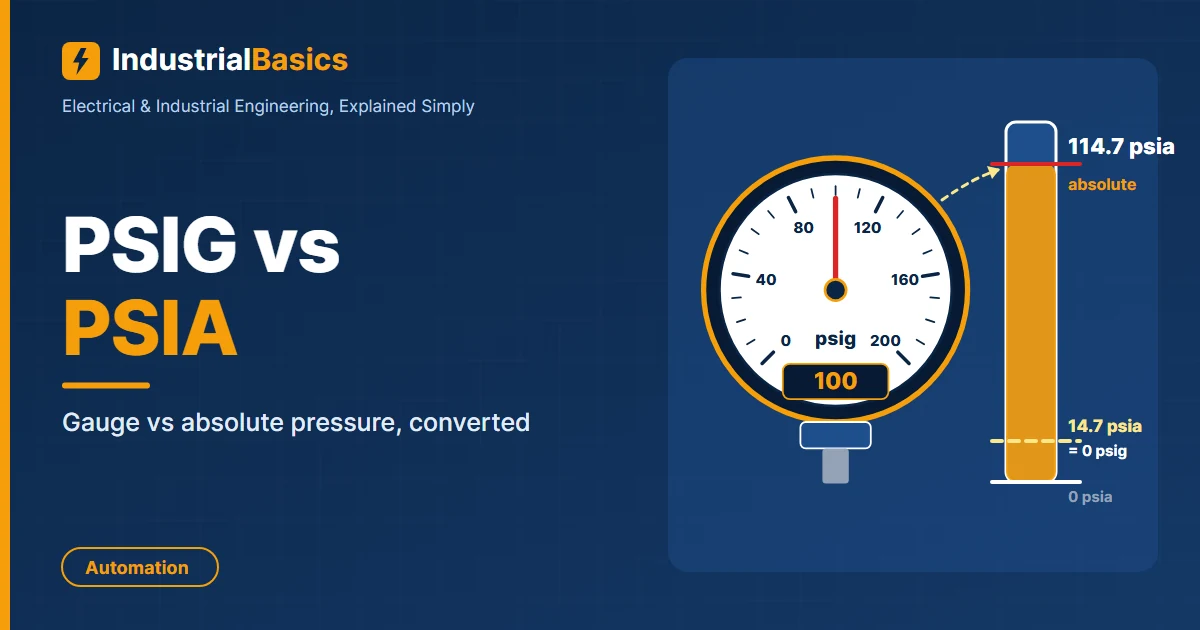
PSIG is pressure measured from the surrounding atmosphere; PSIA is pressure measured from a perfect vacuum. To convert, add or subtract the local atmospheric pressure: psia = psig + atmospheric pressure. At sea level that is about 14.7 psi (14.696 psi standard), so 100 psig = 114.7 psia and 0 psig = 14.7 psia. At higher elevations the atmosphere is lower, about 12.1 psia at 5,280 ft, so the same gauge reading equals fewer psia. Plain “psi” on a US gauge almost always means psig.
PSI, PSIG, PSIA and PSID Explained
| Term | Zero point | Can it be negative? | Typical use |
|---|---|---|---|
| psig (gauge) | Local atmospheric pressure | Yes, a vacuum reads below 0 | Air lines, tires, hydraulics, process piping, most plant gauges |
| psia (absolute) | Perfect vacuum | No | Barometric pressure, vacuum work, gas law and steam table calculations, compressor ratios |
| psid (differential) | A second pressure | Yes, depending on direction | Filter pressure drop, flow across an orifice, level by differential pressure |
| psi (no suffix) | Usually atmospheric (gauge) | Depends on context | Everyday US readings; state the reference when it matters |
Emerson defines gauge pressure as “the difference between the absolute pressure and the atmospheric pressure”, and absolute pressure as the total pressure measured relative to a perfect vacuum. That gives the one rule you need for every conversion: absolute = gauge + atmospheric.
Gauge pressure can be zero, positive or negative. The atmosphere itself is 0 psig, and a vacuum is a negative gauge pressure. Absolute pressure is always positive, because nothing is lower than a perfect vacuum.
How to Convert PSIG to PSIA
- Find the atmospheric pressure where the gauge is. Use 14.7 psi at sea level, the elevation table below, or a barometer reading.
- Add it to the gauge reading to get psia, or subtract it from an absolute reading to get psig.
- Keep the reference with the number. Write the result as psia (or “absolute”) so the next person does not add atmospheric pressure twice.
| Gauge reading | At sea level (14.7 psi) | At 5,280 ft (12.1 psi) |
|---|---|---|
| 0 psig | 14.7 psia | 12.1 psia |
| 32 psig (car tire) | 46.7 psia | 44.1 psia |
| 90 psig (shop air) | 104.7 psia | 102.1 psia |
| 100 psig | 114.7 psia | 112.1 psia |
| 150 psig | 164.7 psia | 162.1 psia |
| −10 psig (vacuum) | 4.7 psia | 2.1 psia |
Going the other way is the same arithmetic in reverse. 50 psia at sea level is 50 − 14.7 = 35.3 psig.
PSIG to PSIA Calculator
Why Altitude Changes the Answer
The 14.7 figure is a sea-level value. Air pressure drops as you climb, so a gauge zeroed to the local atmosphere in a mountain plant starts from a lower absolute baseline. Engineering ToolBox gives the standard relationship as p = 101,325 (1 − 2.25577×10⁻⁵ h)5.25588 Pa, with h in meters, and the calculator above uses the same formula.
| Elevation | Atmospheric pressure | 100 psig equals |
|---|---|---|
| 0 ft | 14.7 psia | 114.7 psia |
| 1,000 ft | 14.2 psia | 114.2 psia |
| 2,000 ft | 13.7 psia | 113.7 psia |
| 3,000 ft | 13.2 psia | 113.2 psia |
| 4,000 ft | 12.7 psia | 112.7 psia |
| 5,000 ft | 12.2 psia | 112.2 psia |
| 6,000 ft | 11.8 psia | 111.8 psia |
| 7,000 ft | 11.3 psia | 111.3 psia |
| 8,000 ft | 10.9 psia | 110.9 psia |
Weather moves the real figure too. The Wikipedia pressure measurement article notes that most sensors up to about 50 bar are built as gauge sensors because otherwise weather-driven changes in atmospheric pressure would show up as measurement error. For an accurate psia figure, use a measured barometric pressure, not a table value. Barometric pressure in weather reports is usually corrected to sea level, so it will not give the pressure at your elevation.
Vacuum Readings: Negative PSIG and Inches of Mercury
Below atmospheric pressure, gauge readings go negative. At sea level the lowest possible reading is about −14.7 psig, which is 0 psia. Vacuum is often read in inches of mercury instead, and Wikipedia notes that inHg usually indicates a gauge vacuum, while torr and microns usually indicate absolute pressure.
Its worked example: a vacuum of 26 inHg gauge equals an absolute pressure of about 4 inHg, because typical atmospheric pressure is about 30 inHg. Converted with NIST’s factor, 4 inHg is about 1.96 psia.
When to Use Gauge vs Absolute Pressure
| Use gauge (psig) | Use absolute (psia) |
|---|---|
| Checking pressure against pipe, tank, flange and vessel ratings | Gas law, density and enthalpy calculations |
| Air, hydraulic and water system operating pressures | Vacuum measurement and leak testing |
| Most pressure switches and local gauges | Compressor pressure ratios and free-air (scfm) conversions |
| Any reading you want to zero by venting to air | Measurements that must ignore weather and altitude |
Emerson says gauge measurement is often preferred in plants because it shows whether a fluid is within the design limits of pipes, tanks, reactors and flanges, and because gauge devices can be zeroed simply by venting them. Absolute measurement is preferred when pressure is used to find fluid properties such as density and enthalpy, to measure vacuum precisely, to find leaks, or to remove the effect of changing atmospheric pressure.
Worked example: compression ratio must use psia
Quincy Compressor defines compression ratio as absolute discharge pressure divided by absolute inlet pressure, and its example gives 114.7 psia ÷ 14.7 psia = 7.8:1. Dividing the gauge values instead (100 ÷ 0) is meaningless, which is why the conversion matters.
Oak Ridge National Laboratory’s MEASUR tool writes the same ratio as (Pgauge + Patm) ÷ Patm and notes that lower atmospheric pressure at higher elevations increases the ratio and the air consumption. For a 100 psig air system: at sea level, 114.7 ÷ 14.7 = 7.8; at 5,280 ft, 112.1 ÷ 12.1 = 9.3. The same gauge reading represents more compression in a mountain plant.
Gauge, Sealed Gauge and Absolute Sensors
Pressure transmitters come in three references, and the label on the data sheet decides which number reaches your PLC:
- Vented gauge: the back of the diaphragm is open to outside air through a vent hole or vented cable, so it always measures relative to the local atmosphere. Sensorsone says it should read zero with the process connection open to air.
- Sealed gauge: roughly one atmosphere is sealed behind the diaphragm. Sensorsone says this suits high ranges such as hydraulics, where atmospheric changes are negligible, and that a sealed gauge transducer “will never read exactly zero” because the real atmosphere keeps changing.
- Absolute: a high vacuum is sealed behind the diaphragm. If its process connection is open to air, it reads the actual barometric pressure, about 14.7 psia at sea level.
That gives a quick field test for an unlabeled transmitter: open its port to air. Close to zero means gauge; around 14.7 psi (less at altitude) means absolute. For how the signal is wired and scaled, see our 4-20 mA guide, and for the wider family of process instruments, read types of industrial sensors.
Pressure Unit Conversion Table
| Unit | Equals (psi) | Pascals (exact NIST factor) |
|---|---|---|
| 1 standard atmosphere (atm) | 14.6959 | 101,325 Pa |
| 1 bar | 14.5038 | 100,000 Pa |
| 1 kPa | 0.14504 | 1,000 Pa |
| 1 inch of mercury, conventional (inHg) | 0.49115 | 3,386.389 Pa |
| 1 millimeter of mercury, conventional (mmHg) / 1 torr | 0.019337 | 133.3224 Pa |
| 1 psi | 1 | 6,894.757 Pa |
Examples: 14.7 psia is about 101.4 kPa absolute; 760 mmHg is 14.70 psia; 2 atm is 29.39 psia, which is 14.70 psig at sea level.
Common PSIG and PSIA Mistakes
- Adding 14.7 twice. If a value is already psia, adding atmospheric pressure again makes it about 15 psi too high.
- Using 14.7 at altitude. At 5,000 ft the standard value is 12.2 psia; using 14.7 overstates absolute pressure by 2.5 psi.
- Dividing gauge pressures in a ratio. Compression ratios and gas law calculations need absolute pressures on both sides.
- Mixing transmitter references. Check the model code before swapping a gauge transmitter for an absolute one, and rescale if they differ.
- Treating a vacuum gauge as absolute. inHg vacuum readings are usually gauge; torr and micron readings are usually absolute.
Working with pumps or tank level? Our psi to feet of head guide converts gauge pressure into feet of liquid for water and other fluids.
For the full standard-atmosphere formula, pressure above 8,000 ft and the aviation definition, see our pressure altitude guide with a pressure-at-elevation calculator.
Working with gas mixtures? Partial pressures always use absolute pressure; our guide on how to calculate partial pressure covers Dalton’s law, water vapor and compressed air condensate.
Compressed air flow is quoted in SCFM, but pipes carry actual volume; our SCFM vs CFM guide converts between them using absolute pressure and temperature.
Working with metric gauges? Our guide to barg pressure explains barg vs bara and converts bar to psig.
Bottled gas is the everyday example: the gauge on a propane tank pressure reading is psig set by temperature, not by how full the tank is.
Frequently Asked Questions
What does PSIG stand for?
Pounds per square inch gauge: pressure measured relative to the surrounding atmosphere. A gauge that reads 0 psig is simply open to the air.
What does PSIA stand for?
Pounds per square inch absolute: pressure measured relative to a perfect vacuum. Standard sea-level atmosphere is about 14.7 psia.
Is psi the same as psig?
In everyday US use, yes. Tire, air-line and most plant gauge readings in plain “psi” are gauge pressure. When the reference matters, write psig or psia, or state “gauge” or “absolute”, so nobody has to guess.
To change from psig to psia you must do what?
Add the local atmospheric pressure: psia = psig + atmospheric pressure. At sea level that is about 14.7 psi, so 100 psig is about 114.7 psia. At higher elevations add less.
How do you convert psia to psig?
Subtract atmospheric pressure: psig = psia − atmospheric pressure. 50 psia at sea level is about 35.3 psig.
What is atmospheric pressure in psig?
Zero. Gauge pressure uses the atmosphere as its zero point, so the atmosphere itself is 0 psig. In absolute terms it is about 14.7 psia at sea level.
Can psia be negative?
No. Zero psia is a perfect vacuum, so absolute pressure is always zero or above. Gauge pressure can be negative: a vacuum reads below 0 psig, down to about −14.7 psig at sea level.
What is psid?
Pounds per square inch differential: the difference between two pressures, such as across a filter, a valve or an orifice plate. It is neither gauge nor absolute.
How do I convert mmHg or inHg to psia?
Using NIST factors, 1 mmHg = 0.019337 psi and 1 inHg = 0.49115 psi. If the mmHg or inHg reading is absolute (as torr and barometric readings usually are), the result is psia. Vacuum readings in inHg are usually gauge, so convert first and then subtract from atmospheric pressure.
How many psia is one atmosphere?
One standard atmosphere is 101,325 Pa, which is 14.696 psia using NIST’s factor of 6,894.757 Pa per psi.
Sources and Further Reading
- NIST SP 811, Appendix B.8: Factors for units listed alphabetically: psi, atm, bar, inHg and mmHg conversion factors.
- NIST SP 811, Chapter 7: Rules and style conventions: Section 7.4 on not attaching letters to units.
- Emerson: Gauge Pressure vs Absolute Pressure: definitions, formulas and when to use each.
- Sensorsone: Gauge reference pressure: vented and sealed gauge sensors.
- Engineering ToolBox: Atmospheric pressure vs elevation: altitude formula and table.
- Oak Ridge National Laboratory, MEASUR: Compression ratio formula: gauge to absolute in compressed air calculations.
- Quincy Compressor: Compression ratio: absolute discharge over absolute inlet pressure.
- Wikipedia: Pressure measurement: zero references, vacuum readings and sensor types.



