
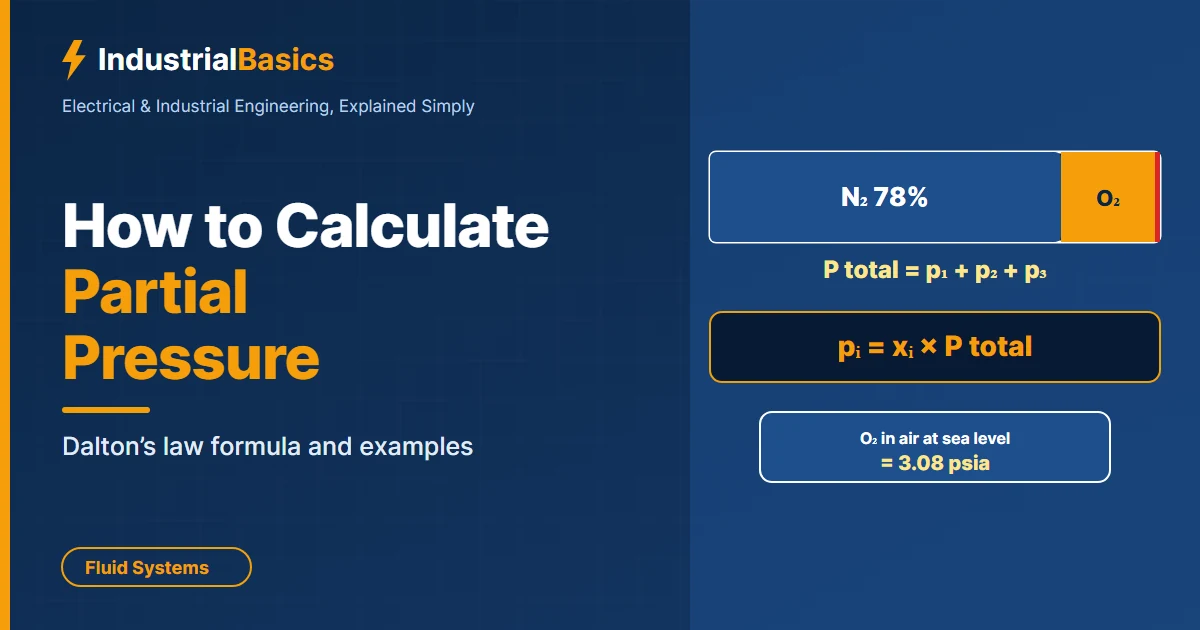
To calculate partial pressure, multiply the gas’s mole fraction by the total pressure: pi = xi × Ptotal. Dalton’s law says the total pressure of a gas mixture is the sum of the partial pressures: Ptotal = p₁ + p₂ + p₃ + … For example, dry air is 20.95% oxygen, so at sea level (14.70 psia) the oxygen partial pressure is 0.2095 × 14.70 = 3.08 psia. Always use absolute pressure, and for ideal gases the volume percent equals the mole fraction.
Dalton’s Law of Partial Pressures
Wikipedia states Dalton’s law as: in a mixture of non-reacting gases, “the total pressure exerted is equal to the sum of the partial pressures of the individual gases.” John Dalton observed it in 1801 and published it in 1802. The partial pressure of a gas is the pressure it would exert if it alone occupied the whole volume at the same temperature.
For an ideal gas mixture, Wikipedia gives the mole fraction as xi = pi/p = ni/n, so pi = xi · p, and notes that the mole fraction equals the volumetric fraction. That is why gas analyzer readings in percent by volume convert directly to partial pressures.
How to Calculate Partial Pressure: Step by Step
- Get the total pressure in absolute units (psia, kPa abs, bar abs). Add atmospheric pressure to a gauge reading; see psig vs psia.
- Find each gas’s mole fraction: moles of the gas ÷ total moles, or volume % ÷ 100.
- Multiply the mole fraction by the total pressure.
- Check that the partial pressures add up to the total.
Worked examples
- Oxygen in air at sea level: 0.2095 × 14.70 = 3.08 psia; nitrogen 0.7808 × 14.70 = 11.47 psia.
- Oxygen in a 100 psig air receiver (114.7 psia): 0.2095 × 114.7 = 24.0 psia.
- From moles: 3 mol CO₂ and 9 mol N₂ at 60 psia: xCO₂ = 3/12 = 0.25, so pCO₂ = 15 psia and pN₂ = 45 psia.
- Total from partials: 4 psia + 6 psia + 10 psia = 20 psia total.
Partial Pressure Calculator
Partial Pressure of Water Vapor and Humidity
Water vapor is one of the gases in air, with its own partial pressure. Wikipedia defines relative humidity as “the ratio of the partial pressure of water vapor to the equilibrium vapor pressure of water at the same temperature”. Engineering ToolBox gives the saturation (maximum) partial pressure of water vapor as a function of temperature:
| Temperature | Saturation pressure (psia) | Saturation pressure (inHg) |
|---|---|---|
| 0 °C (32 °F) | 0.09 | 0.18 |
| 10 °C (50 °F) | 0.18 | 0.37 |
| 20 °C (68 °F) | 0.33 | 0.67 |
| 30 °C (86 °F) | 0.61 | 1.24 |
| 40 °C (104 °F) | 1.06 | 2.16 |
| 50 °C (122 °F) | 1.8 | 3.66 |
| 60 °C (140 °F) | 2.9 | 5.90 |
| 80 °C (176 °F) | 6.8 | 13.84 |
| 100 °C (212 °F) | 14.6 | 29.73 |
So air at 86 °F (30 °C) and 50% relative humidity has a water vapor partial pressure of about 0.5 × 0.61 = 0.31 psia. LibreTexts uses the same idea for gas collected over water: the collected gas is saturated with water vapor, so the total pressure equals the gas’s partial pressure plus the vapor pressure of water.
Why Partial Pressure Matters in Compressed Air
Compressing air multiplies every partial pressure by the compression ratio, including water vapor’s. Once the vapor partial pressure exceeds the saturation pressure at the air’s temperature, the excess condenses. That is the physics behind receiver drains, aftercoolers and dryers. For compression ratios in absolute terms, see our psig vs psia guide.
Other Industrial Uses
- Gas detection: sensors and analyzers report percent by volume or ppm, which converts directly to partial pressure at the measured total pressure.
- Oxygen-enriched or inerted vessels: nitrogen purging lowers the oxygen partial pressure; see Class 1 Div 1 vs Div 2 for hazardous-area protection by purging.
- Process gas mixtures: blending, calibration gases and furnace atmospheres are specified by mole fraction and total pressure.
- Breathing air and diving: Wikipedia notes hypoxia becomes a risk below about 0.16 bar of oxygen partial pressure, and oxygen toxicity at high partial pressures.
When a gas is compressed or expanded rather than mixed, its pressure, volume and temperature follow the polytropic process relation pVⁿ = constant.
Nitrogen makes up most of the air; for its own properties see the density of nitrogen chart and calculator.
Frequently Asked Questions
How do you calculate partial pressure?
Multiply the gas’s mole fraction by the total pressure: pᵢ = xᵢ × P_total. For oxygen in air at 14.70 psia: 0.2095 × 14.70 = 3.08 psia.
What is Dalton’s law of partial pressures?
In a mixture of non-reacting gases, the total pressure equals the sum of the partial pressures of the individual gases: P_total = p₁ + p₂ + p₃ + … John Dalton observed it in 1801 and published it in 1802.
What is the formula for Dalton’s law?
P_total = Σ pᵢ, and for each gas pᵢ = xᵢ P_total, where xᵢ is its mole fraction.
How do you find partial pressure from moles?
Divide the moles of the gas by the total moles to get the mole fraction, then multiply by the total pressure. 2 mol of a gas in 10 mol total at 100 psia: 0.2 × 100 = 20 psia.
Is mole fraction the same as volume percent?
For ideal gases, yes. Wikipedia notes the mole fraction of a component equals its volumetric fraction in the mixture, so 20.95% oxygen by volume is a mole fraction of 0.2095.
Should I use gauge or absolute pressure?
Absolute. Partial pressures add up to the absolute total. For a tank at 100 psig at sea level, use about 114.7 psia.
What is the partial pressure of water vapor?
The share of total pressure due to water vapor. Relative humidity is that partial pressure divided by the saturation pressure at the same temperature; at 68 °F the saturation pressure is about 0.33 psia (Engineering ToolBox).
How do you calculate the partial pressure of a gas collected over water?
Subtract the vapor pressure of water at that temperature from the total pressure. LibreTexts explains the collected gas is saturated with water vapor, so the total equals the gas’s partial pressure plus water’s.
Why does compressed air produce condensate?
Compressing air raises every partial pressure, including water vapor’s. When the vapor partial pressure exceeds the saturation pressure at the air’s temperature, the excess condenses, which is why receivers and dryers drain water.
Does partial pressure depend on the other gases?
For ideal gases, no: each gas behaves as if it alone filled the volume. Real gases at high pressure deviate, and Wikipedia notes the concept is then generalized to fugacity.
Sources and Further Reading
- Wikipedia: Dalton’s law: statement and history.
- Wikipedia: Partial pressure: mole fraction relation, ideal mixtures and oxygen limits.
- Wikipedia: Atmosphere of Earth: dry air composition.
- Engineering ToolBox: Water vapor saturation pressure: saturation pressure table and formula.
- Wikipedia: Humidity: relative humidity definition.
- LibreTexts (OpenStax Chemistry): Gas mixtures: Dalton’s law and gases collected over water.



