
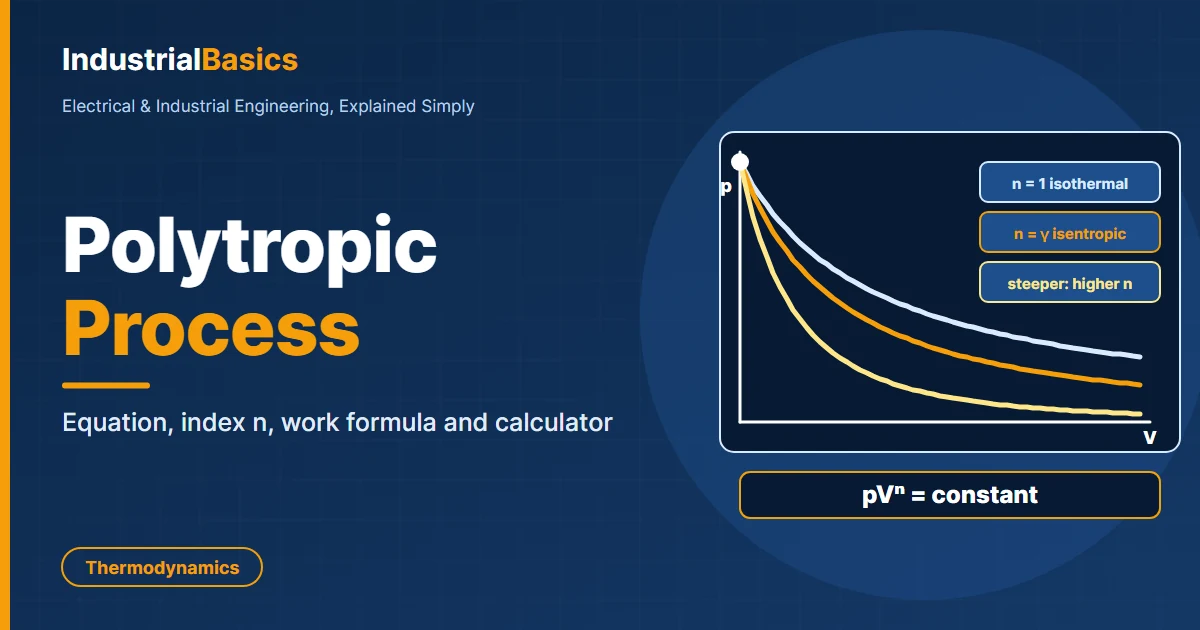
A polytropic process is an expansion or compression that follows pVⁿ = constant, where n is the polytropic index. It covers the ideal cases: n = 0 is constant pressure, n = 1 is constant temperature (for an ideal gas), n = γ is isentropic, and n = ∞ is constant volume. Real compressors and engines fall between these limits because some heat crosses the boundary. The boundary work is W = (p₂V₂ − p₁V₁)/(1 − n).
Polytropic Process Equation
Combined with the ideal gas law (pV = mRT), the same process gives the temperature relations:
Special Cases of the Polytropic Index
| Index n | Relation | Process | Heat and work |
|---|---|---|---|
| n < 0 | — | Special cases only | Work and heat flow in or out together; needs other energy forms |
| 0 | p = C | Isobaric (constant pressure) | |
| 1 | pV = C | Isothermal (ideal gas) | Heat out equals work in |
| 1 < n < γ | — | Cooled compression or heated expansion | Heat and work flow in opposite directions |
| γ | pV^γ = C | Isentropic (ideal gas) | No heat transfer |
| γ < n < ∞ | — | e.g. engine power stroke with wall heat loss | Heat and work flow in the same direction |
| ∞ | V = C | Isochoric (constant volume) | No boundary work |
Wikipedia gives a vapor-compression refrigerator as the example for 1 < n < γ. The compressor heats the vapor, and some of that heat is lost to the cooler surroundings during compression. Its example for n > γ is an engine’s power stroke: the hot gas pushes the piston while also losing heat through the cylinder walls.
Polytropic Work Formula
Boundary work for a closed system is W = ∫p dV. Substituting p = C/Vⁿ and integrating from V₁ to V₂ gives:
The heat transferred follows from the first law. Wikipedia gives the ratio of heat to work as K = δq/δw, with n = (1 − γ)K + γ. Rearranging gives:
For a steady-flow device such as a compressor, the work is −∫V dp rather than ∫p dV. For a polytropic process this is n times the boundary work:
Polytropic Process Calculator
Worked Example: Compressing Air
Air at 100 kPa (absolute), 0.1 m³ and 20 °C is compressed to 800 kPa. The table compares isothermal, polytropic (n = 1.3) and isentropic (n = γ = 1.4) compression.
| n = 1 (isothermal) | n = 1.3 (polytropic) | n = 1.4 (isentropic) | |
|---|---|---|---|
| Final volume V₂ (m³) | 0.0125 | 0.0202 | 0.0226 |
| Final temperature T₂ (°C) | 20.0 | 200.5 | 257.9 |
| Closed-system (piston) work input (kJ) | 20.79 | 20.53 | 20.29 |
| Heat rejected (kJ) | 20.79 | 5.13 | 0.00 |
| Steady-flow (shaft) work input (kJ) | 20.79 | 26.69 | 28.40 |
For n = 1.3: V₂ = 0.1 × (100/800)^(1/1.3) = 0.0202 m³. T₂ = 293.15 × 8^(0.3/1.3) = 473.7 K (200.5 °C). W = (800 × 0.0202 − 100 × 0.1)/(1 − 1.3) = -20.53 kJ, so 20.53 kJ of work goes in. Q = -20.53 × (1.4 − 1.3)/0.4 = -5.13 kJ, so 5.13 kJ of heat is rejected. In a closed cylinder the boundary work differs little between the three cases, because isothermal compression must squeeze the gas to a smaller volume to reach the same pressure. In a continuous-flow compressor the shaft work also includes pushing gas in and out, and isothermal compression needs the least (see the last row). That is why multistage compressors use intercoolers.
Heat Capacity Ratio γ for Common Gases
| Gas | Temperature (°C) | γ = cp/cv |
|---|---|---|
| Dry air | 20 | 1.400 |
| Oxygen O2 | 20 | 1.400 |
| Hydrogen H2 | 20 | 1.410 |
| Helium He | 20 | 1.660 |
| Argon Ar | 20 | 1.670 |
| Carbon dioxide CO2 | 20 | 1.300 |
| Methane CH4 | 20 | 1.320 |
| Water vapor H2O | 100 | 1.324 |
| Propane C3H8 | 16 | 1.130 |
| Ammonia NH3 | 15 | 1.310 |
Monatomic gases (helium, argon) are close to 5/3; diatomic gases (air, nitrogen, oxygen) are close to 7/5. Larger molecules have lower γ. For an ideal gas, γ lies between 1 and 5/3. Pressure in these formulas is always absolute; see psig vs psia. For gas mixtures, see how to calculate partial pressure.
Frequently Asked Questions
What is a polytropic process?
A thermodynamic process that follows pVⁿ = C, where p is pressure, V is volume, n is the polytropic index and C is a constant. It describes real expansion and compression where some heat is transferred (Wikipedia).
What is the polytropic index n?
The exponent in pVⁿ = C. n = 0 is constant pressure, n = 1 is constant temperature (ideal gas), n = γ is isentropic (ideal gas) and n = ∞ is constant volume.
What is the difference between polytropic and adiabatic?
An adiabatic process has no heat transfer. A reversible adiabatic process on an ideal gas is the polytropic case n = γ. Any other n means heat crosses the boundary.
What is the difference between polytropic and isentropic?
Isentropic means adiabatic and reversible (constant entropy). For an ideal gas it is the single polytropic case n = γ (1.4 for air). A polytropic process can use any n.
What is the polytropic work formula?
For a closed system, boundary work W = (p₂V₂ − p₁V₁)/(1 − n) for n ≠ 1, or mR(T₂ − T₁)/(1 − n) for an ideal gas. For n = 1 it is W = p₁V₁ ln(V₂/V₁).
How do you find n from test data?
Measure two states and use n = ln(p₂/p₁) / ln(V₁/V₂). With several points, plot ln p against ln V; the slope is −n.
How do temperature and pressure relate in a polytropic process?
For an ideal gas, T₂/T₁ = (p₂/p₁)^((n−1)/n) = (V₁/V₂)^(n−1).
How much heat is transferred?
For an ideal gas, Q = W(γ − n)/(γ − 1). When 1 < n < γ in compression, heat leaves the gas as work is put in, as in a cooled compressor.
What γ should I use for air?
About 1.40 for dry air from about −15 °C to 200 °C (Wikipedia table: 1.404 at −15 °C, 1.400 at 20 °C, 1.398 at 200 °C). It falls at high temperature: 1.365 at 1,000 °C.
Can n be negative?
Wikipedia notes that negative n means work and heat flow in or out together. Without other energy forms that is not allowed by the second law, but it can appear in plasmas or chemically reacting systems.
Sources and Further Reading
- Wikipedia: Polytropic process: definition, special cases, the index table and K = δq/δw.
- Wikipedia: Heat capacity ratio: γ values for gases and the ideal-gas range.
- Wikipedia: Isentropic process: adiabatic reversible processes and pV^γ = constant.



