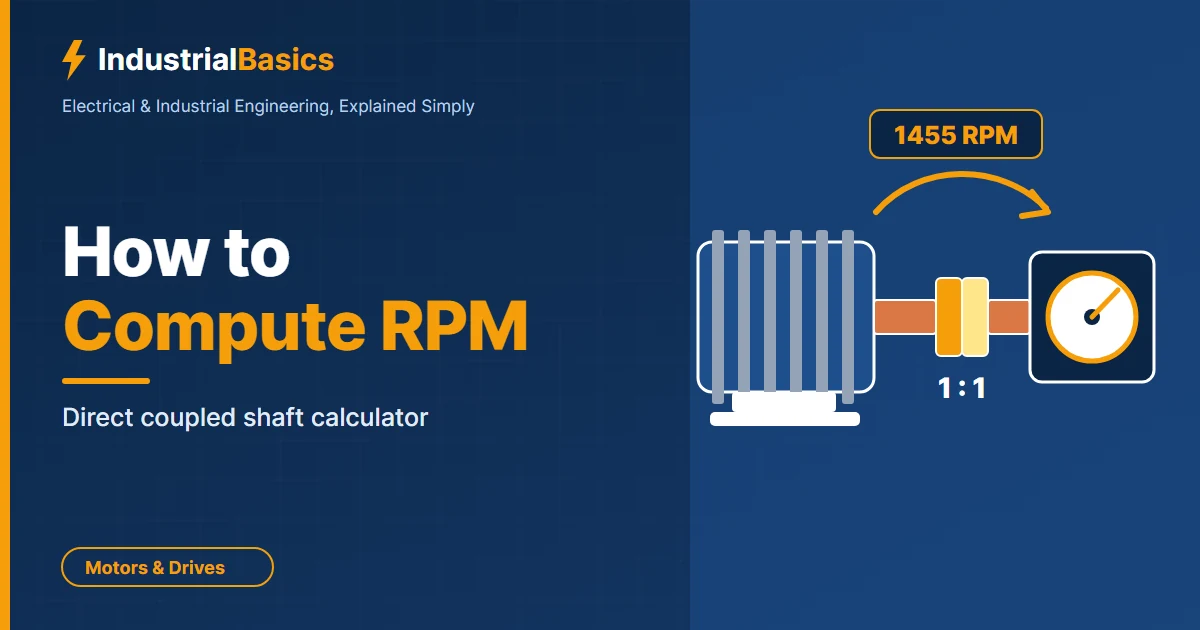
To compute RPM for a direct coupled shaft, calculate synchronous speed with Ns = 120 × f ÷ P, then subtract slip: N = Ns × (1 − s). Because a direct coupling has a 1:1 ratio, the load turns at the same speed as the motor. For example, a 50 Hz, 4-pole motor with 3% slip runs at 1455 RPM, and so does its coupled load.
Direct Coupled Shaft RPM Calculator
Enter the supply frequency, pole count and slip. Add shaft power if you also want the torque at that speed.
The RPM Formula
| Symbol | Meaning | Unit |
|---|---|---|
| Ns | Synchronous speed of the rotating field | RPM |
| f | Supply frequency | Hz |
| P | Total number of poles, not pole pairs | — |
| s | Slip, as a decimal (3% = 0.03) | — |
| N | Actual shaft speed | RPM |
The motor’s stator creates a magnetic field that rotates at synchronous speed. In an induction motor, the rotor must lag slightly behind that field to induce rotor current. Slip increases as load increases, from almost nothing at no load to the rated value at full load.
In a direct drive, the coupling simply joins the two shafts. There is no ratio to apply, so load RPM equals motor RPM. If your drive uses belts or gears, the speed changes and you need a ratio calculation. To convert shaft speed into surface speed, use our RPM to FPM guide.
Worked Example
An 11 kW, 4-pole induction motor runs on a 50 Hz supply with 3% slip and drives a pump through a flexible coupling.
- Synchronous speed: Ns = 120 × 50 ÷ 4 = 1500 RPM
- Shaft speed: N = 1500 × (1 − 0.03) = 1455 RPM
- Load speed: with a 1:1 coupling, the pump also runs at 1455 RPM
- Shaft torque: T = P × 60,000 ÷ (2π × N) = 11 × 60,000 ÷ (2π × 1455) ≈ 72.2 N·m
In US units, the same relationship is Torque (lb-ft) = HP × 5252 ÷ RPM. A 10 HP motor at 1750 RPM produces 10 × 5252 ÷ 1750 ≈ 30 lb-ft.
Motor Speed Table
| Poles | Synchronous at 50 Hz | Synchronous at 60 Hz | Nominal full load at 60 Hz |
|---|---|---|---|
| 2 | 3000 | 3600 | 3550 |
| 4 | 1500 | 1800 | 1750 |
| 6 | 1000 | 1200 | 1150 |
| 8 | 750 | 900 | — |
| 10 | 600 | 720 | — |
Finding Slip From the Nameplate
The nameplate is the best starting point, because it gives the motor’s real full-load speed. Rearranging the formula gives:
A 60 Hz motor stamped 1750 RPM is a 4-pole machine with an 1800 RPM synchronous speed, so s = (1800 − 1750) ÷ 1800 = 2.78%. That falls within the 2% to 5% rated slip range given in Southern Illinois University’s motor course notes.
When Shaft Speed Differs From the Calculation
| Situation | Effect on speed | What to do |
|---|---|---|
| Light load | Runs closer to synchronous speed | Measure if accuracy matters |
| Overload | More slip, lower speed | Check current and the overload relay |
| Low voltage | Speed decreases | Check the supply at the motor |
| VFD operation | Follows output frequency | Calculate with drive frequency |
| Synchronous motor | No slip in steady running | Use Ns |
| Fluid or eddy-current coupling | Load can run slower than motor | Use the coupling’s data |
A VFD is the usual way to change a direct-coupled load’s speed, because it changes the frequency. A soft starter or fixed-speed starter does not change the normal running speed. Changing a motor between star and delta changes the winding voltage, not the pole count, so synchronous speed stays the same.
Frequently Asked Questions
How do you compute RPM of a motor?
Find synchronous speed with Ns = 120 × f ÷ P, then subtract slip for an induction motor: N = Ns × (1 − s). A 50 Hz, 4-pole motor at 3% slip runs at 1455 RPM.
What is the RPM of a direct coupled shaft?
It is the same as the motor shaft speed, because a direct coupling has a 1:1 ratio with no gears or belts.
Why is motor RPM lower than synchronous speed?
An induction motor’s rotor must turn slower than the rotating field so that current is induced in the rotor. That difference is slip.
What is a typical slip for an induction motor?
Rated slip commonly falls around 2% to 5% of synchronous speed. Use the nameplate speed for the actual motor.
How do I find slip from the nameplate?
Use s = (Ns − N) ÷ Ns. A 1750 RPM motor with an 1800 RPM synchronous speed has 2.78% slip.
How many RPM is a 4-pole motor?
Synchronous speed is 1500 RPM at 50 Hz and 1800 RPM at 60 Hz. Loaded induction motors run slightly slower.
Does a flexible coupling change RPM?
No. A flexible coupling allows for small misalignment but keeps a 1:1 speed ratio. Fluid and eddy-current couplings are different because they can slip.
Does a VFD change motor RPM?
Yes. Changing frequency changes synchronous speed. Check the motor and driven equipment limits before running above base speed.
Sources and Further Reading
- NEMA: Motor Terminology and Electrical Performance Characteristics: speed formula, pole table, slip and torque.
- Southern Illinois University: Three Phase Induction Motors, Lesson 12a: slip and typical rated values.
- University of Utah: Induction Motors Notes: synchronous speed and slip.