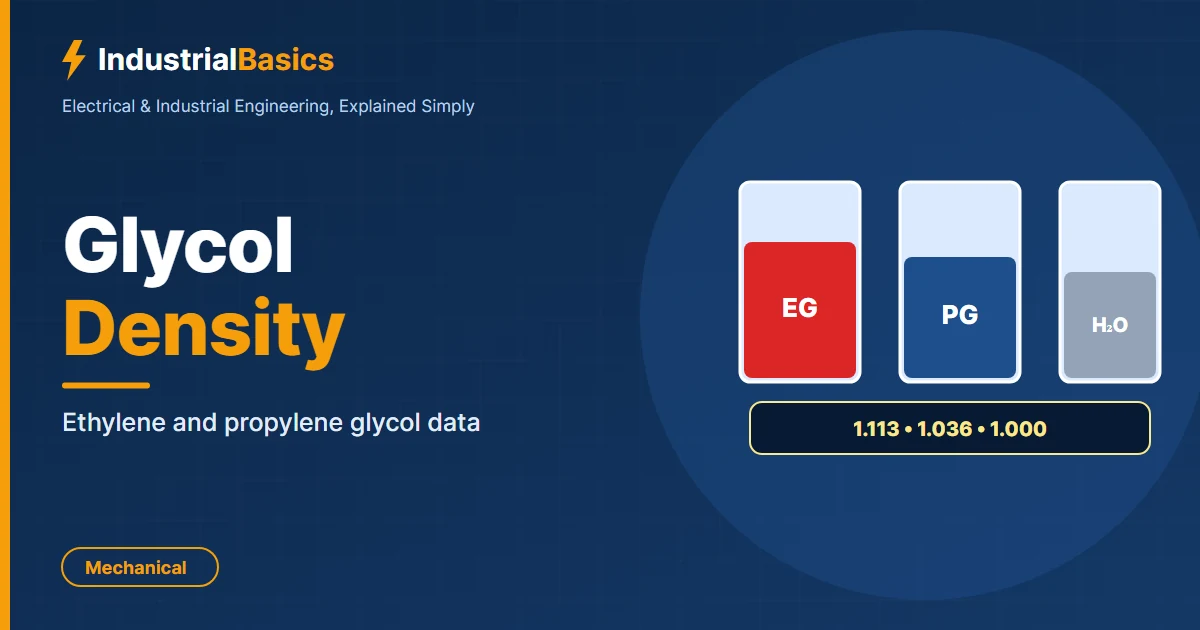
Pure ethylene glycol has a density of about 1.113 g/cm³ (69.5 lb/ft³) and pure propylene glycol about 1.036 g/cm³. Water-glycol heat-transfer fluids fall in between and get lighter as they warm. A 50% by mass ethylene glycol solution is about 1,079 kg/m³ at 20 °C, and a 50% propylene glycol solution about 1,038 kg/m³. Specific gravity of common mixes runs from about 1.01 to 1.10. Viscosity rises steeply in cold weather, which raises pump head.
Glycol Density Calculator
Density vs Temperature
Both glycols are denser than water, and density rises with concentration and falls with temperature. Engineering ToolBox gives a heating-system example. A 0.8 m³ system with 50% ethylene glycol is about 1,090 kg/m³ at 0 °C and 1,042 kg/m³ at 80 °C. That change in volume is what the expansion tank must absorb.
Specific Gravity of Ethylene Glycol Solutions
| Temperature | 25% | 30% | 40% | 50% | 60% | 100% |
|---|---|---|---|---|---|---|
| 40 °F (4.4 °C) | 1.048 | 1.057 | 1.070 | 1.088 | 1.100 | 1.145 |
| 80 °F (26.7 °C) | 1.040 | 1.048 | 1.060 | 1.077 | 1.090 | 1.130 |
| 120 °F (48.9 °C) | 1.030 | 1.038 | 1.050 | 1.064 | 1.077 | 1.115 |
| 160 °F (71.1 °C) | 1.018 | 1.025 | 1.038 | 1.050 | 1.062 | 1.100 |
| 200 °F (93.3 °C) | 1.005 | 1.013 | 1.026 | 1.038 | 1.049 | 1.084 |
Specific Gravity of Propylene Glycol Solutions
| % by mass | 0 | 10 | 20 | 30 | 40 | 50 | 60 |
|---|---|---|---|---|---|---|---|
| % by volume | 0 | 10 | 20 | 29 | 40 | 50 | 60 |
| SG at 60 °F | 1.000 | 1.008 | 1.017 | 1.026 | 1.034 | 1.041 | 1.046 |
Viscosity of Glycol Solutions
| Temperature | 25% | 30% | 40% | 50% | 60% | 100% |
|---|---|---|---|---|---|---|
| 0 °F (−17.8 °C) | – | – | 15 | 22 | 35 | 310 |
| 40 °F (4.4 °C) | 3.0 | 3.5 | 4.8 | 6.5 | 9.0 | 48 |
| 80 °F (26.7 °C) | 1.5 | 1.7 | 2.2 | 2.8 | 3.8 | 15.5 |
| 120 °F (48.9 °C) | 0.9 | 1.0 | 1.3 | 1.5 | 2.0 | 7.0 |
| 160 °F (71.1 °C) | 0.65 | 0.7 | 0.8 | 0.95 | 1.3 | 3.8 |
| 200 °F (93.3 °C) | 0.48 | 0.5 | 0.6 | 0.7 | 0.88 | 2.4 |
Viscosity climbs steeply as fluid cools. A 50% ethylene glycol solution is 2.8 cP at 80 °F but 22 cP at 0 °F, nearly eight times thicker. Pure propylene glycol is about 42 cP against 16 cP for pure ethylene glycol (Wikipedia), so PG solutions are more viscous than EG at the same strength. Higher viscosity means higher pipe pressure loss. For laminar small-bore flow, see the Hagen-Poiseuille equation.
Freezing Points
| EG % by volume | Freezing °F | Freezing °C |
|---|---|---|
| 0 | 32 | 0 |
| 10 | 25.9 | −3.4 |
| 20 | 17.8 | −7.9 |
| 30 | 7.3 | −13.7 |
| 40 | −10.3 | −23.5 |
| 50 | −34.2 | −36.8 |
| 60 | −63 | −52.8 |
| 100 | 9 | −12.8 |
| PG % by mass | PG % by volume | Freezing °F | Freezing °C |
|---|---|---|---|
| 0 | 0 | 32 | 0 |
| 10 | 10 | 26 | −3 |
| 20 | 19 | 18 | −8 |
| 30 | 29 | 7 | −14 |
| 40 | 40 | −8 | −22 |
| 50 | 50 | −29 | −34 |
| 60 | 60 | −55 | −48 |
The lowest freezing point for ethylene glycol comes at around 60% by volume. Stronger mixes freeze at higher temperatures again, and pure EG freezes at 9 °F. Both sources warn against running close to the freezing point, because slush forms before the fluid freezes solid.
Ethylene vs Propylene Glycol
| Property | Ethylene glycol | Propylene glycol |
|---|---|---|
| Density, pure | 1.113 g/cm³ | 1.036 g/cm³ |
| Viscosity, pure | ≈16 cP | ≈42 cP |
| 50% mass, 20 °C density | ≈1,079 kg/m³ | ≈1,038 kg/m³ |
| Freezing, 50% by volume | −34 °F (−37 °C) | −29 °F (−34 °C) |
| Use | Most common antifreeze in heating and cooling | Food processing, potable-water risk areas |
For gas density data, see density of nitrogen. For heat transfer to air, see the convection coefficient of air.
Frequently Asked Questions
What is the density of ethylene glycol?
Pure ethylene glycol is about 1.113 g/cm³ (1,113 kg/m³, 69.5 lb/ft³) (Wikipedia). A 50% by mass water solution is about 1,079 kg/m³ at 20 °C (Engineering ToolBox).
What is the density of propylene glycol?
Pure propylene glycol is about 1.036 g/cm³ (1,036 kg/m³) (Wikipedia). A 50% by mass solution is about 1,038 kg/m³ at 20 °C.
What is the specific gravity of glycol?
Ethylene glycol solutions run from about 1.04 (25% by volume) to 1.10 (60%) at 40–80 °F; propylene glycol solutions from 1.008 (10% by mass) to 1.046 (60%) at 60 °F (Engineering ToolBox).
Why is ethylene glycol denser than propylene glycol?
Pure ethylene glycol is denser (1.113 vs 1.036 g/cm³), so its water solutions are denser at the same concentration.
What is the viscosity of ethylene glycol?
Pure ethylene glycol is about 16.1 mPa·s (cP) (Wikipedia). Solutions are thinner but rise sharply when cold: 50% by volume is 2.8 cP at 80 °F but 22 cP at 0 °F.
What is the viscosity of propylene glycol?
Pure propylene glycol is about 0.042 Pa·s (42 cP) (Wikipedia), much more viscous than ethylene glycol, so PG solutions raise pumping pressure more.
What is the freezing point of 50% ethylene glycol?
About −34 °F (−37 °C) at 50% by volume (Engineering ToolBox). Avoid running close to the freezing point, as slush can form.
When should I use propylene glycol instead of ethylene glycol?
Wherever leakage into potable water or food processing is possible. Ethylene glycol is the common antifreeze otherwise (Engineering ToolBox).
Does glycol change pump and pipe sizing?
Yes. Higher viscosity raises pressure drop, and lower specific heat means more flow is needed for the same heat transfer. Engineering ToolBox advises calculating glycol systems for the actual temperature and mix.
How much does glycol expand when heated?
Density falls with temperature. Engineering ToolBox’s example: 50% EG goes from about 1,090 kg/m³ at 0 °C to 1,042 kg/m³ at 80 °C, which the expansion tank must absorb.
Sources and Further Reading
- Engineering ToolBox: Ethylene glycol heat-transfer fluid properties: density, SG, viscosity, freezing points.
- Engineering ToolBox: Propylene glycol based heat-transfer fluids: density, SG, freezing and boiling points, specific heat.
- Wikipedia: Ethylene glycol and Propylene glycol: pure-fluid density and viscosity.