
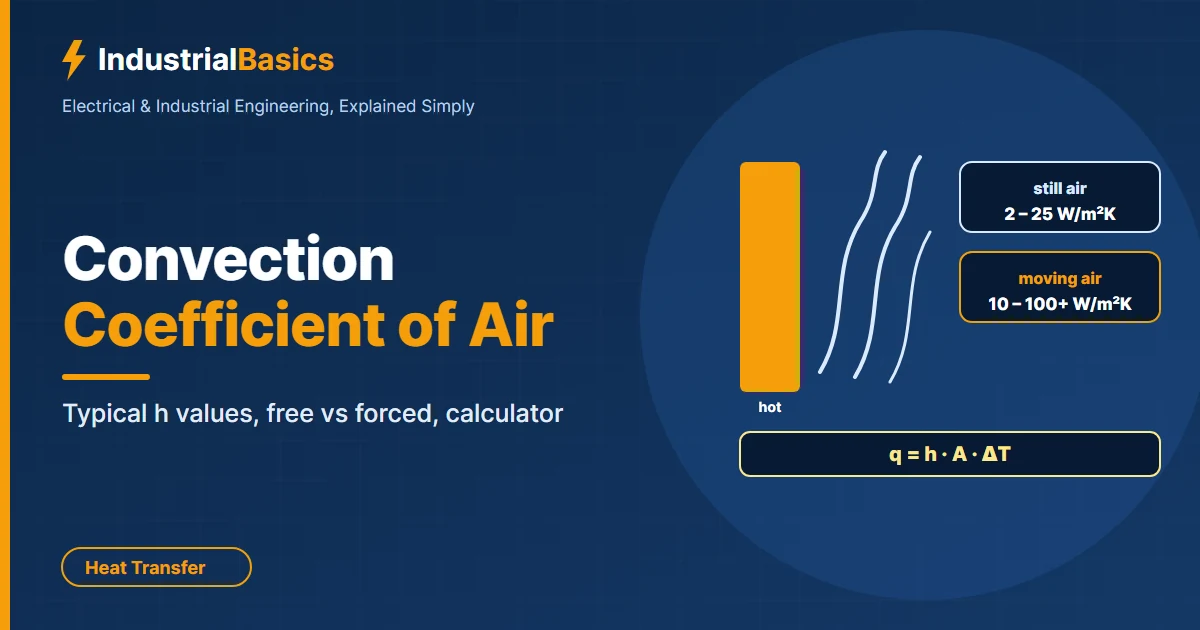
The convection coefficient of air (h, film coefficient) is typically about 2–25 W/(m²·K) in still air (free convection) and roughly 10–100 W/(m²·K) or more when air is blown over a surface (forced convection). It is not a property of air alone: it depends on air speed, surface size, orientation and temperature difference. Engineering ToolBox lists 0.5–1,000 W/(m²·K) for free and 10–1,000 for forced convection in gases. Heat flow is q = h·A·ΔT. In US units, 1 W/(m²·K) = 0.176 Btu/(h·ft²·°F).
Typical Convection Coefficients
| Situation | h, W/(m²·K) | h, Btu/(h·ft²·°F) |
|---|---|---|
| Free convection, air and gases | 0.5 – 1,000 | 0.09 – 176 |
| Forced convection, air and gases | 10 – 1,000 | 1.8 – 176 |
| Free convection, water and liquids | 50 – 3,000 | 8.8 – 528 |
| Forced convection, water and liquids | 50 – 10,000 | 8.8 – 1,761 |
| Boiling water | 3,000 – 100,000 | 528 – 17,600 |
Air Convection Coefficient Calculator
How h Is Calculated
- Free (natural) convection: warm air rises off a hot surface. The Rayleigh number Ra = gβΔT L³ Pr / ν² sets the Nusselt number. For a vertical plate, Churchill and Chu give Nu = [0.825 + 0.387 Ra1/6 / (1 + (0.492/Pr)9/16)8/27]² for Ra below 10¹² (Wikipedia).
- Horizontal plates: McAdams gives Nu = 0.54 Ra1/4 (laminar) or 0.14 Ra1/3 (turbulent) for a hot surface facing up, and 0.27 Ra1/4 for a hot surface facing down. L = area / perimeter.
- Forced convection: fans or wind dominate; use Reynolds-number correlations such as Churchill–Bernstein for cylinders in cross flow, or the simple air approximation above.
- Air properties (k, ν, Pr) are taken at the film temperature, the average of surface and air temperatures. For an ideal gas, β = 1/T (absolute).
| Air at 1 atm | 0 °C | 25 °C | 50 °C | 100 °C |
|---|---|---|---|---|
| Thermal conductivity k, W/(m·K) | 0.0244 | 0.0262 | 0.0281 | 0.0316 |
| Kinematic viscosity ν, 10⁻⁶ m²/s | 13.3 | 15.5 | 17.9 | 23.0 |
| Prandtl number | 0.711 | 0.707 | 0.705 | 0.701 |
Where It Matters
- Control panels and enclosures: heat from drives and power supplies leaves mostly by natural convection and radiation from the enclosure walls; with h of only a few W/(m²·K), sealed cabinets often need fans or air conditioners. See the industrial monitor guide for temperature ratings.
- Heatsinks: a fan can raise h several-fold compared with still air, which is why forced-air heatsinks are so much smaller.
- Pipe and tank heat loss: uninsulated hot surfaces lose heat by convection plus radiation; insulation adds conduction resistance in series.
- Motors: totally enclosed fan-cooled motors rely on forced air over the fins.
To size the ventilation airflow that carries this heat away, see our guide to air changes per hour.
Frequently Asked Questions
What is the convection coefficient of air?
It depends strongly on the situation. Wikipedia gives about 10 to 100 W/(m²·K) as a typical range for air; Engineering ToolBox lists 0.5–1,000 W/(m²·K) for free convection in gases and 10–1,000 for forced convection. Still air on everyday surfaces is usually a few to about 25 W/(m²·K).
What is the heat transfer coefficient for natural convection in air?
Typically a few W/(m²·K): a 0.5 m vertical plate at 60 °C in 20 °C air gives about 5.0 W/(m²·K) by the Churchill–Chu correlation.
What is the convection coefficient for forced air?
It rises with air speed. Engineering ToolBox approximates it as h = 10.45 − v + 10√v kcal/(m²·h·°C); at 2 m/s that is about 26 W/(m²·K).
What are the units of the convection coefficient?
W/(m²·K) in SI, Btu/(h·ft²·°F) in US units. 1 W/(m²·K) = 0.1761 Btu/(h·ft²·°F); 1 Btu/(h·ft²·°F) = 5.678 W/(m²·K).
What is the film coefficient of air?
Another name for the convection (heat transfer) coefficient h, describing heat transfer through the thin air film at a surface.
How do you calculate convective heat transfer?
q = h · A · (T_surface − T_air). Find h from a correlation (Nusselt number) for the geometry and flow, then multiply by area and temperature difference.
How is h found from the Nusselt number?
h = Nu · k / L, where k is the air thermal conductivity and L the characteristic length. Nu comes from correlations: Rayleigh number for free convection, Reynolds and Prandtl numbers for forced convection.
Why is the convection coefficient of air so low?
Air has low thermal conductivity (about 0.026 W/(m·K) at 25 °C) and low heat capacity per volume, so it carries heat away far less effectively than water.
Does radiation matter for air cooling?
Yes. For still air the radiative heat transfer from a surface is often of the same order as natural convection, so enclosure and heatsink calculations usually include both.
What is the k value of air?
Thermal conductivity, about 0.0244 W/(m·K) at 0 °C and 0.0262 at 25 °C, rising with temperature (Engineering ToolBox). It is a property of air, unlike h, which depends on flow and geometry.
Sources and Further Reading
- Wikipedia: Heat transfer coefficient: definition, Churchill–Chu and McAdams correlations, typical air and water values.
- Engineering ToolBox: Convective heat transfer: coefficient ranges, unit conversions, forced-air approximation.
- Engineering ToolBox: Air thermal conductivity: k vs temperature.
- Engineering ToolBox: Air viscosity: kinematic viscosity vs temperature.
- Engineering ToolBox: Air Prandtl number.
- Wikipedia: Churchill–Bernstein equation: forced convection over cylinders.



