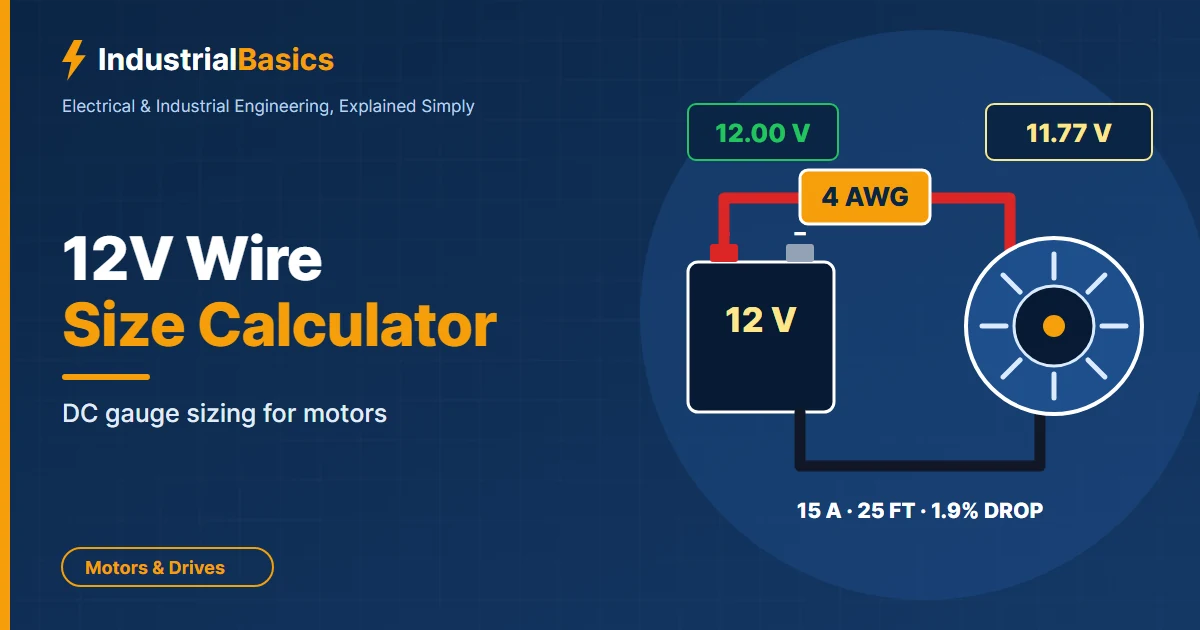
To size wire for a 12V motor, find the smallest gauge that keeps voltage drop within your limit, usually 3%, then confirm it can carry the current. Use VD = 2 × L × I × R ÷ 1000, where L is the one-way length in feet. For example, a 15 A motor 25 ft from the battery needs 4 AWG for a 3% drop. The calculator below does this for you.
12V Wire Size Calculator
Enter the motor current, cable length and allowed voltage drop. If you know the motor’s starting or stall current from its datasheet, enter that as well.
How to Calculate 12V Voltage Drop
| Symbol | Meaning | Unit |
|---|---|---|
| L | One-way cable length | Feet |
| I | Current | Amps |
| R | Conductor resistance | Ω per 1000 ft |
| 2 | Accounts for the return conductor | — |
Voltage drop matters more at 12 V because there is so little voltage to lose. A 0.36 V drop is 3% at 12 V, but only 0.3% at 120 V.
Copper Wire Resistance Table
| AWG | Resistance (Ω/1000 ft) |
|---|---|
| 14 | 3.14 |
| 12 | 1.98 |
| 10 | 1.24 |
| 8 | 0.778 |
| 6 | 0.491 |
| 4 | 0.308 |
| 2 | 0.194 |
| 1/0 | 0.122 |
| 2/0 | 0.0967 |
| 3/0 | 0.0766 |
| 4/0 | 0.0608 |
Maximum Cable Length at 3% Drop
| AWG | 5 A | 10 A | 15 A | 20 A | 30 A |
|---|---|---|---|---|---|
| 14 | 11 | 6 | 4 | — | — |
| 12 | 18 | 9 | 6 | 5 | — |
| 10 | 29 | 15 | 10 | 7 | 5 |
| 8 | 46 | 23 | 15 | 12 | 8 |
| 6 | 73 | 37 | 24 | 18 | 12 |
| 4 | 117 | 58 | 39 | 29 | 19 |
| 2 | 186 | 93 | 62 | 46 | 31 |
| 1/0 | 295 | 148 | 98 | 74 | 49 |
| 2/0 | 372 | 186 | 124 | 93 | 62 |
Worked Example: 15 A Motor at 25 ft
A 12 V motor draws 15 A and sits 25 ft from the battery. The target is a 3% drop, or 0.36 V.
| Wire | Calculation | Drop | Result |
|---|---|---|---|
| 8 AWG | 2 × 25 × 15 × 0.778 ÷ 1000 | 0.584 V (4.9%) | Too high |
| 6 AWG | 2 × 25 × 15 × 0.491 ÷ 1000 | 0.368 V (3.1%) | Just over |
| 4 AWG | 2 × 25 × 15 × 0.308 ÷ 1000 | 0.231 V (1.9%) | Meets 3% |
If the motor’s datasheet lists a 60 A starting current (an illustrative value), the same 4 AWG cable drops 2 × 25 × 60 × 0.308 ÷ 1000 = 0.92 V during starting, leaving about 11.08 V at the motor before any battery sag. Check that against the motor’s minimum voltage.
Motors Need More Than a Running Check
A motor can draw much more than its running current when it starts or stalls, and low voltage reduces its torque. There is no single multiplier that suits every motor, so use the starting or stall current from the datasheet. If the motor is slow to start under load, look at voltage at the motor terminals during starting.
| Check | Why it matters |
|---|---|
| Voltage drop | Low voltage reduces torque and performance |
| Ampacity | The wire must not overheat |
| Temperature | Heat raises resistance and reduces ampacity |
| Bundling | Grouped wires cannot shed heat as well |
| Connections | Poor terminals add resistance and voltage drop |
| Fuse | Protects the wire from overcurrent |
For current-carrying limits, see our AWG wire ampacity chart. Motor current terms are explained in full load vs running vs starting amps, and repeated faults are covered in motor failure causes.
Fusing the Circuit
The fuse protects the wire, so size it no higher than the wire’s rating. It should also be high enough, and of a suitable type, for the motor to start without nuisance blowing. Place it close to the battery so that as much of the cable as possible is protected.
Frequently Asked Questions
What size wire do I need for a 12V motor?
It depends on current and distance. Use the calculator, then confirm ampacity and starting voltage. A 15 A motor 25 ft from the battery needs 4 AWG to stay within a 3% running drop.
How do you calculate voltage drop on 12V DC?
Use VD = 2 × L × I × R ÷ 1000, with L as the one-way length in feet, I in amps and R in ohms per 1000 ft.
Should I use one-way or round-trip length?
Use one-way length in this formula because the factor of 2 already includes the return conductor. If you enter round-trip length, remove the factor of 2.
What is an acceptable voltage drop for 12V?
A common design target is 3%, or 0.36 V on a 12 V system. Some sources allow up to 5% for less sensitive loads. Check the motor maker’s minimum voltage.
Why does a 12V circuit need thicker wire than 120V?
The same voltage drop is a much larger share of 12 V, and the same power needs ten times the current at 12 V as at 120 V.
Do I size for running or starting current?
Check both. Size for the running drop and ampacity, then confirm the motor still receives enough voltage at starting or stall current.
What size fuse should I use?
The fuse protects the wire, so it must not exceed the wire’s rating. It must also allow the motor to start. Follow the motor and fuse maker’s data.
Does temperature affect 12V wire sizing?
Yes. Copper resistance rises with temperature, and high ambient temperature or bundling also reduces ampacity.
Sources and Further Reading
- VoltageLab: NEC Chapter 9 Table 8: conductor resistance and the K-factor method.
- Field PM: NEC Conductor Resistance: stranded 12 AWG value and solid vs stranded note.
- GridWright: DC Wire Gauge Sizing Guide: formula, voltage drop targets and fusing.
- FIRGELLI: 12V Wire Size Calculator: voltage drop limits and motor considerations.