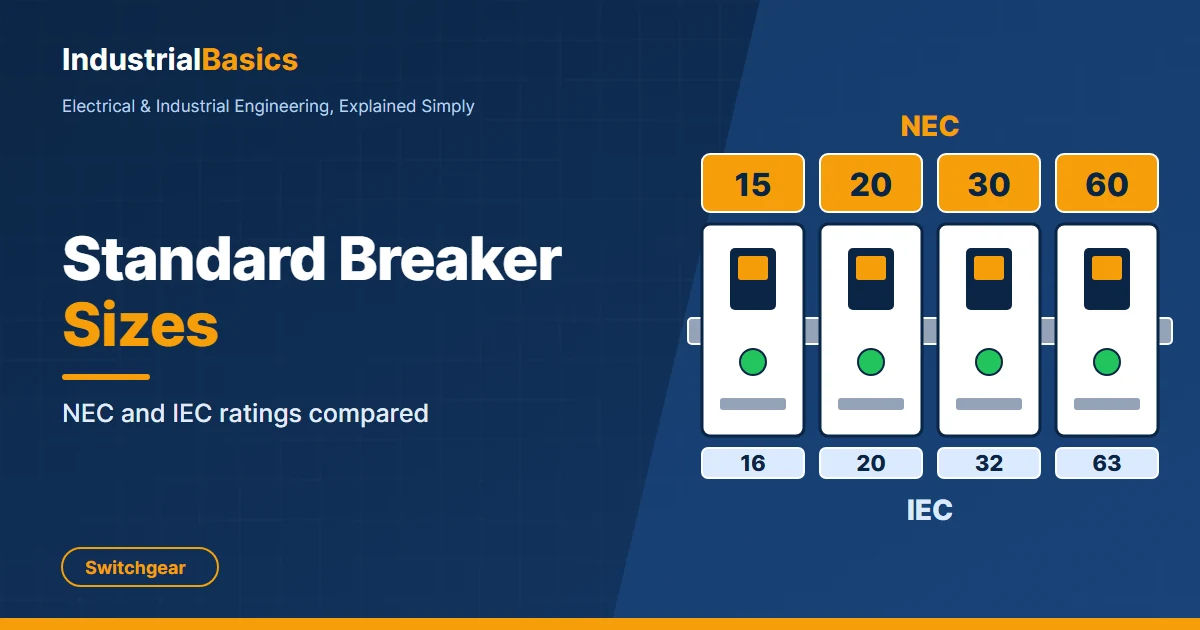
Standard NEC circuit breaker sizes run from 15 A through 6000 A, including 15, 20, 30, 40, 50, 60, 100, 200, 400 and 800 A. A common IEC miniature breaker series is 6, 10, 13, 16, 20, 25, 32, 40, 50 and 63 A. Neither list sets one minimum size for every job. The right breaker must be large enough for the load and small enough to protect the conductor.
NEC Standard Circuit Breaker Sizes
| Range | Standard ratings (A) |
|---|---|
| 15-60 A | 15, 20, 25, 30, 35, 40, 45, 50, 60 |
| 70-225 A | 70, 80, 90, 100, 110, 125, 150, 175, 200, 225 |
| 250-800 A | 250, 300, 350, 400, 450, 500, 600, 700, 800 |
| 1000-6000 A | 1000, 1200, 1600, 2000, 2500, 3000, 4000, 5000, 6000 |
The NEC also lists additional standard ratings for fuses of 1, 3, 6, 10 and 601 A. Fuses and inverse time breakers with non-standard ratings are permitted, so you may see a real device that is not on this list.
For an adjustable-trip breaker, the rating is its maximum long-time pickup setting. If access to the adjustment is restricted as described in 240.6(C), the rating can be the adjusted setting instead.
IEC Standard MCB Sizes
IEC miniature circuit breakers (MCBs) are commonly supplied in the series below. ABB’s comparison guide shows these values for B and C characteristics, and its data covers ratings up to 63 A.
| Curve | Standard | ABB range | Instantaneous trip range | Typical use |
|---|---|---|---|---|
| B | IEC/EN 60898-1 | 6-63 A | 3-5 × In | Cable protection |
| C | IEC/EN 60898-1 | 0.5-63 A | 5-10 × In | Cable protection |
| D | IEC/EN 60898-1 | 0.5-63 A | 10-20 × In | Cable protection, high inrush |
| K | IEC/EN 60947-2 | 0.5-63 A | 10-14 × In | Motors and transformers |
| Z | IEC/EN 60947-2 | 0.5-63 A | 2-3 × In | Control and semiconductor circuits |
For larger currents, you move from MCBs to moulded case and air circuit breakers. See our guide to MCB vs MCCB vs ACB for where each one fits.
NEC vs IEC Sizes Compared
| Topic | NEC | IEC |
|---|---|---|
| Typical small ratings | 15, 20, 30, 40, 50, 60 A | 6, 10, 16, 20, 32, 40, 50, 63 A |
| Rating list | Table 240.6(A) | Product standard and maker’s range |
| Sizing relationship | Article 240 conductor protection | Ib ≤ In ≤ Iz and I2 ≤ 1.45 Iz |
| Trip curves | Set by product type and maker | B, C and D on IEC 60898-1 MCBs |
How Minimum Breaker Size Is Decided
Under IEC
IEC 60364-4-43, as summarized by ABB, gives a simple window for overload protection:
Ib is the design current, In the breaker rating, Iz the cable’s current-carrying capacity and I2 the current that ensures operation within the conventional time. For B, C and D MCBs, ABB gives I2 as 1.45 × In.
Under the NEC
The conductor sets the upper limit. At 800 A or less, NEC 240.4(B) can allow the next higher standard rating when the conductor’s ampacity does not match a standard size and the conditions are met. Above 800 A, conductor ampacity must equal or exceed the device rating.
| Conductor | Maximum overcurrent protection |
|---|---|
| 14 AWG copper | 15 A |
| 12 AWG copper | 20 A |
| 10 AWG copper | 30 A |
| 12 AWG aluminum or copper-clad aluminum | 15 A |
| 10 AWG aluminum or copper-clad aluminum | 25 A |
Load rules set the lower limit, and they differ by circuit type. Branch circuits and feeders are covered in Articles 210 and 215, while motor circuits have their own rules. Our guides to MCA and MOP and AWG wire ampacity can help you take the next step.
Worked Examples
NEC: rounding up
A conductor has a corrected ampacity of 115 A. There is no 115 A standard rating, and the next standard size above it is 125 A. Because this is below 800 A, 240.4(B) may allow the 125 A breaker if all its conditions are met. If the conductor were limited by 240.4(D), that limit would still apply.
IEC: checking the window
- Design current: Ib = 28 A, so the next series value is 32 A.
- Cable capacity: Iz = 36 A, so 28 ≤ 32 ≤ 36 passes.
- Overload check: I2 = 1.45 × 32 = 46.4 A, which is below 1.45 × 36 = 52.2 A.
- Temperature check: ABB says operating current falls about 6% per 10 °C above the 30 °C reference. At 40 °C, 32 × 0.94 ≈ 30.1 A, still above 28 A.
Breaker rating is only part of the selection. You also need the correct interrupting rating, curve and coordination with other devices. See types of circuit breakers for the wider picture.
Before choosing a breaker for a service or feeder, work out the load with the NEC 220 demand factor method.
Frequently Asked Questions
What are the standard circuit breaker sizes in the NEC?
The commonly published list runs 15, 20, 25, 30, 35, 40, 45, 50, 60, 70, 80, 90, 100, 110, 125, 150, 175, 200, 225, 250, 300, 350, 400, 450, 500, 600, 700, 800, 1000, 1200, 1600, 2000, 2500, 3000, 4000, 5000 and 6000 A. Check Table 240.6(A) in your adopted edition.
What is the minimum circuit breaker size?
There is no single minimum that fits every circuit. The breaker must suit the load and protect the conductor, and the smallest available rating depends on the code edition, product and market.
Is a 16 A IEC breaker the same as a 15 A NEC breaker?
No. They belong to different rating series and product standards. Use a device that is certified for your market and installation.
What are standard IEC MCB sizes?
A common series is 6, 10, 13, 16, 20, 25, 32, 40, 50 and 63 A. Manufacturers also offer other ratings.
Can I use the next size up breaker?
Under NEC 240.4(B), often yes at 800 A or less, if all conditions are met. It cannot be used to exceed the small conductor limits or for tap conductors.
What size breaker does 12 AWG copper need?
NEC 240.4(D) generally limits 12 AWG copper to 20 A, unless a specific exception applies, such as certain motor circuits.
Are non-standard breaker ratings allowed?
Yes. The NEC permits fuses and inverse time breakers with non-standard ampere ratings.
How is an adjustable breaker rated?
Its rating is normally its maximum long-time pickup setting. With restricted access to the adjustment under 240.6(C), the rating can be the adjusted setting.
Sources and Further Reading
- IAEI Magazine: Overcurrent Protection, Part 2 (2007): NEC 240.4 and 240.6 ratings, based on the 2005 NEC.
- EC&M: NEC Requirements for Overcurrent Protection (2026): Table 240.6(A), next size up and adjustable breakers.
- EC&M: Code Q&A, Fuse and Breaker Ratings (2019): fuse-only and non-standard ratings, 2017 NEC.
- ABB: Comparison of Tripping Characteristics for Miniature Circuit-Breakers: IEC ratings, curves, sizing and derating.